Anguilla
©
Anguilla

Anguilla

Flat Eastern Caribbean island of pale beaches, strong restaurants, and low-key British Overseas Territory life

Anguilla is a small British Overseas Territory in the Eastern Caribbean that has quietly become one of the region's most celebrated beach destinations. It is 26 km long and about 5 km wide, flat and scrubby, sitting directly north of St. Martin. What it lacks in dramatic landscapes it more than makes up for in beaches: the island has 33 of them, and several rank among the best in the Caribbean.

The island draws two kinds of traveler — those who come for the luxury resorts clustered along Meads Bay and Maunday's Bay, and those who come for the beaches and the food and are happy to stay somewhere simpler. Both can be satisfied here. Anguilla's restaurant scene is remarkably strong for an island of roughly 18,000 people, earning it a reputation as the culinary capital of the Caribbean.

Anguilla has been a British colony since 1650, though the Arawaks were here thousands of years before that. The island's most dramatic modern moment came in 1967, when Anguillans revolted against federation with St. Kitts and Nevis and eventually won the right to remain a British territory — a revolution achieved almost entirely without bloodshed, and celebrated to this day on Anguilla Day (May 30).

The Valley is the small capital at the centre of the island. Most visitors arrive by ferry from nearby St. Martin, docking at Blowing Point in the south. The island is flat enough that driving it end to end takes less than half an hour.

Guide

A Trip to the Beach

An American couple quit their careers and moved to Anguilla to open a restaurant. This is the story of what happened — charming, honest, and full of practical observation about island life. The restaurant, Blanchard's on Meads Bay, is still open. A good read before or during the trip.

Guide

Beaches

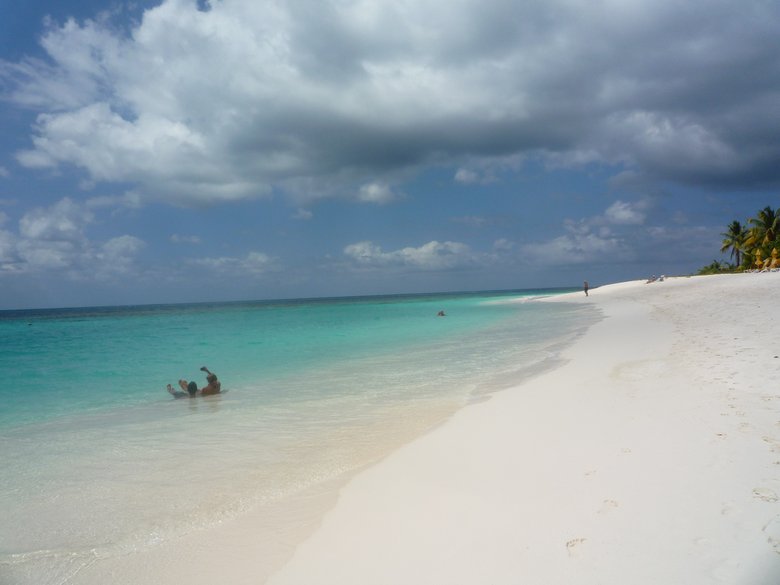
Anguilla has 33 beaches for an island just 26 km long. Most are uncrowded, accessible by car or a short walk, and free of the large resort infrastructure that dominates some Caribbean destinations. The sand is consistently white and fine; the water runs from pale turquoise in the shallows to deep blue offshore.

Shoal Bay East is the signature beach — a long crescent with calm, clear water, beach bar options, and snorkelling just offshore. It is the most visited and deservedly so. Meads Bay on the northwest coast is wider and lined with some of the island's better restaurants; the sunsets here are reliable. Rendezvous Bay is the longest beach on the island and home to the Dune Preserve, Bankie Banx's famous beach bar.

On the north coast, Little Bay requires a short boat trip or a rope descent down a cliff — the effort keeps it quiet. Shoal Bay West (not to be confused with Shoal Bay East) is more remote and almost entirely undeveloped. Maunday's Bay is where the high-end resorts cluster, and the beach reflects that — well-maintained and calm, with good swimming. Sandy Ground is a working fishing village with a reef-sheltered beach and a handful of casual bars; more local in character than the resort beaches.

Guide

Books

Anguilla has inspired a small but good shelf of books — novels about its most dramatic historical moment, a memoir about building a restaurant on the island, and history that fills in the colonial background. The 1967 revolution, in which Anguillans peacefully expelled their Kittitian administrators and won the right to remain a British territory, is the recurring subject.

Guide

Eating Out

Anguilla punches well above its weight in the kitchen. The island's food culture draws on West African, Caribbean, British, and French influences — the last partly attributable to the proximity of French St. Martin, whose chefs and produce cross regularly on the ferry. Seafood is central: lobster, conch, crayfish, snapper, and grouper appear on menus across the price spectrum.

The local staples are simpler: johnny cakes (deep-fried dough), saltfish in stews and with vegetables, rice and peas, and souse (pickled pork). On weekends especially, roadside barbecue stalls outside The Valley and in Stoney Ground set up grills and sell ribs, chicken, and fish for a few dollars. The roadside scene is excellent and easy to miss if you stick to resort dining.

At the higher end, Anguilla has a cluster of genuinely accomplished restaurants. Tasty's in South Hill has been a local institution for years, serving Creole and Caribbean food in a relaxed setting. Blanchard's on Meads Bay is the best-known fine-dining option, run by Americans Bob and Melinda Blanchard. The Dune Preserve, Bankie Banx's beach bar on Rendezvous Bay, is more atmosphere than cuisine but is not to be missed. Reservations are advisable at the better places in high season.

Guide

Getting Around

The island is small but spread out — 33 beaches are scattered across both coasts, and the villages are connected by a single main road running east to west. You will want some form of transport.

Rental cars are the most practical option if you want to explore freely. Rates run from around US$45 to US$85 per day. You will need a temporary Anguillian driving permit (US$25), available through any rental agency. Driving is on the left, as in Britain. Roads are paved and in reasonable condition, and the flat terrain means none of the terrifying switchbacks you find elsewhere in the Caribbean. Note that addresses do not exist — places are referred to by beach, bay or neighbourhood, so download an offline map before you set out.

Taxis are reliable and government-regulated, with fixed fares posted at the airport and ferry terminal. They are more expensive than renting a car but convenient for short hops. A surcharge applies between 6pm and 6am. If you find a driver you like, get their number — a local guide is worth more than a GPS on Anguilla.

There is no public bus network worth relying on. If you are staying at a resort, many properties offer shuttle services to nearby beaches and restaurants.

Guide

Getting There

Most visitors arrive by ferry from St. Martin, which is the easiest and cheapest option. Ferries run from Marigot (French side) and Simpson Bay to Blowing Point on Anguilla's south coast roughly every 30 to 45 minutes from early morning to late evening. The crossing takes about 20 minutes. The one-way fare is around US$30 per person, and there is a separate departure tax of US$36 for adults when leaving Anguilla by ferry.

By air, Anguilla's Clayton J. Lloyd International Airport (AXA) receives a limited number of direct flights. There are direct services from Miami, and seasonal nonstop flights from Boston and Baltimore operate through AnguillAir (a codeshare with BermudAir) during the winter season. The more common approach is to fly into Princess Juliana International Airport (SXM) on St. Martin and then take the ferry — it adds an hour to the journey but opens up many more flight options from North America and Europe.

From Puerto Rico it is also possible to fly direct; the flight takes about an hour. Small charter operators connect Anguilla to several other Eastern Caribbean islands.

Departure tax at the airport is US$28 for adults and must be paid in cash. Keep dollars handy when you leave.

Guide

Night of the Rambler

A novel about the 1967 revolution — the rebellion in which Anguillans expelled their Kittitian administrators and demanded the right to remain a British territory. Kobbe writes with the sprawling energy of the Latin American tradition about an event that deserves to be better known. An excellent book to read on the ferry from St. Martin.

Guide

Out of Crowded Vagueness: A History of the Islands of St. Kitts, Nevis and Anguilla

Provides the historical context the other books assume. Dry in places, but thorough — useful if you want to understand Anguilla's colonial history and the political circumstances that led to the 1967 revolution.

Guide

Things to Do

Anguilla rewards those who look beyond the beach. The island's beaches are genuinely exceptional — Shoal Bay East ranks among the best in the Caribbean — but the boat races, hiking trails, and offshore cays add texture to what could otherwise be a purely horizontal holiday.

Guide

Under an English Heaven

An earlier, more comic account of the 1967 revolution, written shortly after the events. Westlake was a crime novelist; he brings the same dry eye to the absurdities of small-island politics. A companion piece to Kobbe's novel — read both and you get the story from very different angles.

Guide

When to Go

Anguilla has a warm, dry climate year-round, with temperatures hovering around 27°C (80°F). The trade winds keep things comfortable even in summer. The distinction between seasons is mostly about rainfall and hurricane risk, not cold.

December to April is high season — sunny, dry, and busy. This is when the resorts are full, prices are at their highest, and the island looks its best. Book accommodation and restaurants well in advance. May to November is the rainy season, and July through October falls within the Atlantic hurricane season. The upside: hotels are significantly cheaper, beaches are quieter, and the island has a more local feel. Late May or June can be a sweet spot — mostly fine weather and much lower prices.

Events worth timing around:

Moonsplash (March or April) is Anguilla's most famous festival — a reggae and roots music event hosted by Bankie Banx at his Dune Preserve beach bar on Rendezvous Bay. It has run continuously for over 30 years, making it one of the oldest independent music festivals in the Caribbean. Bands play on an open stage, people sit on the sand, and the bar stays open late.

Anguilla Day (May 30) marks the anniversary of the 1967 revolution with boat races, cultural events, and island-wide celebration. It is the best day to see traditional wooden-boat racing.

Anguilla Culinary Experience (ACE) (May) is a multi-day food and wine festival drawing chefs from across the Caribbean for dinners, beach barbecues, and cooking demonstrations.

Anguilla Summer Festival / Carnival (late July to early August) is the big cultural event of the year, coinciding with emancipation commemorations. The week includes street parades, pageants, boat races, and beach parties. Accommodation fills up fast — book early.

Festival Del Mar (Easter weekend) is held in Island Harbour, the island's fishing village, with a focus on fresh seafood. More local in character than ACE.

thecaribbean