French Caribbean half-island of beaches, Marigot markets, and easy border crossings with Sint Maarten.
Saint-Martin is the French half of a 37-square-mile island it shares peacefully with the Dutch territory of Sint Maarten. Together they form the smallest landmass in the world divided between two sovereign nations. The French side is slightly larger — 21 square miles to the Dutch 16 — and holds the capital Marigot and the gastronomic hub of Grand Case.
The island sits in the northeastern Caribbean, roughly midway between Puerto Rico and Guadeloupe, with Anguilla just a short ferry ride to the north and Saint-Barthélemy to the southeast. Its location made it a prize worth fighting over: the Spanish, French, and Dutch all staked claims before the two sides settled into the informal partition that has held, more or less, since 1648.
The island is known above all for its food, its beaches, and the easy movement between two very different European cultures. On the French side, the pace is slightly more relaxed and the cooking distinctly better. Grand Case, a single street of restaurants along a bay, has the best food on the island and arguably some of the finest dining in the Caribbean. Creole, French, and fusion kitchens compete for your attention, and the "lolos" — simple barbecue shacks on the beach side — serve grilled ribs and lobster at a fraction of the restaurant prices. On the Dutch side, the casinos, duty-free malls, and Maho Beach — where planes pass terrifyingly low overhead — draw a different crowd. Visitors who stay a week can sample both without formality: there is no border control crossing between the two sides.
Hurricane Irma struck in September 2017 with catastrophic force, destroying around 90% of the island's infrastructure. Recovery was slow but real. By the early 2020s, most hotels, restaurants, and beaches had reopened, the airport terminal was rebuilt and reopened in 2023, and the island was broadly back to normal. Some shells of damaged buildings remain visible, particularly in the less-visited parts of Sint Maarten. The French side recovered somewhat faster.
Guide
Beaches
The island has more beaches than most visitors expect, and they vary considerably in character. The French side tends toward quieter, less developed strands; the Dutch side has the more commercial beach scene. Given the island's small size, it is possible to visit several in a single day.
Orient Bay is the liveliest — long, windy, backed by restaurants and beach bars, and partly clothing-optional. It draws a crowd in high season but is large enough to absorb it. Baie Longue on the western shore is the opposite: a long, mostly empty sweep of white sand with calm water and almost no commercial development.
Maho Beach on the Dutch side is in a category of its own — the planes are the attraction, not the sand.
Guide
Eating Out
Saint-Martin has an outsized reputation for food given its size, and it is largely deserved. The French influence on the northern half is real: you will find proper bistros, serious wine lists, and precise cooking alongside Caribbean and Creole options. The island calls itself the "Culinary Capital of the Caribbean" — a claim that is slightly self-promoting but not entirely wrong.
Grand Case is the centre of the island's food scene: a single road running along a small beach on the French side's north coast, lined with restaurants on both sides. Prices at the sit-down restaurants are high by Caribbean standards. At the northern end of the strip, the lolos — open-air barbecue shacks — offer fresh fish, chicken, ribs, and rice at a fraction of the price. Both ends of the street are worth exploring.
Local Creole cooking draws on African and Caribbean heritage. Look for grilled fish, oxtail stew, rice and peas, johnny cakes (fried dough), and crab and rice — more available at lolos and local spots than at tourist-facing restaurants. Marigot has a morning waterfront market where local produce, spices, and street food are sold. Get there before 10am. A good bottle of French wine is easier to find here than almost anywhere else in the Caribbean, and more reasonably priced than you might expect.
On the Dutch side, Philipsburg and the Maho area have a large number of restaurants aimed at the cruise ship and resort market. If food matters to you, eat on the French side.
Guide
Getting Around
The island is small enough to drive across in 30 minutes, and a rental car makes it significantly easier to explore. Car hire starts at around €40–60 per day in high season; book ahead if you are visiting between December and April. Traffic in and around Marigot can be slow due to the one-way system and general congestion.
Taxis are widely available but there are no meters — fares are regulated by zone and set by the government. Always confirm the fare before getting in. Drivers generally accept both euros and US dollars. There is no Uber or Lyft service on the island.
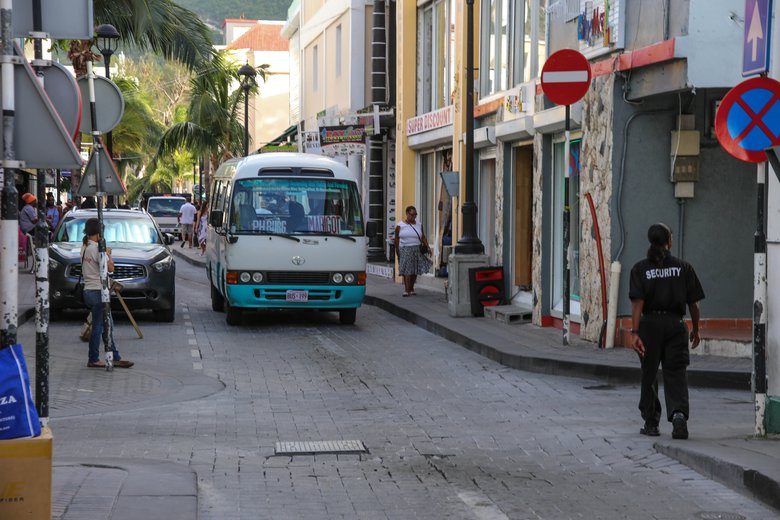
Minibuses run between the main towns on both sides and are the cheapest way to get around, though schedules are informal and they stop running in the early evening. The French side has a bus station in Marigot with services to Grand Case, Orient Bay, and French Quarter. Flag one down on the road rather than waiting for a schedule.
Crossing between sides requires no formality — there is no passport control or customs at the border. Drive or take a taxi straight through.
Ferries to nearby islands depart from Marigot: Anguilla to the north (20 minutes), Saint-Barthélemy to the south (45 minutes). The terminal is in the centre of town on the waterfront and is open daily 8:30 to 18:00 except in bad weather.
Guide
Getting There
By air
Almost all visitors arrive at Princess Juliana International Airport (SXM) on the Dutch side, which handles direct flights from the US, Canada, and Europe. American, Delta, United, Air France, Air Canada, and KLM all serve the island. From the US East Coast, flying time is roughly three to four hours.
The airport terminal was extensively rebuilt after Hurricane Irma and a new departures hall opened in late 2023. It is functional and reasonably modern.
There is a small airport at Grand Case (SFG) on the French side, served mainly by inter-island carriers such as Air Caraïbes and St. Barth Commuter. If you are arriving from another Caribbean island, Grand Case is the more convenient option. From Europe or North America, you will almost certainly land at SXM.
From SXM airport, the French side capital Marigot is around 45 minutes to an hour by road; Grand Case is a similar distance. Taxis have fixed government-set rates by zone — confirm the price before you get in.
By sea
Ferries arrive at Marigot from Anguilla (around 20 minutes, multiple departures daily), from Saint-Barthélemy (around 45 minutes), and from other neighbouring islands. The ferry terminal is on the Marigot waterfront. Tickets are sold on-site; no advance online booking is available.
Cruise ships dock in Philipsburg on the Dutch side. From there, taxis to Marigot or Grand Case run around $25–35 depending on your destination.
Guide
Shopping
The Dutch side is the island's shopping hub. Sint Maarten is a free port with no sales tax, which makes it popular with cruise ship passengers hunting for duty-free electronics, jewellery, liquor, and perfume. Philipsburg's Front Street is lined almost entirely with duty-free shops and souvenir stalls. Prices can be genuinely good on spirits and branded goods; the atmosphere is commercial and crowds can be thick when ships are in.
Marigot on the French side has a more relaxed shopping scene: boutiques selling French cosmetics, beachwear, and jewellery, plus the waterfront market where local crafts, spices, and Caribbean produce are sold. The Wednesday and Saturday morning markets are the best attended.
The Marigot Marina area has several boutiques and galleries that carry local artwork and Caribbean craft. Worth a browse if you want something that isn't a bottle of rum.
Guide
When to Go
The island has two distinct seasons. High season runs from mid-December through April: dry, sunny, temperatures in the mid-20s Celsius (low-to-mid 80s Fahrenheit), and relatively low humidity. This is when prices are highest, beaches are at their most popular, and restaurants are fully staffed. Book ahead for the best places to eat in Grand Case.
Low season (May through November) brings heat, higher humidity, more rain, and the genuine risk of hurricanes — peak hurricane season is August through October. Prices drop significantly, beaches empty out, and some smaller businesses close. If you are comfortable with the weather risk, May to early July and late October to late November offer reasonable value and much quieter conditions.
The island was effectively destroyed by Hurricane Irma in September 2017. The recovery is largely complete, but it is a reminder that late summer and autumn travel in the Caribbean carries real risk. Check conditions and travel advisories before booking low-season travel.
Average sea temperature stays around 27°C (80°F) year-round, and the water is warm enough to swim in any month.