AMAZON IN ECUADOR TOP
EXTENSION
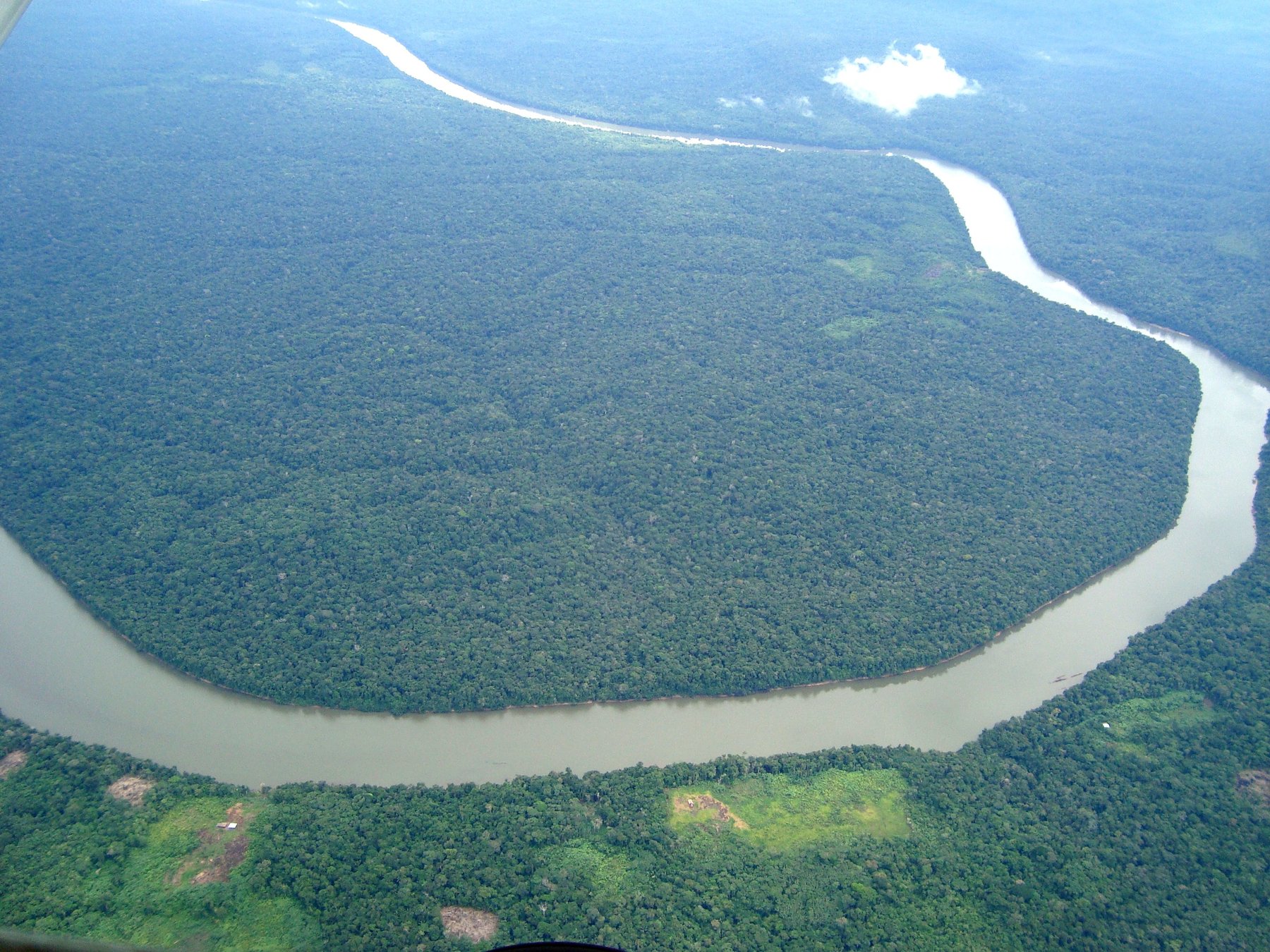
Covering approximately 12'000,000 H., the major area of the Ecuadorian Amazon supports exuberant vegetation that is typical of humid tropical forests, its western limit is the Andes Mountain Range, Peru lies to the south and Colombia to the north.
Immense quantities of material flowing from the Andes have been washed down the rivers, forming strips of alluvial soils and terraces that are used for farming.
**
TEMPERATURE **
The annual average temperature falls between 25° and 25,5° F. Between 300 and 400 cm. of rainfall are distributed more or less equally throughout the year, although December through February are the drier months.
**FLORA **
The principal attraction of the hilly forest is, of course, the trees, some soaring higher than 46 m. Common species are cinnamon, silkcotton, jacaranda and several leguminous trees. The alluvial plains, located on the terraces of the principal rives, support great concentrations of palm trees.
NAPO RIVER
The principal Amazon artery for visitors is the Napo River, a major tributary of the main Amazon River. Its basin is 1400 Km. long and one to three miles wide. As a result of fluvial dynamics, the Napo's 130 islands are covered by young forests, which provide refuge and nesting sites for a multitude of bird species, many of them migratory.
**COMMUNITIES
**Along the length of the Napo, natives and settlers have established communities, intersperced occasionally with small hotels and lodges. Most of the shore is covered with tropical forest, and over thousands of years, riverbeds have formed many attractive lakes.
Historically, the indigenous communities have been able to maintain a productive subsistence within the existing ecosystems of vast forest preserve. The most representative are: the Siona Secoya, Cofan, Huaorani, Quichua, Shuar and Ashuar.
**ECOSYSTEM **
The Amazonas ecosystem, particularly its tropical rain forest, is considered to be one of the richest and most complex communities of plant and animal life in the world. The region is characterized by huge and diverse amounts of flora and fauna with extraordinary variations in their habitats and micro habitats.
In the jungles of the Upper Amazon 100 species of trees per acre habe been recorded. In Central America, only up to 40 species per acre have been discovered. In the temperate forests of North America and Europa, rarely more than 20 different species exist per acre.
The Amazon's rivers, lakes, streams and marshlands support over 600 species of fish and more than 250 species of amphibians and reptiles. The lagoons of the Napo and Aguarico River basins are home to colonies of two species of caymans that grow to over 13 feet in length.
MAMMALS
Typical South American mammals which live in Ecuador's Amazon include armadillos, honey bears and sloths. Amazon bats form a cosmopolitan group numbering more than 60 species. Other mammals found in the tropical forest include tapirs, monkeys, and ocelots (or jaguars). On a walk through the forest, you will observe groups of monkeys, boars and large rodents; and in the lagoons there are manatees and caymans.
**BIRDS **
Birds are the richest group of Amazon vertebrates, and approximately 1.000 species live in a variety of forest habitats, lagoons and open areas. In all Amazon ecosystems, colorful birds make themselves at home. Familiar sightings will be parrots, macaws and tanagers on land and on water, darters, herons and gulls flourish.
CONSERVATION
Ecuador's extensive national park system, scientific station and protected areas cover nearly a 7.5 million acres. To preserve areas, Ecuador has created the Yasuni National Park Biosphere Reserve8, the Limoncocha Ecological Reserve9, the Cuyabeno Wildlife Reserve10 and others. The Napo and Aguarico River basins offer multiple possibilities for you to enjoy the ecosystem complexes, alluvial plains, swamps and flooded areas all of which are inhabited by a variety of species. The Yuturi, Yasuni, Tiputini, Tivacuno and Cononaco rivers are completely surrounded by virgin forest.