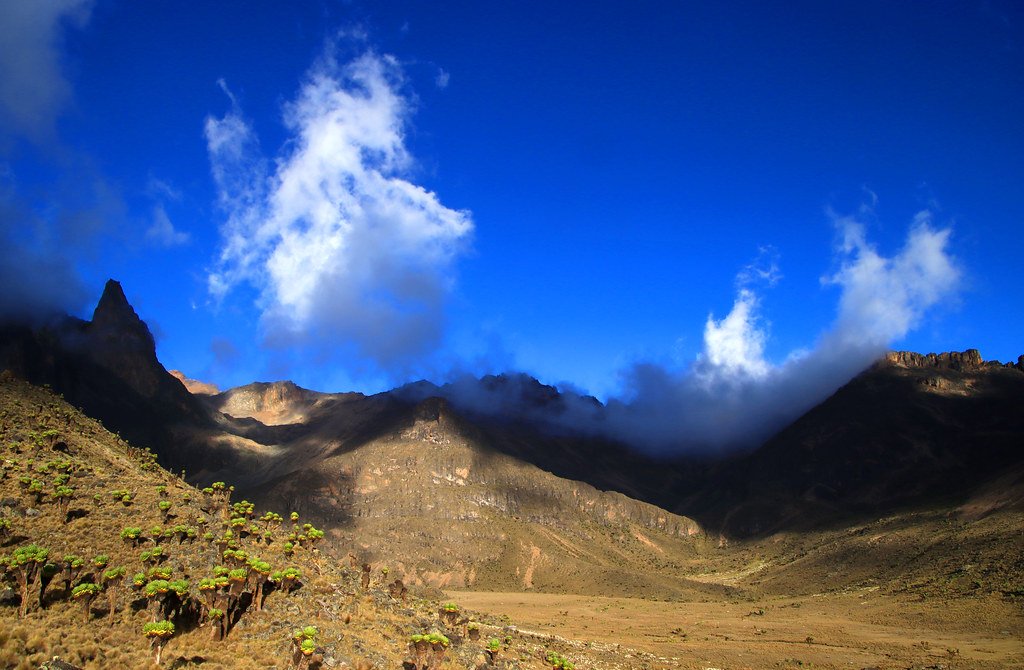
Mount Kenya foothills town and main staging point for climbs on the Naro Moru route.
Naro Moru is a small town on the western side of Mount Kenya, and the most common starting point for trekkers climbing the mountain via the Naro Moru route. There is little reason to linger in town itself — it exists almost entirely as a staging post for the mountain.
The Naro Moru River Lodge, a few kilometres outside town, is where most climbers base themselves. The lodge manages the mountain huts along the route, so booking accommodation here — at the Met Station and Mackinder's Camp — is essential if you want a roof over your head on the climb. Guides, porters, and cooks can be hired at the lodge or at the Mt Kenya Hostel & Campsite, which sits about 12 kilometres up the trail and offers a useful head start and a night to acclimatise. The trail leads into Mount Kenya National Park, a UNESCO World Heritage site.
The route itself is the shortest but steepest approach to the peaks, crossing moorland and the famous Vertical Bog before reaching the alpine zone and finally Point Lenana, the trekker's summit. It is not technically difficult but demands good fitness and proper preparation for altitude. For supplies, banks, and a more substantial town, Nanyuki sits 30 kilometres north on the equator.
Guide
Getting There
Naro Moru sits on the main A2 highway between Nyeri and Nanyuki, about 175 kilometres north of Nairobi. Buses and matatus run from Nairobi via Nyeri to Nanyuki throughout the day; ask for a Nanyuki bus and tell the conductor to drop you in Naro Moru. The journey from Nairobi takes about four hours.
By car it is a straightforward drive on tarmac all the way. Most climbers arrange a vehicle through the Naro Moru River Lodge or a Nairobi-based trekking operator, which can include onward transfer to the park gate.
The closest airstrip is at Nanyuki, which has daily flights from Wilson Airport in Nairobi.
Guide
When to Go
Mount Kenya has two dry seasons that are the best times to climb: January and February, and July through September. Conditions in these months are generally clear in the early morning, with cloud building through the day and clearing again before dawn — perfect for the standard pre-dawn summit attempt.
Avoid the long rains (March to May) and the shorter wet season (October to November). The mountain stays climbable in the rains but the Vertical Bog becomes a real ordeal and the views are usually obscured. Temperatures at the summit hover around freezing year-round; the lower forests are cool and pleasant.