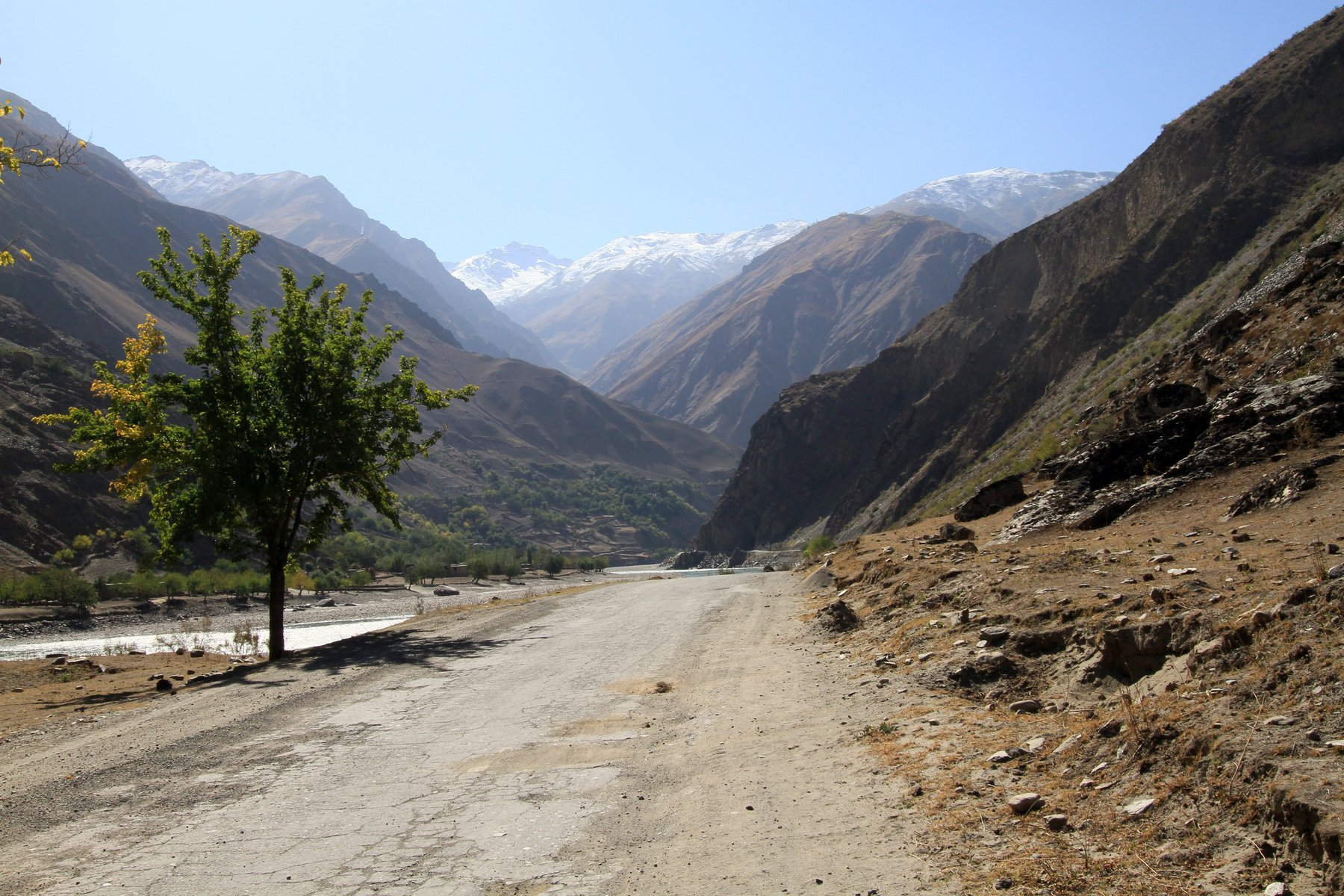
The Pamir Highway (M41) is one of the great overland routes in the world. Running from Dushanbe across the eastern half of Tajikistan to Osh in Kyrgyzstan, it crosses terrain that was largely closed to outsiders until the 1990s. The Pamirs sit at the crossroads of the Karakoram, Himalaya, Hindu Kush, and Tian Shan mountain systems — the "Roof of the World" is not an idle phrase.
The road passes through the semi-autonomous Gorno-Badakhshan Autonomous Oblast (GBAO). You need a GBAO permit to travel here, obtainable in Dushanbe or added when applying for an e-visa. Don't skip it — checkpoints enforce it.
The route
From Dushanbe, the highway follows the Panj River south and east, with Afghanistan visible across the water for much of the way. The road is partly paved, partly gravel, and passes through landscapes that shift from river gorges to high plateaus. The main town on the Tajik side is Khorog, the capital of GBAO.
Khorog (elevation 2,200 m) is a small but functional base with a handful of guesthouses, restaurants, and a botanical garden improbably planted at this altitude. The domestic flight from Dushanbe is spectacular — and regularly delayed or cancelled. Most travelers reach Khorog by shared jeep (12–14 hours from Dushanbe).
Beyond Khorog, the highway climbs toward the high plateau. The Wakhan Corridor extends east along the Afghan border — a narrow strip of Afghanistan that once separated the British and Russian empires. Trekking and horse riding into the Wakhan from Khorog is possible with a local guide.
Continuing north from Khorog, the M41 climbs to the Murghab plateau, over 3,600 meters, a high and treeless steppe that feels like the surface of another planet. The small town of Murghab is the last significant settlement before the Kyrgyz border. From there the road crosses the Kyzyl-Art Pass (4,280 m) into Kyrgyzstan and eventually down to Osh.
Practicalities
Allow at least five to seven days from Dushanbe to Osh at a reasonable pace, more if you want to trek or explore side valleys. The road is at its most accessible from June to September; snow can close passes outside this window.
Most travelers hire a 4WD with driver in Dushanbe or find shared transport at the Dushanbe shared taxi stand. Guesthouses exist in Khorog, Murghab, and many villages along the route — booking ahead in summer is wise. Homestays are common and often the only option in smaller villages; the hospitality is genuine.
Cyclists tackle the route in significant numbers each summer. It is a major undertaking — altitude, rough roads, long distances between supplies — but the cycling community considers it one of the world's great rides.