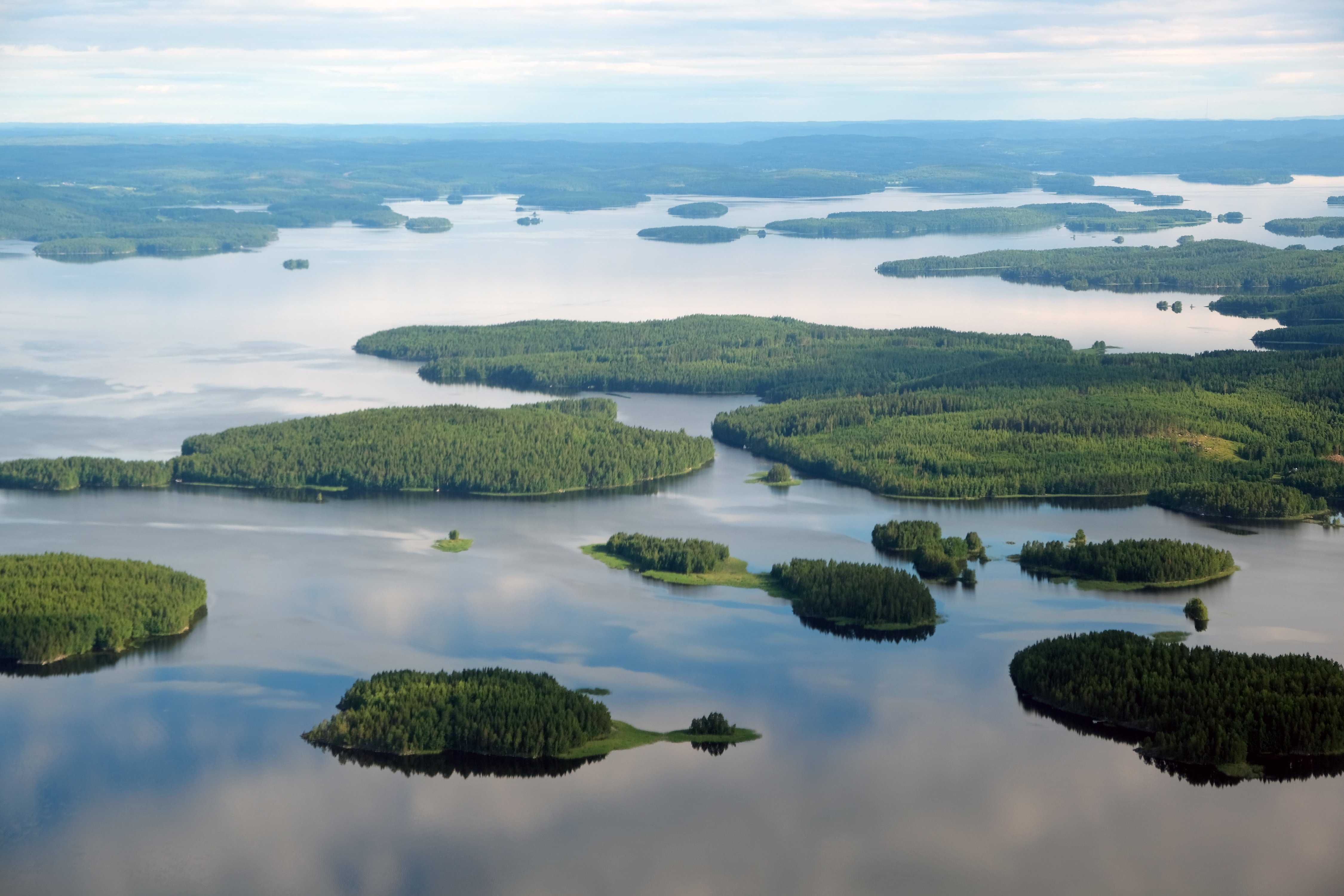
Vast Finnish lake district where forest and water form Europe's largest inland patchwork.
The Finnish Lakeland — Järvi-Suomi in Finnish — is the largest lake district in Europe: an enormous patchwork of water and forest covering the southern interior of the country from Tampere in the west to the Russian border in the east. Finland has around 188,000 lakes, and most of them are here. The region is defined less by any single city than by the relationship between land and water, which in places becomes so intertwined that it is hard to say whether you are on an island or a peninsula.
The centre of the Lakeland is Lake Saimaa, the fourth-largest lake in Europe, which sprawls across four provinces and empties west through a canal to the Gulf of Finland. Savonlinna, on three islands in the Saimaa system, is the region's flagship city and home to Olavinlinna castle, a medieval fortress rising from a rock in the lake. Kuopio in the north is the region's largest city, a working place with a strong food culture. Lappeenranta at the south end of Saimaa commands the canal connection to Russia and has a well-preserved fortress area on the lakeside.
The summer landscape is extraordinary — glittering water in every direction, forested ridges and eskers breaking the surface as peninsulas and islands, the afternoon light staying long into the evening. The most dramatic of these formations is the Punkaharju Ridge, a seven-kilometre esker so narrow in places that you can see both water surfaces from the path running its spine. The rare Saimaa ringed seal, one of the world's most endangered seals, survives only in this lake system — spotting one from a boat or kayak is among the region's defining experiences.
Winter transforms the Lakeland completely: ice roads form across the frozen lakes, cross-country ski tracks run through silent forests, and the saunas — a genuine cultural institution here, not a tourist amenity — acquire particular meaning when the temperature outside is minus twenty.
Guide
Books
The Year of the Hare by Arto Paasilinna (1975) — A journalist abandons his life after hitting a hare on a country road, and wanders through the Finnish countryside in a comic picaresque. Paasilinna captures the relationship between Finns and their landscape with both affection and dry humour. It is set partly in the lake district and gives a feel for the Finnish interior that no travel guide can quite replicate.
Seven Brothers by Aleksis Kivi (1870) — The foundational Finnish novel: seven brothers flee civilisation to live in the forest, making chaos and gradually finding their way back to society. It is set in an earlier era but the forest, the lakes, and the Finn's complicated relationship with both are as central to the book as to the country today.
Tove by Boel Westin (2014) — A biography of Tove Jansson, creator of the Moomins, who spent her summers on an island in the Finnish archipelago. The Moomin stories are soaked in the atmosphere of Finnish island summers; the biography explains where that atmosphere came from.
Guide
When to Go
Summer (June to August) is the classic time for the Lakeland. Days are very long — around the solstice, true darkness never arrives in this latitude — and the combination of warm water, white nights, and a landscape entirely green and reflective is the experience the region is famous for. July is the peak month and coincides with the Savonlinna Opera Festival; book accommodation well ahead for that period.
Winter has its own appeal. The lakes freeze by January, cross-country ski tracks are maintained through the forests, and the smoke saunas and ice swimming culture comes into its own. The scenery is stripped and dramatic — black trees against white ice, the frozen lake stretching to a distant shore. Cross-country skiing conditions are generally good from January through March.
The shoulder seasons (May, September) offer lower prices, fewer crowds, and the particular beauty of the Finnish autumn in September, when the birch leaves turn gold against the dark lake water.