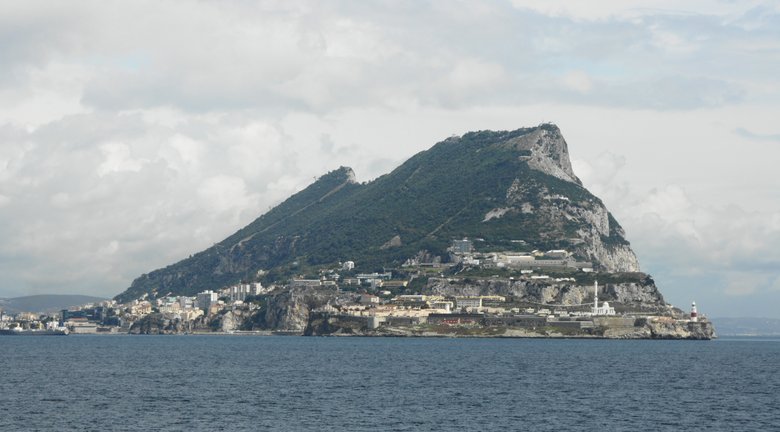
Compact British territory on Spain's southern tip, dominated by the limestone Rock at the Mediterranean entrance.
Gibraltar is one of those places that shouldn't quite exist — a 6.5-square-kilometre British territory on the southern tip of Spain, within sight of Morocco, fiercely proud of its identity and stubbornly resistant to the obvious logic that it should belong to someone else. The Rock of Gibraltar, that massive limestone ridge rising 426 metres from the narrow isthmus, has defined the territory's history and still dominates everything about it.
It sits at the entrance to the Mediterranean where the Atlantic meets a sea that has been at the centre of world trade and conflict for three millennia. Phoenicians, Carthaginians, Romans, Moors, and eventually the British all recognised what the location meant. Britain has held it since 1704, and after referendums in 1967 and 2002 — both producing votes of around 99% to remain British — the question of sovereignty is unlikely to go anywhere soon, despite ongoing Spanish claims.
For visitors, Gibraltar offers a compact and surprising few days. The Rock itself contains an extraordinary amount: hand-carved siege tunnels, limestone caverns with spectacular formations, the famous Barbary macaques, and views across two continents on a clear day. The town below is a curious blend of British pub culture, Spanish language, Genoese culinary heritage, and a Sephardic Jewish tradition that goes back centuries. The local vernacular, Llanito, switches between English and Andalusian Spanish in ways that are genuinely unique.
Gibraltar is often visited as a day trip from the Costa del Sol, but it deserves at least a night or two to get past the cruise-ship crowds and into the quieter rhythms of the place. The border crossing can be slow — occasionally over an hour by car — but once through, the territory is entirely walkable.
The currency is the Gibraltar pound, alcohol is cheap and untaxed, and the Rock is worth more than the couple of hours most visitors give it.
Guide
Getting Around
Gibraltar is only about 6.5 square kilometres, and the town centre is walkable in 20 minutes end to end. For most visitors, the best transport is their own feet.
On foot is the default for town. Main Street runs almost the full length of the commercial centre and is pedestrianised for much of its length. The older residential streets are steep in places but navigable.
Cable car: the cable car to the top of the Rock has been closed for refurbishment and is not expected to reopen until around 2028. In the meantime, the Upper Rock Nature Reserve is accessible by minibus tour (the standard "Rock Tour" takes about 1.5–2 hours and covers the main sites), on foot via marked paths, or by taxi.
Rock Tour taxis: the most popular way to see the Upper Rock. Licensed guides operate from the border and from Cathedral Square. A full Rock Tour by taxi takes about 1.5 hours and covers St Michael's Cave, the Great Siege Tunnels, the Moorish Castle, and the Apes' Den. Agree on the price and what's included before you set off.
Buses: a small fleet of buses covers the main routes. Line 2 goes to Catalan Bay on the eastern side; line 3 goes to the airport and the frontier; line 4 serves the southern tip at Europa Point. Fares are cheap. The central stop is Market Place.
Taxis: metered taxis are available from the border crossing and at Cathedral Square and Casemates Square. They're a practical option for a quick trip to the beaches or Europa Point.
Cycling is possible but the town is hilly and traffic on the main roads can be heavy. Most visitors don't bother.
Guide
Getting There
By air is the easiest way to arrive. Gibraltar Airport (GIB) sits right at the northern edge of the territory — the runway actually crosses the main road into Spain, which closes briefly for each landing. British Airways flies from London Heathrow and London City; easyJet operates from London Gatwick, Manchester, and Bristol. Flight time from the UK is around 2.5–3 hours. The terminal is tiny and a short walk from the town centre, or take bus 3 (runs every 30 minutes).
By road from Spain is straightforward. The border crossing at La Línea de la Concepción is open 24 hours. Waits can be long at peak times — an hour or more is not unusual. Pedestrians and cyclists cross more quickly than cars. Once across, the town is compact enough to walk. If you're driving, note that parking in Gibraltar is tight and expensive; most visitors leave cars in La Línea.
By bus from Spain: regular buses run to La Línea from Algeciras, Málaga, and other Andalusian cities. From La Línea bus station it's a 10-minute walk across the border. There is no direct long-distance bus into Gibraltar itself.
By ferry, a regular service runs to Tangier, Morocco. Cruise ships dock frequently at the port.
Entry requirements: EU nationals can enter on a valid national identity card. British citizens need no visa. US, Canadian, Australian, and New Zealand passport holders can visit visa-free for stays up to 90 days. Holders of a Schengen visa should be aware that Gibraltar is outside the Schengen area — you will need a valid re-entry visa for Spain if you plan to continue into the EU. Nationals who need a UK visa will generally also need a Gibraltar visa; check before travelling.
Guide
When to Go
Gibraltar's Mediterranean climate makes it a year-round destination, but the timing of your visit makes a real difference.
Spring (April–June) is arguably the best time. Temperatures are warm (20–25°C), the crowds are manageable, and the Rock is at its most scenic. The Calentita food festival in June is a good reason to visit in early summer.
Summer (July–August) is hot and busy. Day-trippers pour in from the Costa del Sol and cruise ships dock almost daily. July and August temperatures regularly hit 30°C. If you're planning to explore the Upper Rock on foot, go early in the morning. The Gibraltar Fair at the end of August is a week-long fairground in the Alameda area — rides, food stalls, and live entertainment, more local than tourist.
Autumn (September–October) is the best time to visit. National Day (10 September) is the most important date in the Gibraltarian calendar — the entire territory turns out in red and white, marching from the frontier to Casemates Square, with music, food stalls, and an enormous balloon release. The atmosphere is genuinely celebratory; book accommodation well in advance. The Gibraltar International Jazz Festival in October draws international and local artists across multiple venues. Temperatures drop to a comfortable 20–25°C and crowds thin out after the summer.
Winter (November–March) is quiet and mild — rarely below 13°C, and snow essentially unheard of. Rainfall picks up, particularly December through February, and some tourist operations run on reduced schedules. That said, a winter visit has a charm of its own, with short queues and a chance to see everyday Gibraltar without the summer rush.
One weather note: the Levanter wind pushes a distinctive cloud cap over the top of the Rock, visible from Spain. It doesn't affect the town much but can reduce the views from the Upper Rock.