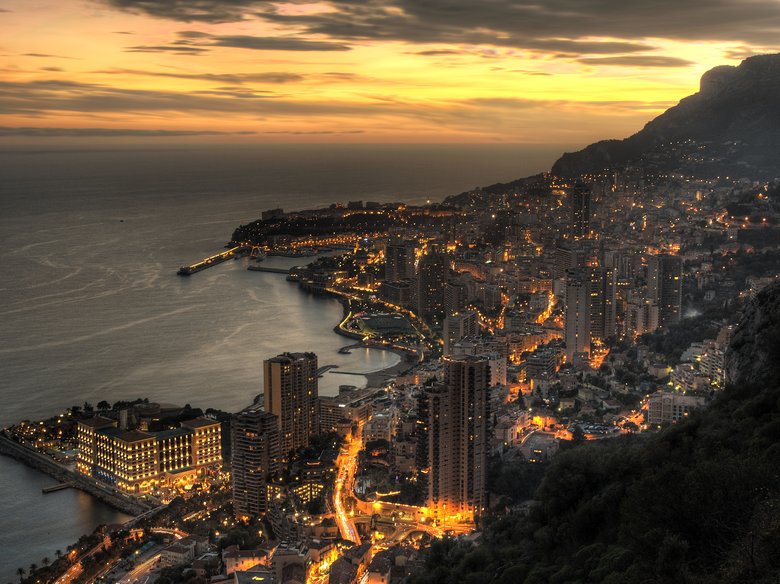
Monaco
©
Monaco

Monaco

Tiny Riviera principality packed between France and the sea, with Monte Carlo glamour and a rock-top old quarter.

Monaco is one of the world's smallest countries — 2.1 square kilometres wedged between France and the sea — and one of the most densely packed with wealth. The glittering yachts, the casino, the Grand Prix circuit threading through city streets: it's a place where ostentation has been elevated to an art form. But it's also genuinely worth visiting, even if you're not a billionaire.

Most people come on a day trip from Nice or the Italian Riviera. That's usually enough. Monaco doesn't have the depth of a full destination, but it rewards a few hours of wandering — up to Monaco-Ville, the old rock-top quarter with the palace and cathedral, then down to Monte Carlo for the casino and the Oceanographic Museum perched on the cliffs.

The principality is ruled by the Grimaldi family, who have held power since 1297 (with a few interruptions). Prince Albert II has been on the throne since 2005. Despite appearances, Monaco takes environmental issues seriously — Albert has been outspoken on climate and ocean conservation, and the Oceanographic Museum founded by his great-great-grandfather Prince Albert I reflects a genuine scientific tradition.

About 38,000 people live here, representing nearly 150 nationalities. Monegasques — actual citizens — now make up roughly 24% of the population, the largest single group ahead of French and Italian residents. French is the official language; Italian and English are widely spoken. There's also Monégasque, a dialect related to old Genoese Ligurian, which the principality has been working to revive in schools.

The currency is the euro. Roman Catholicism is the state religion, though freedom of worship is guaranteed. The national holiday falls on 19 November.

Guide

Books

Monaco's outsized cultural footprint — royalty, glamour, crime, and political intrigue — has inspired a steady stream of books. Here are some worth reading before or after a visit.

The Royal House of Monaco by John Glatt covers the Grimaldi dynasty from its medieval origins through the late 20th century, focusing on the scandals, marriages, and succession crises that have defined the family. Readable popular history.

The Grimaldis of Monaco by Anne Edwards is a thorough biography of the ruling family, with substantial focus on Grace Kelly's transformation from Hollywood star to princess.

Grace by Robert Lacey is one of the more thoughtful biographies of Grace Kelly — less fixated on glamour than most, more interested in the complicated reality of her life in Monaco.

Monte Carlo: A Living Legend by Frédéric Mitterrand traces the history of the casino quarter and the Société des Bains de Mer, the company that has controlled Monte Carlo's grand hotels and gaming since the 19th century.

Guide

Festivals

For a tiny state, Monaco maintains an impressive calendar of events — partly because the principality uses major events to sustain its international profile, and partly because the Grimaldi family has always been an active patron of culture and sport.

Monaco Grand Prix (late May) is the centrepiece of the year. The Formula 1 race on the streets of the principality is one of the sport's most famous events — technically not the most competitive race due to the difficulty of overtaking, but historically the most glamorous. The city fills up completely the week before. Book accommodation months ahead and expect prices to triple.

International Circus Festival of Monte-Carlo (late January) was founded by Prince Rainier III, who was a circus enthusiast. It has grown into one of the world's premier circus competitions, drawing acts from across Europe and beyond. The Golden Clown is the top prize.

Monaco Yacht Show (September) brings the world's largest superyachts to Port Hercule for four days. It's a trade show as much as a spectacle, but the boats are genuinely impressive and the port becomes unusually animated.

Monte-Carlo Jazz Festival (November–December) has been held since 2006 under the patronage of the Grimaldi family. International jazz and soul acts perform at Salle des Étoiles.

Monte Carlo Gastronomie (late November) is an international food fair in the Grimaldi Forum, featuring wines, champagnes, caviar, cheeses, and demonstrations by Michelin-starred chefs. Primarily aimed at trade buyers but open to the public.

Monte-Carlo Rally (January) is one of the oldest motorsport events in the world, dating to 1911. Stages run in the mountains above Monaco and Nice; the ceremonial start and finish take place in Monaco.

Guide

Food

Monaco's food scene sits firmly in the Provençal and Ligurian tradition — olive oil, seafood, fresh vegetables, pasta — elevated by the principality's wealth into some of the finest restaurants on the Mediterranean. It also means you can eat extremely well or extremely expensively, depending on your choices.

The flagship is Le Louis XV, Alain Ducasse's three-starred Michelin restaurant in the Hôtel de Paris. It has been one of Europe's great restaurants since it opened in 1987 — the setting alone, in the Belle Époque dining room overlooking the casino, is extraordinary. A dinner here costs several hundred euros per person. The Monte Carlo resort also has Blue Bay (two stars) and Pavyllon by Yannick Alléno (one star).

For less spectacular but still very good meals, the streets of Monaco-Ville and the La Condamine district have bistros and restaurants where you can eat well for €25-40 per person. Look for barbagiuan — a Monégasque speciality of fried pastry stuffed with ricotta, spinach, or chard — and socca, the chickpea flatbread common across the region.

The market in La Condamine (Marché de la Condamine) is the best place to buy local produce, olives, cheese, and charcuterie. It opens mornings, Tuesday to Sunday.

Eating in Monaco is never cheap. If you're watching your budget, the supermarkets in the Fontvieille district stock everything you need for a picnic by the port.

Guide

Getting Around

Monaco is small enough to walk across in about 30 minutes on flat ground, but it isn't flat — the principality climbs steeply from the port up to Monaco-Ville and Monte Carlo. What saves you is the network of free public lifts and escalators that connect the different levels. These are surprisingly useful and marked on most maps.

On foot is the best way to explore. Most of the key sights are within easy walking distance of each other once you're oriented. Give yourself more time than you think you need — the terrain adds effort and the views slow you down.

By bus, Monaco has five routes serving 143 stops, running roughly 6am to 9pm. A single ticket costs €2 on board or €1.50 if you buy in advance at a news stand or shop. A day pass is €5.50. The buses are useful for getting between Monaco-Ville and Fontvieille, or out to Larvotto beach.

By taxi, cabs are available but expensive, as you'd expect. There are ranks near the casino and at the main train station. Uber does not operate in Monaco.

There is no metro. The train station (Monaco-Monte Carlo) connects you to Nice and the Italian border town of Ventimiglia, and is useful for day trips along the coast.

Renting a car makes no sense within Monaco — parking is almost entirely underground, limited, and costly. If you're based here and exploring the wider Riviera, pick up a rental in Nice.

Guide

Getting There

Monaco has no airport of its own. The nearest is Nice Côte d'Azur Airport (NCE), about 30 km away — roughly 20 minutes by train or 40 minutes by road depending on traffic.

By train is the easiest option from Nice. Trains run frequently throughout the day along the coast, stopping at Monaco-Monte Carlo station (which is mostly underground). The journey from Nice takes around 20-25 minutes. From Paris you can take a TGV to Nice and connect from there. The station sits below Monaco-Ville, with lifts and escalators bringing you up into the city.

By bus from Nice airport, the No. 110 express bus runs directly to Monaco. It's slower than the train but drops you close to the casino area.

By car from Nice, take the A8 motorway or the more scenic Moyenne Corniche (D6007). Parking in Monaco is mostly underground and expensive. For a day trip, consider leaving the car in Menton or Beausoleil (just across the French border) and walking in.

By helicopter from Nice airport takes about 7 minutes and operates several times daily with Monacair. It's not cheap, but it's memorably dramatic, landing on the helipad above the port. Worth it for a special occasion.

Monaco is not a practical drive-through destination — it's a cul-de-sac at the end of a promontory. You come here on purpose.

Guide

Highlights

Oceanographic Museum

The single best thing in Monaco. Prince Albert I founded it in 1910; Jacques-Yves Cousteau ran it for decades. The aquarium on the lower floors is one of the finest in Europe, with species — sea dragons, deep-water fish — that you won't see elsewhere. The building itself, on the cliff edge above the sea, is dramatic. Allow two to three hours. The terrace looks along the Riviera toward Italy.

Monaco-Ville

The old town on the rock above the port. Narrow cobbled streets, the 13th-century palace, the cathedral with Grace Kelly's tomb, and some of the best views in the principality. The changing of the guard at the palace happens daily at 11:55am. Less crowded than the casino district and the most atmospheric part of Monaco.

Casino de Monte-Carlo

Even if you don't gamble, the casino is worth seeing. Charles Garnier designed it — the same architect who did the Paris and Monte Carlo opera houses — and the Belle Époque interiors are extraordinary. Entry to the main gaming rooms costs €18 and requires a passport. Formal dress is enforced after 7pm (jacket and tie for men). The square in front of it, lined with Ferraris and Bentleys, is its own spectacle.

La Condamine and the Port

The working harbour district between Monaco-Ville and Monte Carlo. The port is where the grand yachts moor, and during the Grand Prix, it doubles as part of the circuit. Wander the waterfront for the best views of the principality's skyline.

Prince's Car Collection

Prince Rainier III assembled over 100 vehicles — Rolls-Royces, Bugattis, Formula 1 cars — which are now on permanent display in Fontvieille. Worth the visit if you have any interest in automotive history.

Grand Prix Circuit

Every May, the streets of Monaco become one of Formula 1's most prestigious circuits. Outside race weekend, you can walk the route: through the tunnel, up to Casino Square, down the hairpin at the Hotel de Paris. The combination of impossibly tight streets and the memory of the races gives it a particular atmosphere.

Guide

People

Monaco has a population of around 38,000, making it the most densely populated sovereign state in the world. The mix of nationalities is extraordinary: nearly 150 different nationalities are registered as residents, with Monegasques, French, Italians, and British making up the largest groups.

Monegasques themselves — people with Monegasque citizenship — now represent about 24% of residents, roughly 9,200 people. This is actually a recent shift: for most of the 20th century, French nationals were the majority. Citizenship is tightly controlled and largely passed through the paternal line, though naturalisation is possible after long residence. The result is a citizenry that is acutely conscious of its status and identity.

The overwhelming majority of Monaco's working population commutes in from France and Italy daily — around 50,000 cross-border workers each day, outnumbering the resident population. The principality has almost no unemployment.

French is the official language and the language of government, education, and daily life. Italian is widely spoken, especially in the east of the principality near the Italian border. English is well understood in hotels, restaurants, and tourist areas. Monégasque, a dialect related to old Genoese Ligurian, is spoken by older Monegasques and is taught in schools as part of an effort to preserve it.

Roman Catholicism is the state religion; the cathedral in Monaco-Ville is the spiritual centre of the principality. Other faiths are freely practiced.

Guide

Practical Information

Visas

Monaco follows the Schengen Agreement. If you can enter France, you can enter Monaco. Citizens of the EU, US, Canada, Australia, New Zealand, the UK, and most other Western countries do not need a visa for stays up to 90 days. Carry your passport — it's worth having on you even though border checks are rare.

Currency

The euro. Credit cards are accepted almost everywhere, including small purchases. There are ATMs throughout the principality.

Language

French is the official language and what you'll hear in shops, restaurants, and government offices. English is widely spoken in tourist areas and hotels. Italian is common near the Italian border. Most signage is in French.

Costs

Monaco is expensive. A coffee at a café in Monte Carlo will cost €4-6; a modest restaurant lunch runs €25-40 per person. There's no way around the fact that this is one of Europe's priciest destinations. Budget travellers should base themselves in Nice or Menton and visit as a day trip.

Opening hours

Shops typically open Monday to Saturday, 10am to 7pm. Museums vary — check ahead for the Oceanographic Museum and the Palace, which have seasonal hours. The Casino de Monte-Carlo opens at 2pm for slot machines and from around 4pm for table games; formal dress is required in the gaming rooms after 7pm.

Casino entry

You must be 18 or over, show a passport (driver's licences are not accepted), and pay an entry fee of €18 for the main gaming rooms. The public areas with slot machines have a lower cover charge.

Electricity

230V, type E plugs (French/Belgian two-pin round). Same as the rest of continental Europe.

Emergency number: 112 (European standard). Monaco also has its own police: 17.

Guide

When to Go

Monaco's Mediterranean climate means it's pleasant year-round, but the seasons vary more than you might expect.

Spring (April–May) is the best time to visit. Temperatures are warm (18–22°C), crowds are manageable, and prices are lower than summer. The rose garden at Fontvieille is at its best in late April and May. The Monaco Grand Prix falls in late May — spectacular if you're there for it, but the city fills up completely and hotel prices become eye-watering for that week.

Summer (June–August) is peak season: hot, sunny, and crowded. Sea temperatures are ideal for swimming at Larvotto beach. July and August bring the densest tourist numbers and the highest prices. The heat can be oppressive in the middle of the day — the principality's density of concrete and glass intensifies it.

Autumn (September–October) is another good window. The Monaco Yacht Show takes over the port in September, which is either a draw or a reason to avoid it depending on your interests. By October, the crowds have thinned and the weather is still warm enough to enjoy the terraces and the seafront.

Winter (November–March) is quiet and mild. Temperatures rarely drop below 8°C and snow is essentially unheard of. The International Circus Festival runs in late January, and the Monte Carlo Rally happens in January too. Otherwise it's a good time for a peaceful visit at off-season prices — though some beach facilities close.