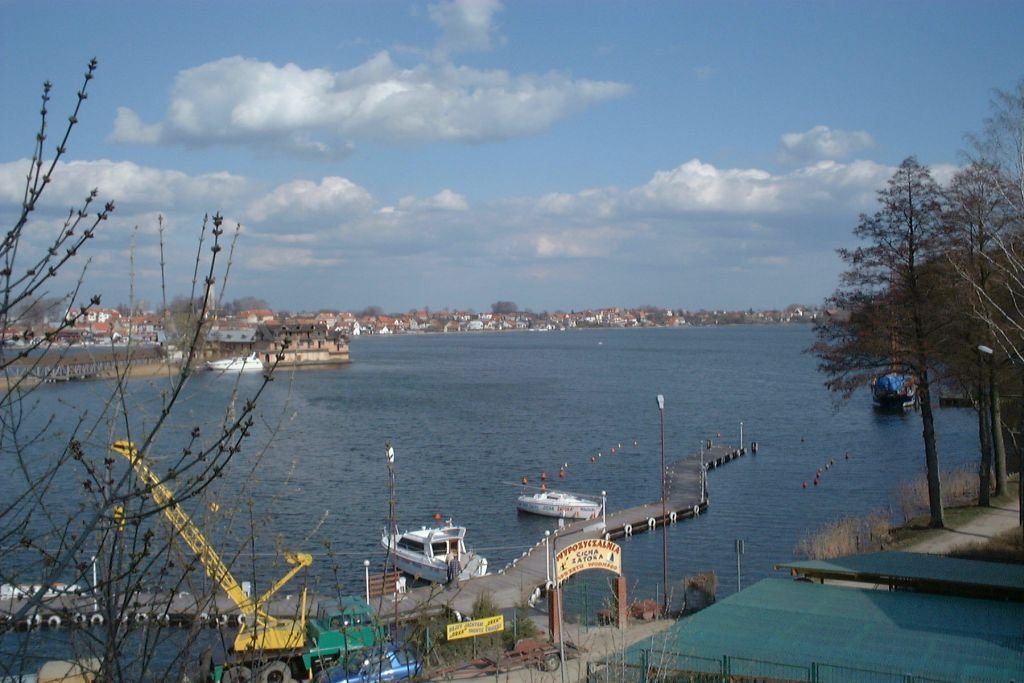
Northeastern Polish lake district of more than 2,000 glacial lakes linked by rivers and canals.
The Mazurian Lakes — Pojezierze Mazurskie — are the largest lake district in Europe: more than 2,000 lakes connected by rivers and canals in the northeastern corner of Poland, covering an area larger than Luxembourg. The landscape was carved by retreating glaciers at the end of the last ice age, leaving a mosaic of water, forest, and meadow that stretches from Olsztyn in the west to the Belarusian border in the east. In summer, when the water is warm and the forests are green, the region is as close to paradise as Poland offers.
The centre of Mazuria — as it is commonly called — is the chain of large lakes running from Giżycko in the north through Mikołajki to Lake Śniardwy, Poland's largest lake at 110 square kilometres. This chain is the main sailing and motorboat corridor, served by marinas, yacht clubs, and hire facilities at every town. Giżycko is the largest town in the region and the sailing capital; Mikołajki, smaller and more attractive, is where the sailboats actually converge on summer weekends until the town quay is so packed you can barely see the water.
Beyond sailing, Mazuria offers kayaking on the Krutynia River — a classic multi-day river journey through forest and quiet lakes — birdwatching at the Łuknajno Reserve (one of Europe's most important mute swan colonies), and cycling on the flat roads between lakes. In winter the frozen lakes support ice fishing, ice yachting, and cross-country skiing. The region was also the setting for some of the most intense fighting on the Eastern Front in 1944–45; Wolf's Lair, Hitler's main wartime headquarters, lies in the forests near Kętrzyn.
The Mazurian Lakes are enormously popular with Polish holidaymakers and far less known to foreign visitors, which means a more genuine experience in most places. The main season is June to August; the rest of the year is quiet and the smaller towns essentially shut down.
Guide
Books
Günter Grass: The Tin Drum — the great novel of the eastern German territories, not set in Mazuria specifically but in Danzig (Gdańsk) and the Kashubian countryside. The Masurian world — Protestant farmers, Prussian order, violent displacement — is adjacent to this novel's world and illuminated by it.
Marion Dönhoff: Before the Storm: Memories of My Youth in Old Prussia — the Countess Dönhoff grew up on an estate in East Prussia (now Poland) and escaped on horseback in January 1945 as the Soviet Army advanced. Her memoir is a description of a world that vanished completely and the particular Masurian landscape of forests and lakes. Essential reading for understanding the postwar transformation of the region.
Wiesław Myśliwski: Stone Upon Stone — not set in Mazuria but a classic of Polish village fiction that captures the postwar experience of resettlement and rebuilding. The displaced families who repopulated former East Prussia came from exactly this world.
Guide
Getting There
By train: The main rail connections are from Warsaw to Olsztyn (about 2 hours on fast trains) and from Warsaw or Gdańsk to Kętrzyn and Giżycko. Train services in the region are less frequent than in western Poland; check current PKP timetables carefully. Some connections require changes in Olsztyn or Elk.
By car: The most practical way to explore the region. From Warsaw, the S51 expressway runs north toward Olsztyn and the lakes are about 2.5–3 hours by road. A car allows you to reach the quieter lakes, cycle routes, and forest areas not served by public transport. Road quality in the region is mixed; main roads are good, minor forest roads require care.
By bus: Regional buses connect the main towns in the lake district but services can be infrequent, especially on weekends and outside summer. Useful for connections between Giżycko, Mikołajki, and Ruciane-Nida.
The nearest airports are Szymany/Mazury Airport near Szczytno (seasonal flights from Warsaw and charter destinations), Gdańsk (about 3.5 hours by road), and Warsaw Chopin (about 2.5 hours).
Guide
When to Go
The Mazurian Lakes have a very distinct season driven by sailing and swimming.
June to August is the main tourist season. The lakes are warm enough to swim (18–22°C in July), the daylight lasts until 9pm, and the marinas fill with boats. July and August are the peak months with school holidays bringing large numbers of Polish families; accommodation in the popular towns (Mikołajki, Giżycko) must be booked months in advance for August.
June is excellent if you can: fewer people than July/August, the weather is warming, and the wildflowers are at their best in the meadows.
September is one of the best months for kayaking and cycling: the summer crowds have thinned, the forests are beginning to turn gold and rust, mushroom season starts, and the weather is often settled and warm. Sailing continues on the lakes. Some facilities begin to close.
October to May is effectively off-season. Most lake-oriented businesses close after September. However, the forests are beautiful in autumn, the ice fishing season on frozen lakes runs from January, and Wolf's Lair is far better appreciated without the summer tour groups.
Mosquitoes are a serious consideration in June and July, especially near reed beds and in forested lakeshores. Bring repellent; it is not optional.