Transylvania is the large plateau that fills the centre and north of Romania, ringed on three sides by the great arc of the Carpathian Mountains. For a word so saturated with vampire associations in the English-speaking imagination, the reality is almost comically unlike it: rolling farmland, forested hills, beech woods that still shelter the densest populations of brown bear and wolf in Europe, and a collection of small, beautifully preserved medieval towns that would not look out of place in Austria or southern Germany. That resemblance is not a coincidence — from the 12th century until the end of the First World War, Transylvania was ruled by Hungarians, and colonised by German-speaking "Saxons" who built the fortified churches and the cobbled squares that still dominate its towns today.
The great draws are the Saxon towns. Braşov, beneath the wooded cone of Mount Tâmpa, has the best-preserved old town and a huge Gothic Black Church. Sighişoara is a hilltop citadel of pastel houses and a clock tower, famous as the birthplace of Vlad Țepeș — the Wallachian prince Bram Stoker borrowed for his novel. Sibiu, with its pair of linked squares and eyelid-dormered roofs, was European Capital of Culture in 2007. And scattered across the countryside between them, dozens of fortified Saxon villages — including the UNESCO-listed Biertan, Viscri and Prejmer — have churches with four-metre walls and towers built to resist Turkish and Tartar raids.
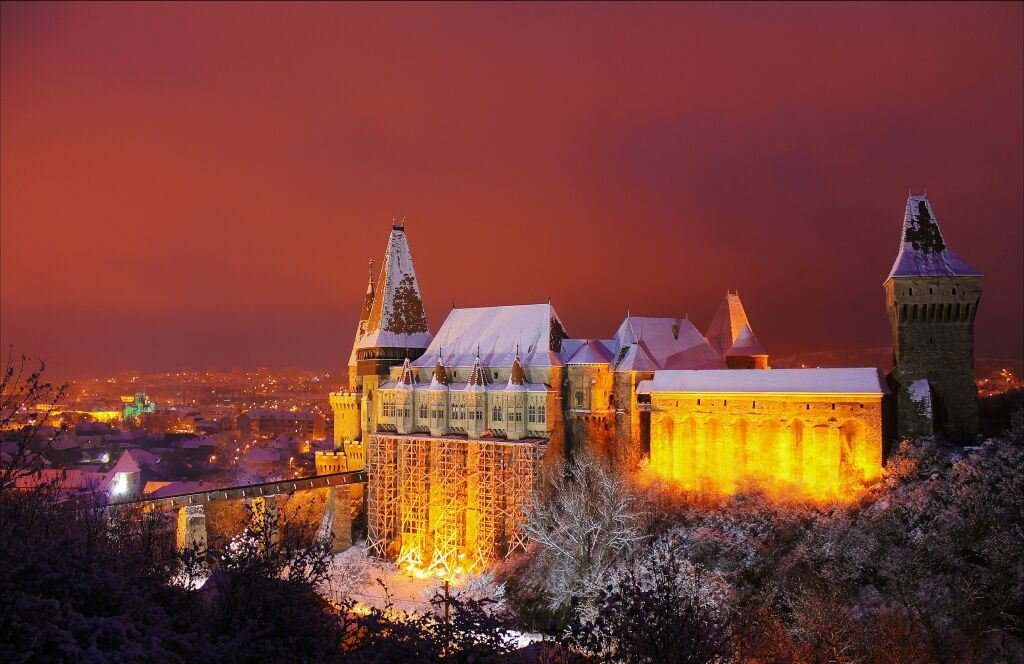
Of the castles, Bran Castle near Braşov is the one marketed to tourists as Dracula's (Stoker never saw it, and Vlad almost certainly never lived there); the much more interesting castles are Corvin Castle at Hunedoara, a 14th-century Gothic fortress that may be the finest in Romania, and Peleș Castle near Sinaia, a fairy-tale late-19th-century royal summer residence. Beyond the towns and castles, the Apuseni Mountains in the west hold caves and rural communities where the old ways of life survive, and Maramureș, just over the northern border, preserves wooden churches and a way of life unchanged for centuries.