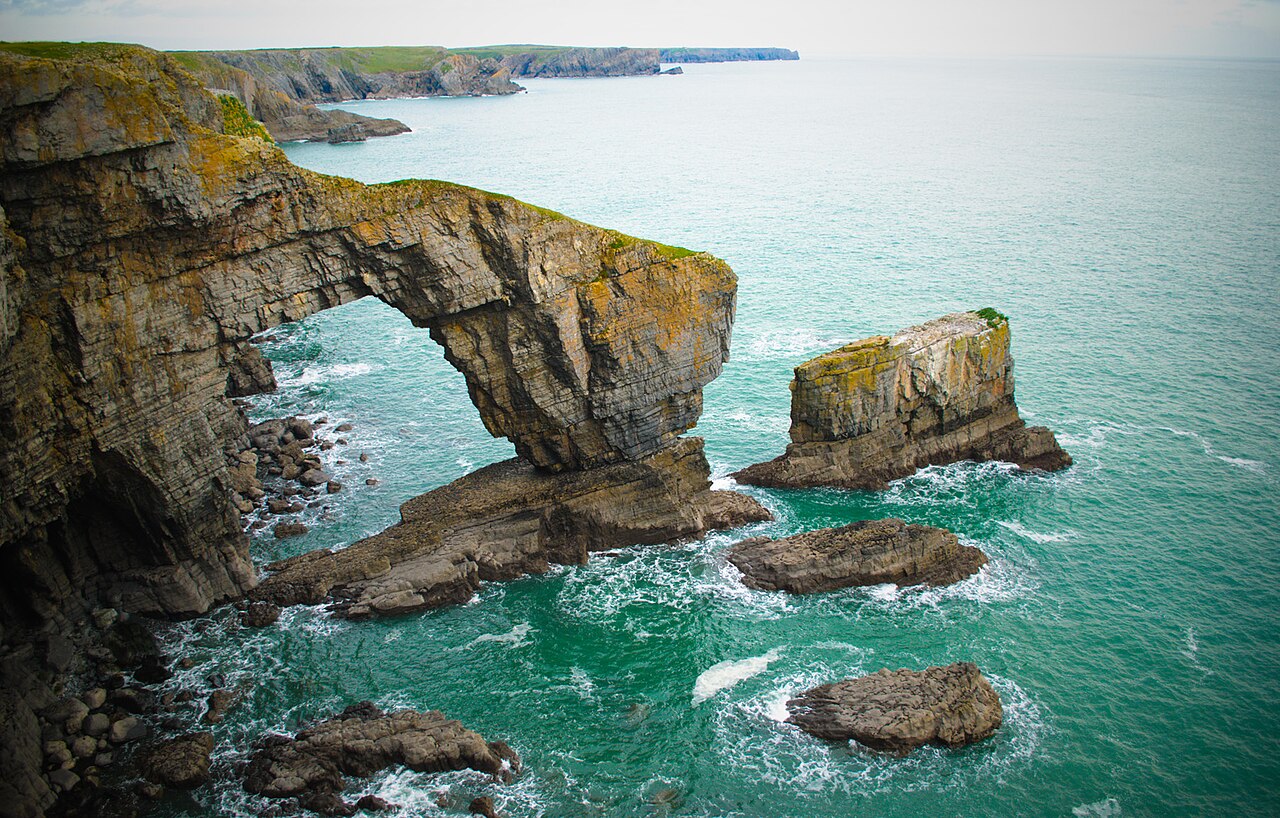
Pembrokeshire sits at the south-west tip of Wales, where the land breaks into a ragged coastline of headlands, sea stacks, coves, and beaches in startling variety. The national park is defined by that coast — a 186-mile path runs its full length, taking in everything from family beaches with donkeys to remote coves accessible only on foot.
The beaches alone justify the trip. Some, like Broad Haven and Little Haven, are almost resort-like in summer. Others, like Marloes Sands and Druidston Haven, stay quiet because the parking is poor or the walk is long — which is exactly the point. The sand changes colour from beach to beach: red, pink, yellow, near-white — a geological variety you do not expect in a stretch of coast this size.
St David's is the heart of the park — a cathedral city so small it barely qualifies, officially the smallest in Britain. The cathedral and ruined Bishop's Palace, both built of the same warm red sandstone, were deliberately tucked below the skyline so as not to be visible from the sea. The effect is still striking today. Nearby, the headland at St David's Head has its own Bronze Age cromlech, and the cliffs around Strumble Head lighthouse offer some of the wildest scenery in Wales.
The north coast around Abereiddy is worth a detour for the Blue Lagoon — a flooded slate quarry — and for the fossils that erode out of the cliffs at low tide, making the Bronze Age monuments seem almost recent by comparison. Fishguard, in the north, is the ferry port for Ireland; the Preseli Hills in the interior are the source of the bluestones hauled all the way to Stonehenge.