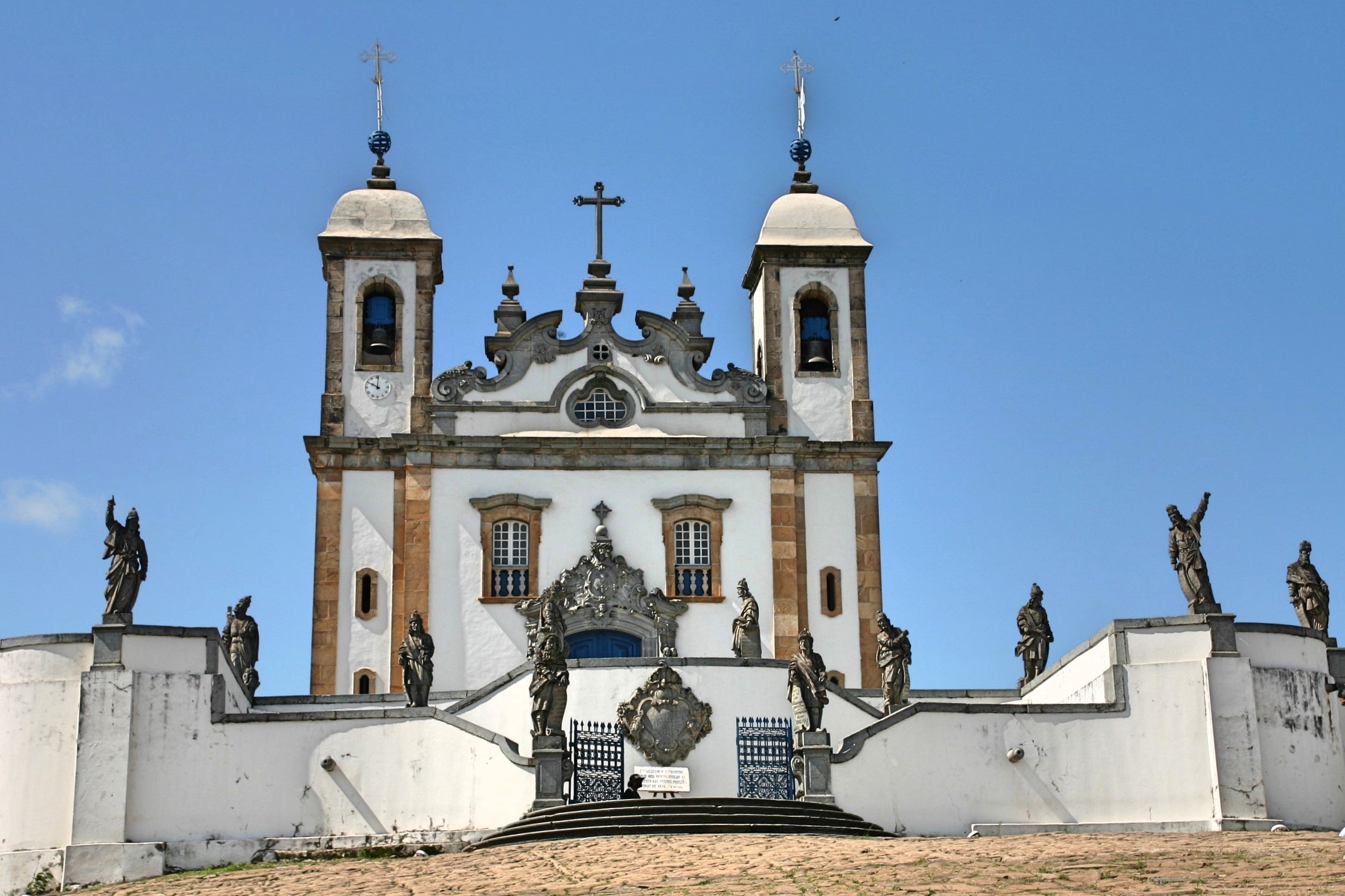
Congonhas is a small mining town in the mountains of Minas Gerais, about 80 km south of Belo Horizonte, with one overwhelming reason to visit: twelve over-life-size soapstone prophets carved by the eighteenth-century master Aleijadinho, ranged along the terraces in front of the Sanctuary of Bom Jesus de Matosinhos. They are widely considered the finest sculptural ensemble of the colonial Americas, and the whole sanctuary complex has been a UNESCO World Heritage site since 1985.
The town grew up around gold mining in the 1700s and was for a time prosperous enough to commission such elaborate religious art. Today it is a modest, working town of about 50,000 — iron ore mining is the main industry, and the centre is mostly utilitarian apart from the hill at its western edge where the sanctuary stands. The Aleijadinho prophets dominate that hill, set in a wide sloping forecourt with sweeping views over red-tiled roofs and green ridges beyond.
Most visitors come on a half-day trip from Belo Horizonte or combine Congonhas with Ouro Preto and Mariana on a longer Minas Gerais loop. The sanctuary takes a couple of unhurried hours: time to walk slowly along the prophets terrace, to look inside the church at the painted ceiling, and to descend into the six passion chapels that house Aleijadinho's polychrome wood Stations of the Cross — sixty-six figures in total, arranged in dramatic tableaux. The Museu de Congonhas on the site gives useful context, including the story of Aleijadinho himself: Antônio Francisco Lisboa, the mixed-race son of a Portuguese architect, who carved most of his greatest work in his fifties and sixties as a progressive disease ate away his hands and feet.
Practical details: Congonhas has a basic bus terminal and a few small hotels and pousadas, but most travellers do not stay overnight. The sanctuary is on the western hill, about 2 km from the bus station — a taxi or a moto-taxi takes a few minutes.