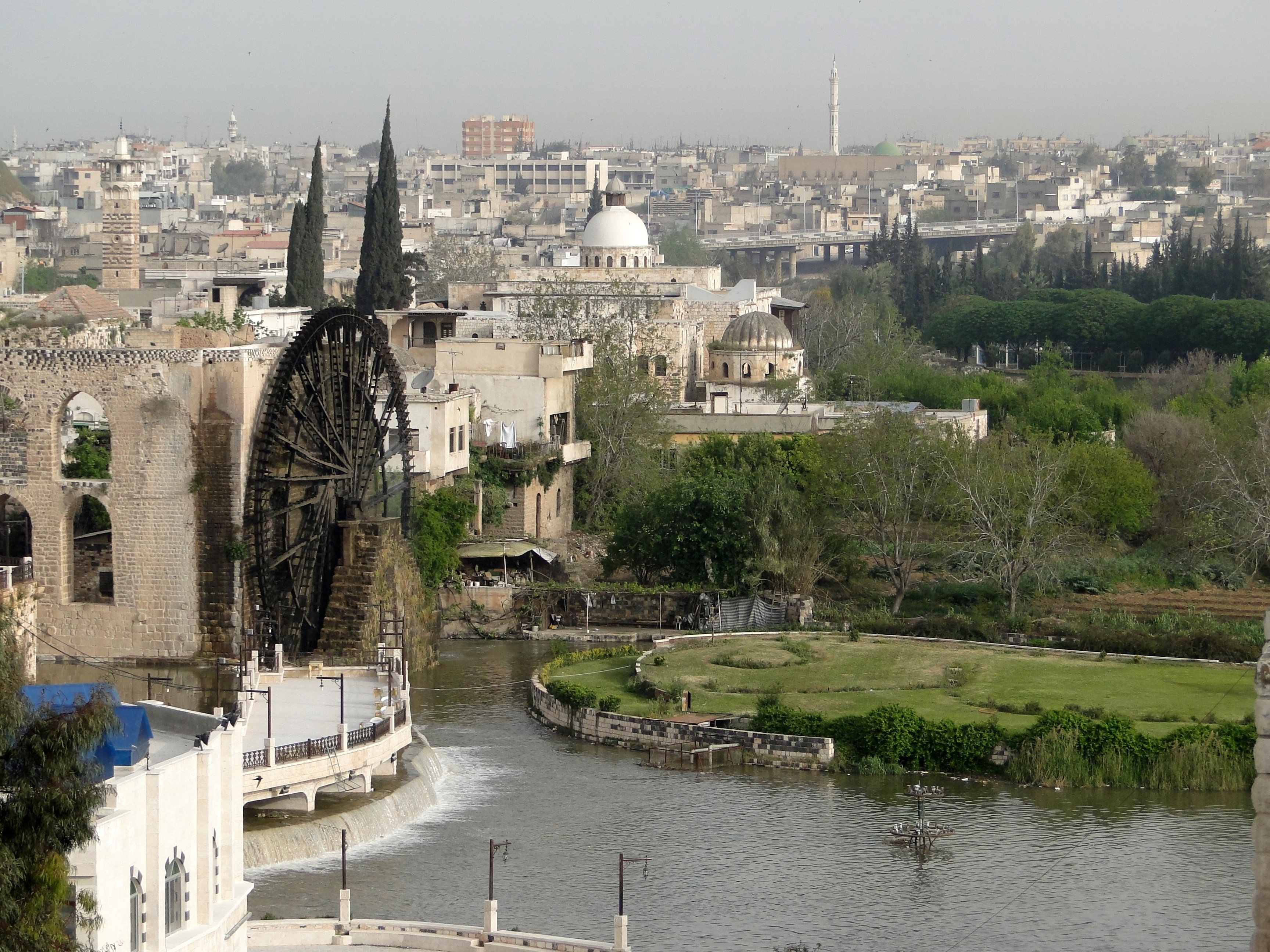
Hama is an ancient city on the Orontes River in central Syria, roughly 180 kilometres north of Damascus. It has been inhabited for at least 4,000 years, though much of the old city was destroyed in the devastating 1982 government crackdown on the Muslim Brotherhood, in which an estimated 20,000 people were killed.
Despite that history, Hama has a certain beauty. The Orontes runs through the centre, its palm-lined banks shaded by gardens. The main attraction is the norias — enormous wooden waterwheels, some 27 metres high, that have groaned and turned on the river since antiquity. The Four Norias of Bichriyat, in a park on both sides of the river in the town centre, are the most impressive. Their eerie creaking is one of the most distinctive sounds in Syria.
From the hill where the citadel once stood (nothing remains — its stones were scavenged for other buildings), you get a fine overview of the city and river. Other worthwhile stops include the 18th-century Al-Azem Palace, now a museum of Roman, Christian, and Islamic artefacts, and the Khan Assad Pasha and Khan Rustem Pasha caravanserais — the latter now serves as a handicrafts market.
Several rewarding day trips lie within reach: Qalaat al-Mudiq (Apamea), a hilltop fortress founded by one of Alexander the Great's generals; the Roman temple at Asriyeh; and the Qasr ibn Wardan, a striking 6th-century church and palace complex in the desert east of town.