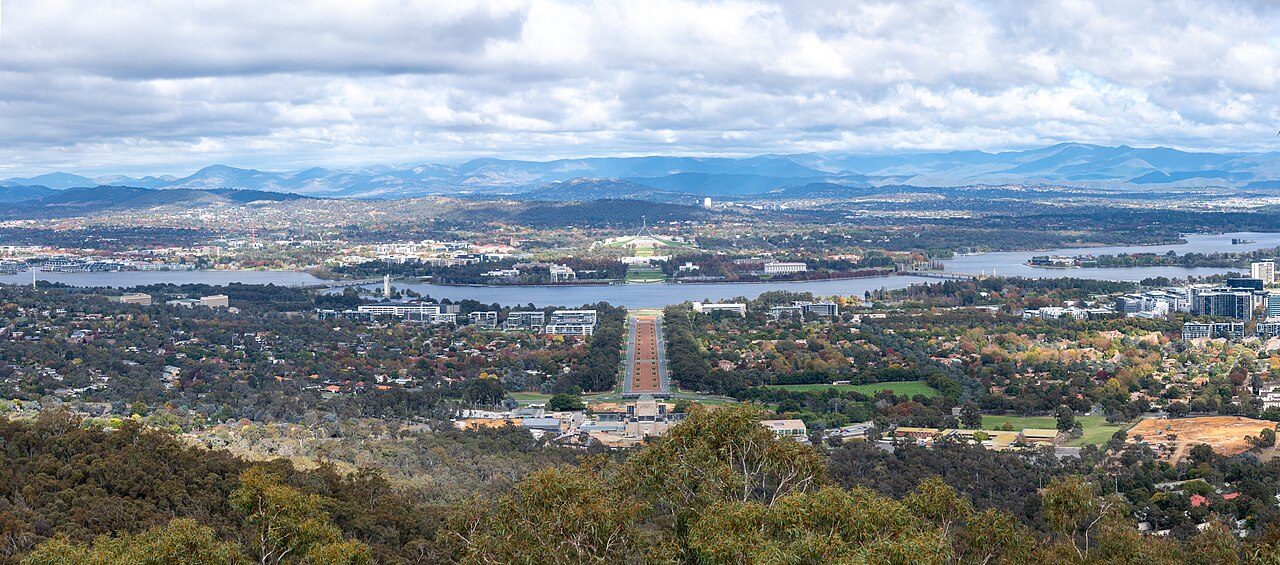
Planned Australian capital of parliament, national museums, and broad lakefront avenues below low hills.
Canberra is Australia's federal capital. Established as part of Australia's federation in 1901, Canberra houses the national parliament, federal government departments, the High Court of Australia, the Australian War Memorial, and several other important institutions.
Canberra is comprised of five large "town centres" that lie in the valleys of the Canberra region. These are Central Canberra, Belconnen, Woden, Tuggeranong and Queanbeyan (actually in New South Wales). For tourists, Central Canberra is the only major area of interest, but the presence of the other centres will explain why the size of Canberra's population seems so out of proportion with its low-built appearance. These other centres are also en route to local wilderness from central Canberra.
Canberra is very different from most Australian capital cities. Firstly, it is relatively young (established ~1927) and secondly, its planned development has excluded the presence of buildings on any surrounding hilltops, or that are over fifteen stories high. Thus visitors may be slightly under-awed by Canberra, but don't just turn around. Explore the sites and appreciate the presence of so much wilderness within a city. You will realise that Canberra is a great place to explore, relax, and learn.
It's also fun to note that the 'mall' running between the War Memorial and Parliament looks familiar. This is because much of Canberra was designed by a US Architect and the mall in Canberra is reminiscent of the mall in Washington DC, specifically the reflecting pool between the Washington Monument and Lincoln Memorial.
Orginal article by TravellingMap on 28 January 05
Guide
Bars and Cafes
Canberra's drinking culture is dominated by two complementary trends: a strong specialty-coffee scene (driven partly by the city's enormous public-sector population and partly by competitive small operators), and a wave of craft-beer and cool-climate-wine bars that have opened since the late 2000s.
For coffee, the Braddon and inner-north corridor (Lonsdale Street, Lyneham, Dickson) holds the most consistent cluster of good operators — Ona, Lonsdale Street Roasters, Barrio Collective, Coffee Lab. For drinks, look to Bar Rochford in the Melbourne Building, Highball Express, the Knightsbridge Penthouse and Molly Bar (a deliberate Prohibition pastiche) in Civic; Hopscotch and the Capital Brewing taproom in Braddon for craft beer; and the Kingston Foreshore strip for waterside drinking. Most of the wine bars carry strong Canberra district and Tumbarumba lists.
Guide
Eating Out
Canberra has, in the last fifteen years, transformed itself from a fast-food backwater into a genuinely interesting eating city. Two factors have driven the change: the rise of a cohort of small ambitious operators in Braddon and Kingston, and the strength of the surrounding ACT and southern New South Wales food region — particularly the cool-climate wines of Murrumbateman and Tumbarumba.
The main eating districts are Braddon (Lonsdale and Mort streets), Kingston (Giles Street and the Foreshore precinct), Manuka, and central Civic. Standout restaurants over recent years have included Pilot, Aubergine, Such & Such, Lazy Su, Bar Rochford, and Monster Kitchen and Bar (in the Hotel Hotel building). For coffee, Lonsdale Street and the inner-north suburbs around Dickson and Lyneham are reliable.
The Old Bus Depot Markets in Kingston on Sundays and the Capital Region Farmers Market in Exhibition Park on Saturdays are the main weekend food markets; both are very good.
Guide
Getting Around
Canberra is built around the car: the city is large, low-density and arranged around a series of self-contained town centres connected by parkways. A rental car is much the easiest way to see everything. Parking is free for short stops at most of the national institutions and ticketed but cheap in the central districts.
The public transport system is operated by Transport Canberra. There is a single tramway (the Light Rail) running north up Northbourne Avenue from Civic to Gungahlin, and an extensive bus network. The bus network is reliable but the frequencies are low outside peak periods. A MyWay card or contactless card payment works on both bus and light rail.
For visitors who plan to spend most of their time around the Parliamentary Triangle, walking and the Lake Burley Griffin shared cycling and walking paths are realistic options. Hire bicycles are available from operators around the lake. Most of the city's major axial routes have parallel separated cycle paths.
Guide
Getting There
Canberra Airport, about 8 kilometres east of the city centre, has direct flights from all the major Australian capitals (Sydney, Melbourne, Brisbane, Adelaide, Perth, Hobart) and a single international route to Singapore. It is a modern, easy airport — security queues are short, the terminal is one building. Taxis and ride-share to the city are around AUD 30; the public bus is much cheaper.
By road, Canberra is 286 km from Sydney (about 3 hours on the Hume Highway and Federal Highway) and 660 km from Melbourne (about 7 hours). The drive from Sydney is straightforward; from Melbourne it is a long day. The coach companies (Murrays and Greyhound) run multiple daily services from both cities.
By rail, the NSW TrainLink Xplorer service runs three times a day from Sydney Central to Kingston station in about 4 hours 20 minutes — slower than the bus and slower than driving, but pleasantly scenic through the Southern Tablelands.
Guide
When to Go
Canberra has four genuinely distinct seasons — much more so than coastal Australian cities — and they are part of the city's experience. Summer (December to February) is warm to hot, with January highs typically around 28°C and frequent dry sunny days; this is bushfire season and smoke haze can be a real consideration. Autumn (March to May) is the standout: cool nights, mild sunny days, and the city's enormous deciduous tree canopy turning gold and red.
Winter (June to August) is cold by Australian standards, with frosts most mornings and occasional snow on the Brindabella range backdrop. Daytime temperatures usually 10-13°C; clear blue skies are common. Spring (September to November) brings the Floriade tulip festival, deep-blue jacarandas and weather that is variable but mostly fine.
For visitors, autumn and spring are the strongest seasons. The big festivals (Floriade in spring, the Balloon Spectacular in March, Enlighten in March) all cluster outside the deep summer and winter.