Norfolk Island
©
Norfolk Island

Norfolk Island

Remote Pacific island of convict ruins and Bounty descendants on the Norfolk Ridge.

Norfolk island was virtually uninhabited when, in 1774, Captain James Cook fell across it. If you see how small the island is and how big the Ocean around, you understand that a bit of luck was involved, even if you take into account that Cook was a great explorer.

Lying 1500 kilometres due east of Australia's Byron Bay, Norfolk and its two satellite islands, are aactually part of a gigantic undersea chain of mountains called The Norfolk Ridge, which stretches for 1770 kilo-metres from New Caledonia to New Zealand - but almost all of it is below the surface of the Ocean.

Captain Cook described the island as 'a Paradise' - a word he did not use to describe any other of his many discoveries. We can agree with him. Norfolk started its career as an inhabited island as a settlement where convicts worked as slaves and living conditions on this paradise were actually close to those of Hell.

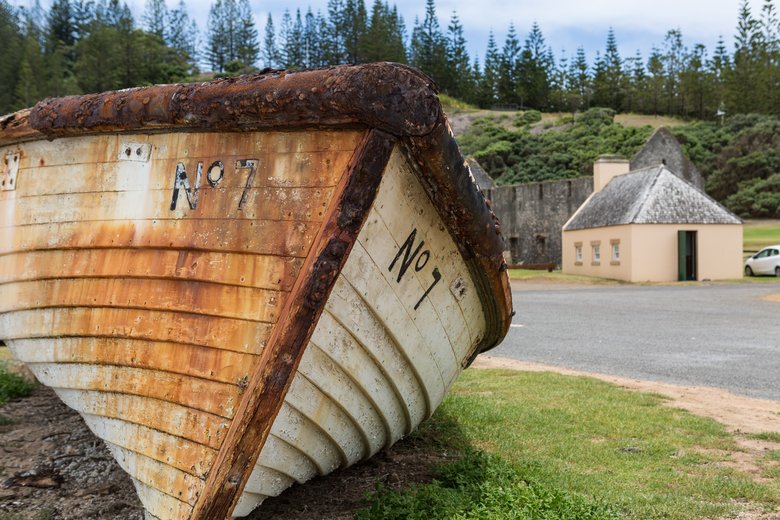
Standing today on Queen Elizabeth's Lookout, gazing out over the peacock's-tail colours of Emily Bay and down at the superbly-preserved Georgian residences of Quality Row, one can scarcely comprehend that this was once a place in which were perpetrated some of the worst depravities in the history of British colonialism.

Another fascinating aspect of Norfolk's heritage is that this is the home of the descendants of the mutineers of the Bounty. If you pick up Norfolk's slim telephone book, you will find something in the order of 36 families with the surname of Christian or Christian-Bailey, and 31 Buffets, 26 Quintals, 20 Nobbs, 18 Evans, 17 Adams and 8 McCoys. All go back, at least by matrilineal descent, to the mutineers. With so many shared surnames, identification is made easier by the use of nicknames and this is the world's only phone book to use them. Amongst the Christians we have Bodge, Loppy, Smudge, Toofie and Tatie, whilst the Evans boast a Bubby, Diddles, Hunky, Tardy and Pelly!

The main attraction of the island consists of natural beauty: beautiful landscapes and wild seascapes. Almost a third of the island is devoted to reserves and national parks.

Guide

Food

Eating well on Norfolk Island is not difficult, which surprises some visitors who expect a remote Pacific island to have limited options. There are around 20 restaurants, cafes, clubs and takeaway outlets — a reasonable number for a population of 2,200 — and the quality of fresh ingredients is genuinely high.

The volcanic soil is fertile and most restaurants source produce locally. Beef and pork are raised on the island, and the surrounding waters yield yellowfin tuna, kingfish, sweet lip and other reef and pelagic species. Seafood landed that morning appears on lunch menus by afternoon. Local artisan producers make Norfolk honey, goat cheese, cow cheeses and island sea salt.

Traditional Norfolk Islander food draws on the Pitcairn culinary heritage — a blend of 18th-century English cooking and Tahitian ingredients. Pilhi (a banana pudding) and mudda (green banana fritters) appear at community gatherings and the occasional restaurant menu. They're not easy to find on a regular dinner menu, but asking locals will point you in the right direction.

Most of the restaurants cluster around Burnt Pine or along the Kingston road. The Homestead Restaurant is well regarded for its wood-fired Argentinian grill and farm-to-plate approach, sourcing meat and produce from local farms. Hilli Restaurant has been a fixture of the island dining scene for years and receives consistently good reviews. Café LaPérouse brings French cafe influence to the island, with pastries and savoury dishes. Bailey's is a reliable option for a substantial meal in a relaxed setting.

Hours vary and seasonal closures happen. Ring ahead or check at the Visitor Information Centre before making firm plans for dinner, especially outside peak season.

Guide

Getting Around

There is no public transport on Norfolk Island. A single taxi service operates on the island but is impractical for anything beyond airport transfers. The vast majority of visitors hire a car, and this is the right call — the island has over 120 kilometres of road, and the best things to see are spread across it.

Car hire operators offer sedans, hatchbacks and small SUVs. You don't need a 4WD. A valid Australian or New Zealand licence is sufficient; international licences are also accepted. You must be at least 17 years old to drive. Traffic moves on the left, and the maximum speed limit is 50 km/h, dropping to 40 km/h in some areas. Expect livestock on the road, particularly cows and feral chickens — they have right of way, and this is not a joke. A few unsealed roads become impassable after heavy rain; watch for signage and use common sense.

Many accommodation packages include a hire car, which usually makes them better value. There are three petrol stations, all in Burnt Pine, open seven days a week.

Bicycles and e-bikes are available for hire through the Visitor Information Centre. The terrain is hilly in places, so the e-bikes are popular. For a guided experience with local commentary, several operators run half-day and full-day tours covering history, nature and scenic highlights. These are worth considering for at least one day of your trip.

Driving Norfolk Island takes getting used to. The roads are narrow, the local custom is to wave at every passing vehicle (a raised finger, a nod or a full wave all work), and nobody is in a hurry. Lean into it.

Guide

Getting There

Norfolk Island is served only by air. There are no passenger ferries or cruise ship terminals.

Qantas operates the most flights, running several times weekly from Sydney (about 2h 30min) and Brisbane (about 2h 10min). Air Chathams offers seasonal direct services from Auckland, which is useful if you're coming from New Zealand or want to combine the trip with a wider Pacific itinerary.

Despite being an Australian territory, you check in at the international terminal in both Sydney and Brisbane — international-style biosecurity and border formalities apply. Flights are treated as domestic for Australians, meaning no passport is technically required, but carrying one is strongly recommended in case of a diversion.

Fares fluctuate considerably. Booking two to three months out typically gets reasonable prices; mid-week departures tend to be cheaper than weekends. Shoulder season (May, or September to October) offers the best combination of lower fares and decent weather. Peak season (December to February) sees prices climb and capacity tighten, so book early.

Package deals bundling flights with car hire and accommodation are often better value than booking separately, and several operators specialise in Norfolk Island travel. Given the limited options on the island, sorting logistics before you arrive makes sense.

Guide

Highlights

Norfolk Island is one of Australia's least-visited territories and one of its most rewarding. It sits 1,500 kilometres due east of Brisbane, a two-and-a-half-hour flight away, but feels much further removed from the mainland in every way that matters.

The island's strongest selling point is the layering of history. Kingston, the original colonial settlement, is home to a remarkably intact collection of Georgian convict-era buildings — Quality Row, the cemetery, the old gaol and the mill ruins — all set against a backdrop of crashing surf. The Kingston and Arthur's Vale Historic Area is listed as a UNESCO World Heritage Site as part of the Australian Convict Sites inscription. Walking it in the late afternoon, when the light is soft and the tourists have thinned out, is genuinely moving.

Emily Bay is the island's most sheltered beach, tucked inside a reef that turns the water glassy and warm. It was named Australia's third-best beach in recent rankings. The snorkelling here is easy and rewarding, with turtles and reef fish common. Nearby Slaughter Bay, despite the name, is another good swimming spot.

Norfolk Island National Park covers around a third of the island's interior and northern coast. The native Norfolk Island pines, which can reach 60 metres, are everywhere — they were what Cook noticed from the sea in 1774, and they're still the island's defining visual feature. The park has short walking tracks through remnant subtropical forest and dramatic coastal cliffs.

Captain Cook Monument stands on the headland where Cook's lookout once gave him his first clear view of the island. The views over the western cliffs and out to Philip Island are as good as anything on Norfolk. Philip Island itself, visible offshore to the south, is a nature reserve and looks almost comically volcanic — a bare, eroded cone rising from the blue.

Away from the main sites, Norfolk's best quality is simply its pace. Cows wander across roads. Everyone waves at passing cars. Burnt Pine, the main shopping strip, has a handful of cafes and a supermarket that keeps island hours. Most visitors find this slowness either relaxing or maddening. If you're drawn to it, Norfolk will reward you.

Guide

People

Norfolk Island has a permanent population of around 2,200, though the number swells considerably during peak tourist season. What makes it unusual is the deep cultural split between two distinct communities who have learned to share a small rock in the Pacific.

About 40 percent of residents are descendants of the Bounty mutineers and their Tahitian companions, who settled Pitcairn Island after the 1789 mutiny and were resettled here by the British Crown in 1856 when Pitcairn became overcrowded. The surnames tell the story: flip through the phone book and you'll find rows of Christians, Quintals, Nobbs, Buffetts, Adamses and McCoys — all traceable back to the nine mutineers who made it to Pitcairn. Because so many people share the same surnames, the island's phone directory has long used nicknames to distinguish entries. Amongst the Christians alone you'll find Bodge, Loppy, Smudge, Toofie and Tatie.

The other residents are Australians, New Zealanders and a smattering of others who came for work or lifestyle and stayed. Relations between the two groups are generally cordial, though the question of local self-governance — Norfolk Island had its own elected assembly until Canberra abolished it in 2015 — remains a source of frustration for many islanders of Pitcairn descent.

The local language, Norf'k, is a remarkable linguistic survival: a creole descended from 18th-century English and Tahitian, carried here from Pitcairn. It was formally recognised as a co-official language alongside English and declared endangered by UNESCO in 2008. Fluent speakers are now mostly older islanders, though efforts to teach it in schools and use it in signage have given it some renewed visibility. You'll hear it in conversation, see it on road signs, and notice it in the warmth with which locals greet each other.

Bounty Day on 8 June is the island's most important cultural event, marking the anniversary of the Pitcairners' arrival in 1856. The Kingston foreshore fills with islanders in period dress re-enacting the landing from HMS Morayshire. It's worth timing your visit around it if you can.

Guide

Practical Information

Status and entry. Norfolk Island is an Australian external territory. Australian citizens do not need a passport but should carry one regardless, as identity checks on arrival are thorough. Visitors from countries that require a visa for Australia must have one before flying to Norfolk Island. New Zealanders can enter without a visa.

Currency. The Australian dollar is the currency. Major credit cards are accepted at most tourist businesses. There is one ATM on the island, operated by the Commonwealth Bank in Burnt Pine. Carry cash as a backup — some smaller places, markets and local sellers prefer it.

Biosecurity. Take the biosecurity rules seriously. Norfolk Island has strict controls to protect its agriculture and native species. All food items must be declared on arrival. Fruit, vegetables, plants and seeds are prohibited. Pork and poultry from New Zealand are banned. Commercially packaged and sealed goods are generally fine but must be declared. Non-declaration can result in fines.

Health. Australian Medicare applies on Norfolk Island. There is a small hospital in Burnt Pine (Norfolk Island Hospital) capable of handling routine emergencies. Serious illness or injury requiring specialist care means medical evacuation to the mainland, which is expensive without travel insurance. Get comprehensive travel insurance that covers evacuation — this is not optional on a remote island two hours from the nearest major hospital.

Communications. Mobile coverage on the island uses Telstra's network. Roaming should work for Australian and New Zealand customers but check with your provider. Internet is available at most accommodation and some cafes, but speeds are nothing like the mainland. The island's remoteness is part of its character.

Shopping. Burnt Pine is the island's commercial centre — a modest strip with a supermarket, pharmacy, post office, a few clothing and souvenir shops, and the Visitor Information Centre. Opening hours are shorter than you'd expect; many businesses close early or adjust hours outside peak season. Check before you go.

Time zone. Norfolk Island observes UTC+11 (UTC+12 during daylight saving time, which runs from the first Sunday in October to the first Sunday in April). This puts it one hour ahead of the eastern Australian states.

Guide

When to Go

Norfolk Island is small enough and temperate enough that any month is viable, but the differences between seasons are real.

Summer (November to April) is warm and humid, with temperatures typically between 19°C and 25°C. This is the best time for swimming, snorkelling and beach days — Emily Bay is at its best. December through February is peak season, with higher prices and the most visitors, which on a place this size is noticeable. Be aware that tropical cyclones occasionally affect the island between January and March, though direct hits are rare.

Winter (May to September) is cooler and drier, with temperatures ranging from about 14°C to 19°C. The humidity drops, which makes hiking and walking significantly more comfortable. The national park trails are particularly good in this season. Prices are lower, the island is quieter, and the sea is rougher — swimming is less appealing but not impossible.

The shoulder seasons — March to May and September to October — offer the most balanced experience: reasonable weather, manageable crowds and mid-range prices. If you're visiting for the first time, September or October are good choices.

Bounty Day on 8 June is worth planning around if the island's Pitcairn history interests you. The Kingston foreshore celebration draws the community together in a way that's genuinely hard to witness elsewhere.

Whatever time you visit, pack a light layer for evenings, even in summer. The island is subtropical but sits alone in the ocean, and the temperature drops after dark.