Recife
©
Recife

Recife

Pernambuco capital built on rivers and islands, with frevo, maracatu, bridges, and colonial quarters.

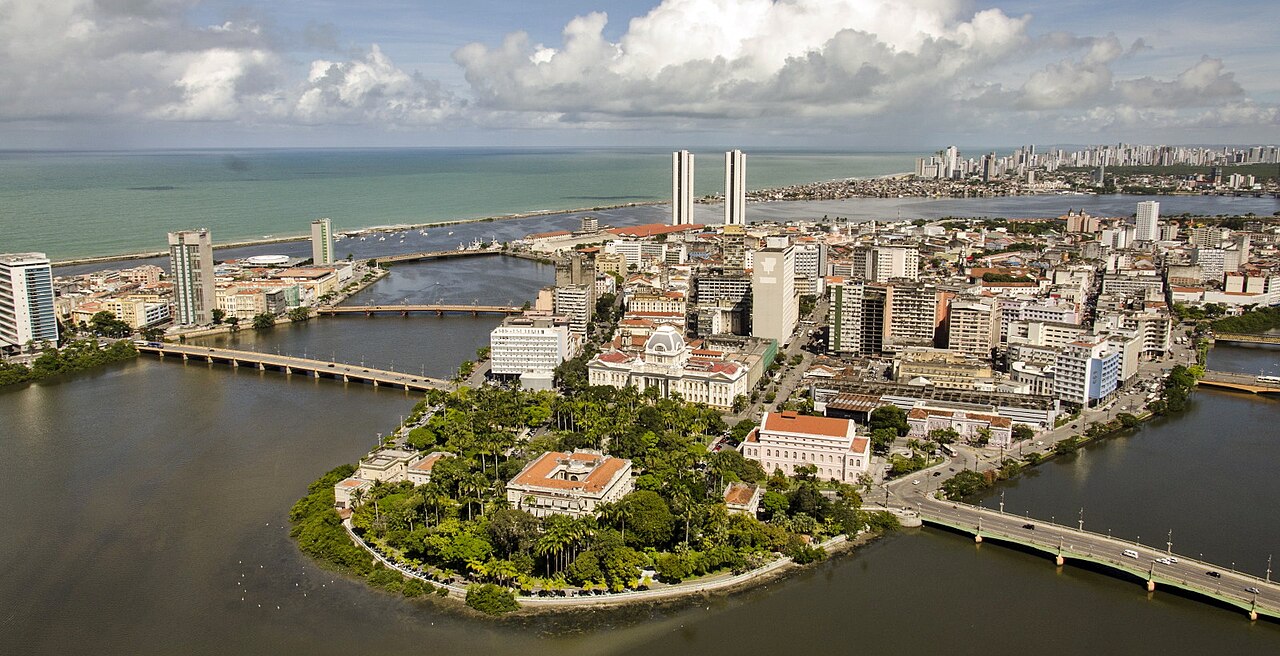
Recife is the capital of Pernambuco State and one of northeast Brazil's most vibrant cities. Built on a network of rivers, islands, and peninsulas where the Atlantic coast meets the Rio Capibaribe, it has a distinctive low-rise colonial skyline and a reputation for strong regional culture — frevo music, maracatu drumming, and the most intense carnival outside of Rio.

The historic center divides into the quarters of Santo Antônio and Boa Vista, where baroque churches, 19th-century public buildings, and the lively Polo Bom Jesus waterfront sit alongside street markets and pedestrian squares. The Recife Antigo island just to the east is the main hub for eating out and evening entertainment, with Marco Zero at its tip. For beaches, head south to Boa Viagem, a long strip of urban beach lined with hotels and restaurants.

Recife is most useful as a base for visiting Olinda, the beautifully preserved colonial town on the hill just to the north — one of Brazil's finest, and worth at least half a day.

Guide

Day trips

Olinda is the obvious one — Recife's UNESCO-listed colonial sister on the hill ten minutes north, with the cleaner streetscape and the louder carnival. Half a day is enough; a full day better.

Porto de Galinhas, an hour south by car, is a beach town built around a string of natural pools formed by an offshore reef — easily the best swimming in the region. Worth a long day or an overnight.

Caruaru, two hours west into the sertão, has the largest open-air market in the northeast every Saturday and the country's most important São João festival in late June. Itamaracá and Igarassu, an hour north, hold some of the oldest colonial churches in Brazil and quieter beaches.

Guide

Getting around

The historic centre — Recife Antigo, Santo Antônio, São José, Boa Vista — is best done on foot, and the distances between churches, markets, and museums are short. The metro is useful for moving between the airport, the central station, and outlying districts but it does not serve most tourist sites directly.

Boa Viagem is connected to the centre by frequent buses and by taxi or ride-share, the easier choice. Uber and 99 operate well across the city and are usually cheaper than street taxis. Driving yourself is not recommended in central Recife: parking is awkward and traffic is heavy.

For longer trips — Olinda, Porto de Galinhas, the Brennand institutes — taxis or ride-shares are the simplest option.

Guide

Getting there

Recife's Guararapes International Airport (REC), about ten kilometres south of the centre, is the main air gateway to northeast Brazil. Direct flights connect to most major Brazilian cities and to a growing list of European hubs — Lisbon, Frankfurt, Paris, Madrid — alongside seasonal services to North America.

From the airport, a metered taxi to Boa Viagem takes ten to fifteen minutes; to the historic centre, around twenty-five. There is also a metro line running from the airport to the central station, useful at peak hours when traffic congeals.

Long-distance buses use the TIP terminal in the western suburbs, with services across the northeast, to the south as far as São Paulo, and to inland Pernambuco and Paraíba.

Guide

When to go

Recife is tropical and warm year round, with daytime highs in the high 20s to low 30s celsius. The rainy season runs roughly April to July: short, heavy showers most afternoons, often followed by sunshine. The dry season runs September to February and is the most reliable for beach time.

The peak event is Carnival, in February or early March. Recife and neighbouring Olinda put on one of the largest street carnivals in Brazil, with the famous Galo da Madrugada parade — sometimes credited as the largest single carnival bloco in the world — drawing more than a million people through Recife Antigo. Accommodation books out months in advance and prices double; if you are not coming for the parties, avoid carnival week.

The second peak is mid-year, in late June, for the São João festivals — quieter than carnival but culturally as important in the northeast.