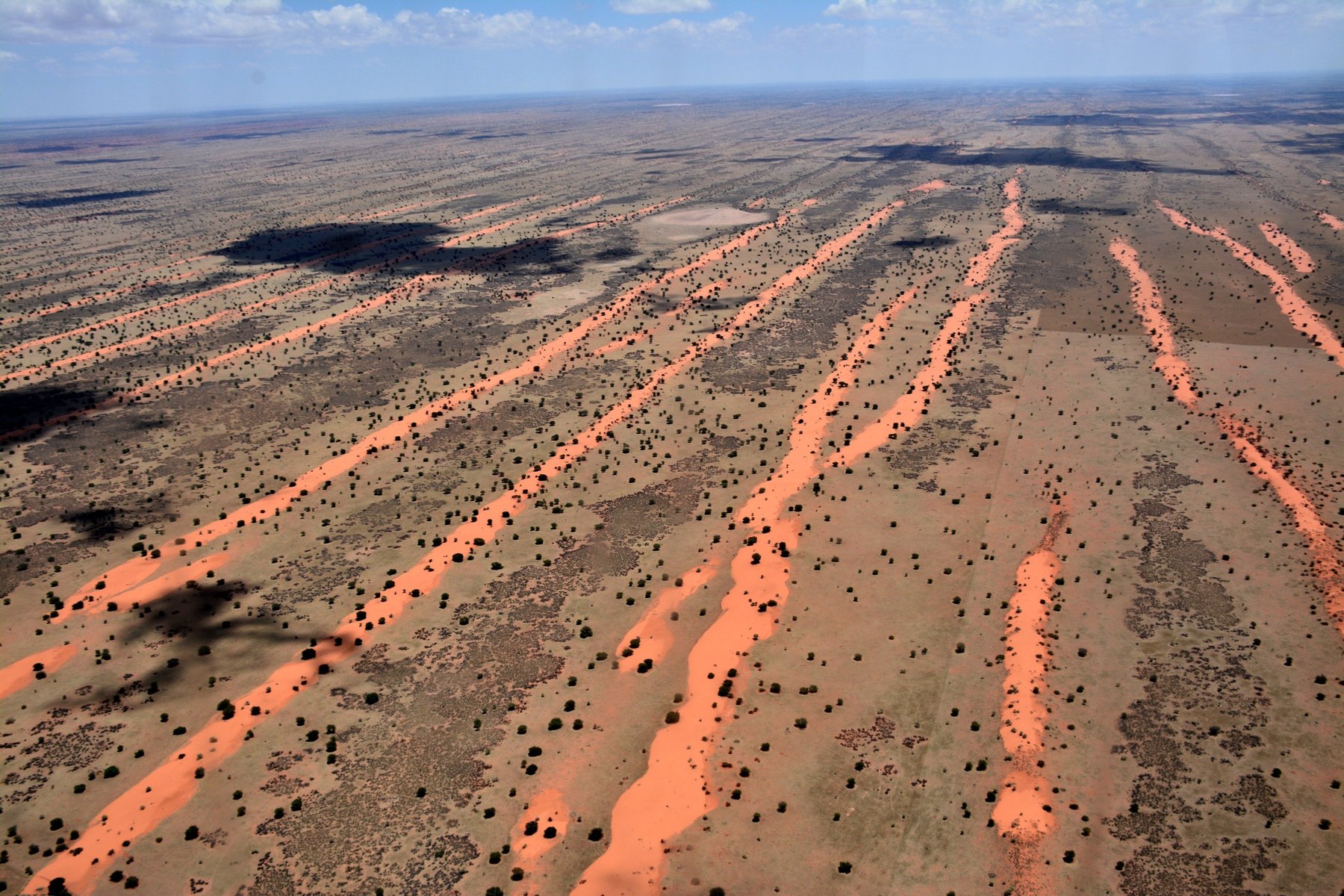
Derived from the Tswana word "Kgalagadi" meaning "the great thirst", the Kalahari is one of the world's most extensive mantles of sand. It stretches south into South Africa, west into Namibia, and north into Angola and Zambia. This ocean of sand covers the hollow basin of Botswana and forms a flat plain that accounts for nearly 70% of the country.
Despite the name, the Kalahari is not a true desert — it receives enough rainfall to support grasses, shrubs, and trees, making it a semi-arid savannah. A striking feature of the landscape is its pans: shallow, round depressions of hard grey clay that glint in the harsh sun. They range from a few hundred metres to several square kilometres, and provide essential salt licks for the wildlife. Between the pans stretch rich savannah and rolling golden grasslands.
The heart of the Kalahari is protected by the Central Kalahari Game Reserve, one of the largest game reserves in the world, covering over 52,000 square kilometres. The reserve was originally set aside to protect the traditional way of life of the San (Bushmen), who have inhabited the Kalahari for tens of thousands of years. Today it harbours lion, cheetah, brown hyena, gemsbuck, springbok, and the famous black-maned Kalahari lions. The smaller Khutse Game Reserve lies to the south and is more accessible from Gaborone. The diamond town of Orapa sits on the eastern edge of the region.