Kawar
©
Kawar

Kawar

Saharan oasis chain in northeastern Niger, where salt towns sit below the Kawar escarpment

Kawar is a string of oases stretching from Bilma north toward the Libyan border in the remote northeastern corner of Niger. An ancient salt-producing center and the western edge of Toubou territory, these towns are about as far from anywhere as it gets.

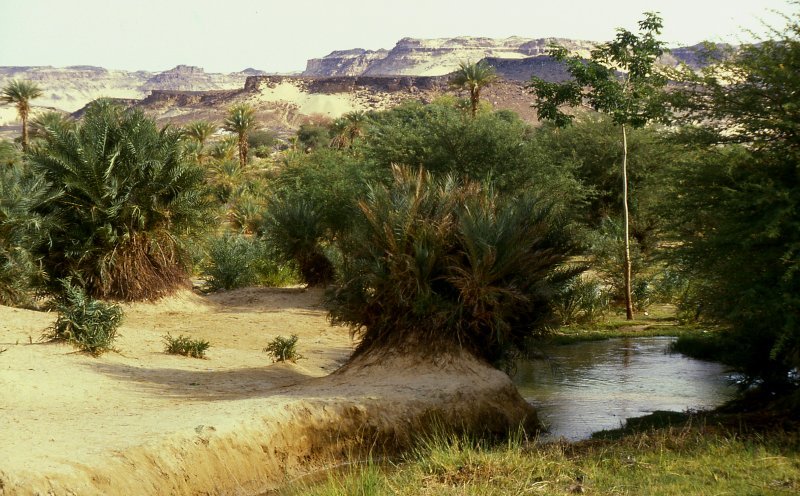
The scenery is extraordinary. The red and black Kawar escarpment forms a jagged wall to the east, while the dunes of the Tenere dissolve into the horizon to the west. In sharp contrast to all that sand and rock are the lush natural springs at Bilma — palm-shaded pools that feel like another world entirely after a long desert crossing.

Getting here without your own vehicle means finding a truck out of Agadez. Tour companies in Agadez offer organized desert crossings that are expensive but take the hassle out of the logistics. For more on travelling by truck, see the Tenere Desert section. Dirkou is the transportation hub of the region; Bilma is the main destination.

Guide

Getting There

Getting to Kawar is a serious undertaking. There is no paved road, no scheduled transport, and no margin for error in this part of the Sahara. The standard approach is to travel from Agadez northeast across the Ténéré Desert — a crossing of several days over open desert and loose sand that requires GPS navigation, mechanical reliability, and enough fuel and water to handle problems along the way.

The most straightforward option for most visitors is to join an organized tour out of Agadez. Several operators there run desert crossings that include Bilma as a destination, typically as part of a longer Ténéré circuit. This is expensive but removes the burden of logistics and local knowledge. Prices vary considerably depending on group size and itinerary length; book well in advance and ask specifically about experience with the Bilma route. Independent travel is possible if you have your own well-equipped 4WD, a reliable GPS track, and experience in remote desert navigation — but you should not attempt this route alone or without preparation.

Dirkou, roughly 100 km north of Bilma, is the main administrative hub of the region and has a fuel depot and a small market. Bilma itself is the main destination, home to the salt works and the natural springs. Trucks do run between Agadez and Dirkou carrying goods and occasionally passengers, but departure times are unpredictable and the journey uncomfortable. For more on the Ténéré crossing, see the Ténéré Desert section.

Guide

Things to Do

Kawar rewards travellers willing to make the effort to get here, but be honest with yourself about what that means: there are no guesthouses, no guides on call, and no marked trails. What there is — ancient salt flats, palm-fringed springs, towering sandstone escarpments, and the immense open dunes of the Ténéré — is quietly extraordinary.

The highlights are concentrated around Bilma, the main oasis town. The salt works are the centrepiece, a landscape that looks much the same as it did when Tuareg and Toubou caravans crossed the Sahara carrying salt north to Fezzan and south to Lake Chad. The natural springs at the edge of town are worth an hour or two, as is time spent simply watching the surrounding desert from the base of the escarpment. For the dunes, you'll need to head a little south and west — the Erg du Bilma is as elemental a sand sea as you'll find anywhere in the Sahara.