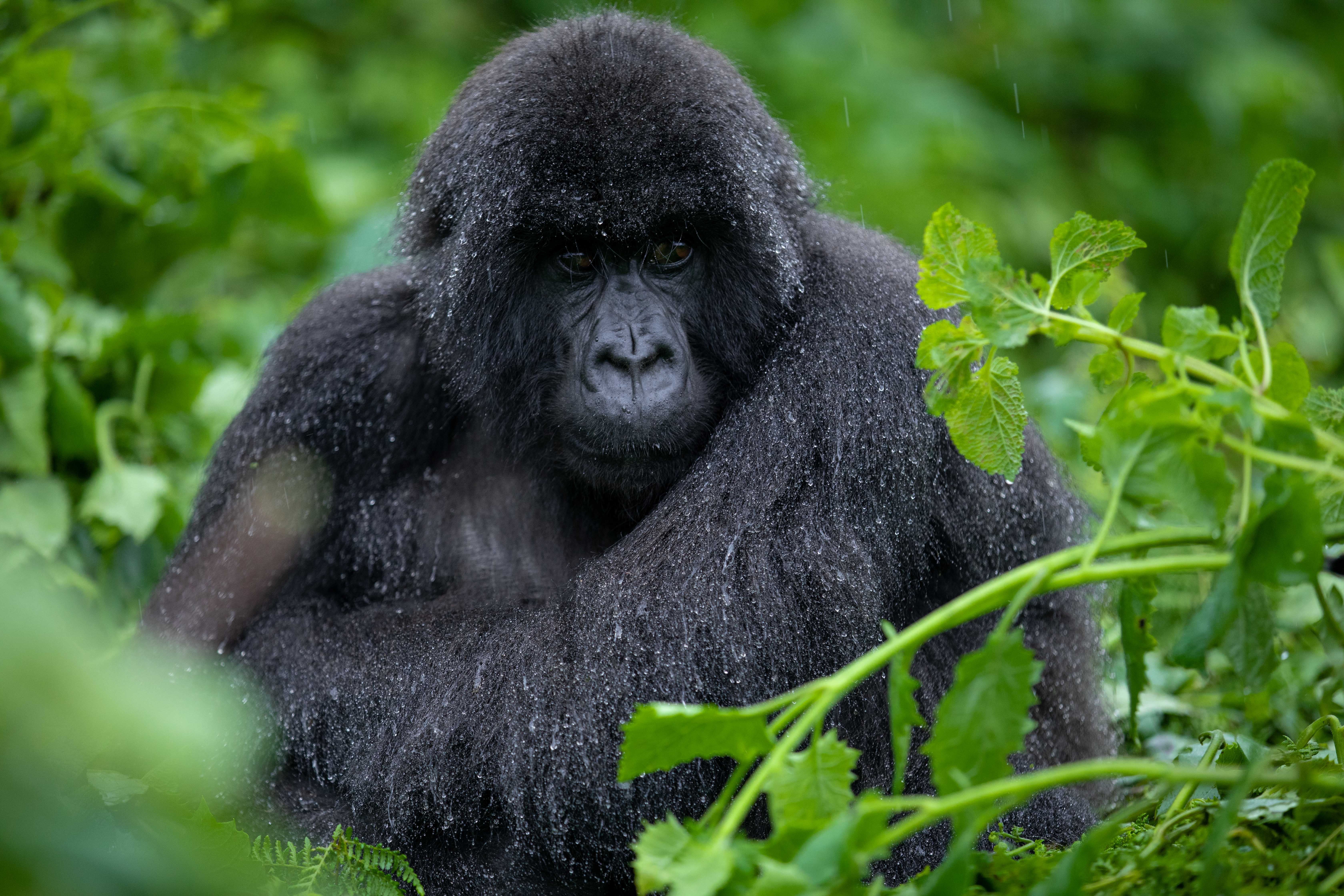
Virunga mountain park in northwestern Rwanda, protecting gorilla habitat and Dian Fossey's research landscape.
Volcanoes National Park in northwestern Rwanda is one of the most important conservation areas in Africa — the home of the mountain gorilla, the subject of Dian Fossey's 18-year study, and one of the few places on earth where an encounter with a great ape in the wild is accessible, if expensive, to any traveller willing to make the journey. The park protects the Rwandan slopes of the Virunga Mountains, a chain of eight volcanoes straddling the borders of Rwanda, the Democratic Republic of Congo, and Uganda. The volcanic peaks visible from the park headquarters at Kinigi — Karisimbi, Bisoke, Muhabura, Gahinga, and Sabyinyo — form a green wall that changes colour from dark jungle to bare volcanic rock as you look upward.
The mountain gorilla population across the Virungas now stands at around 600 individuals (out of a worldwide total of around 1,000), split into about 40 habituated and non-habituated families across the three countries. In Volcanoes National Park, twelve gorilla families are habituated for trekking, each visited by a single group of eight trekkers per day. The experience — spending one hour with a gorilla family in the forest, watching the silverback eat nettles and the infants tumble over each other in the undergrowth — is extraordinary. Gorilla trekking is the primary reason to visit, and the permit cost (US$1,500 in 2024) reflects the conservation value, the exclusivity, and, frankly, the demand.
The park is more than gorillas. Mount Bisoke offers an excellent full-day summit hike to a spectacular crater lake. Golden monkey trekking is cheaper and more acrobatic — a different and thoroughly enjoyable experience. The Karisoke Research Center site, where Fossey conducted her work and is buried, is accessible on a special hike. And the park's bamboo forest, through which you approach the gorilla families, is beautiful in its own right — cool, green, and densely alive.
Most visitors base themselves in the town of Musanze (formerly Ruhengeri), about 12km from the park headquarters at Kinigi. The journey from Kigali is around two and a half hours on a well-maintained road.
Guide
Getting There
Volcanoes National Park is reached from Musanze, 12km from the park headquarters at Kinigi. Musanze is 2.5 hours from Kigali by road on a well-paved highway through Rwanda's northern highlands. Both public minibuses and private vehicles make this journey; most organised tour operators include transport in their package.
The nearest international airport is Kigali International Airport (KGL). Flights from Europe, the Middle East, and East African hubs (Nairobi, Addis Ababa, Johannesburg) serve Kigali. There are no scheduled domestic flights between Kigali and Musanze — the road trip is the standard option. Private charter helicopter transfers from Kigali to a landing site near Musanze are available but very expensive.
From Kigali, most tour operators offer day trips to the gorillas, which is technically possible but exhausting — a full day of driving plus a demanding trek. The more comfortable option is to stay at least one night in Musanze before the trek. Several lodges are located within the park or on its boundary, ranging from basic guesthouses to high-end safari camps.
Uganda borders Rwanda's north; the border crossing at Katuna/Gatuna connects to Kabale and the road to Bwindi Impenetrable Forest, where Uganda's mountain gorilla trekking is centred. A combined Rwanda–Uganda gorilla itinerary, staying a night in each country, is a popular circuit for dedicated wildlife travellers.
Guide
When to Go
Volcanoes National Park is open year-round, and gorilla trekking is possible in every month. Gorillas live in the forest regardless of the weather, and finding them is the rangers' job, not yours. The main considerations are weather, trail condition, and permit availability.
June to September is the long dry season — the best conditions for trekking, with drier forest floors, clearer summit views, and lower risk of being soaked to the skin. This is the peak tourist season for Rwanda generally, and gorilla permits sell out furthest in advance during July and August.
December to February is the short dry season — a second good window with fewer visitors than the June–September peak. Permit availability is generally better.
March to May is the long rainy season — the trails are muddy and the forest wet, but the vegetation is lush and photography can be atmospheric. Permits are easier to obtain. The gorilla trekking is entirely viable; you will just get wet.
October to November is the short rainy season. Conditions are similar to March–May. Some of the high-altitude hikes (Bisoke, Karisimbi) are more challenging in the rain.
Book gorilla trekking permits as far in advance as possible through the Rwanda Development Board. The number of permits per family per day is fixed at eight; with twelve habituated families, that is 96 permits per day in total. They sell out months ahead in peak season.