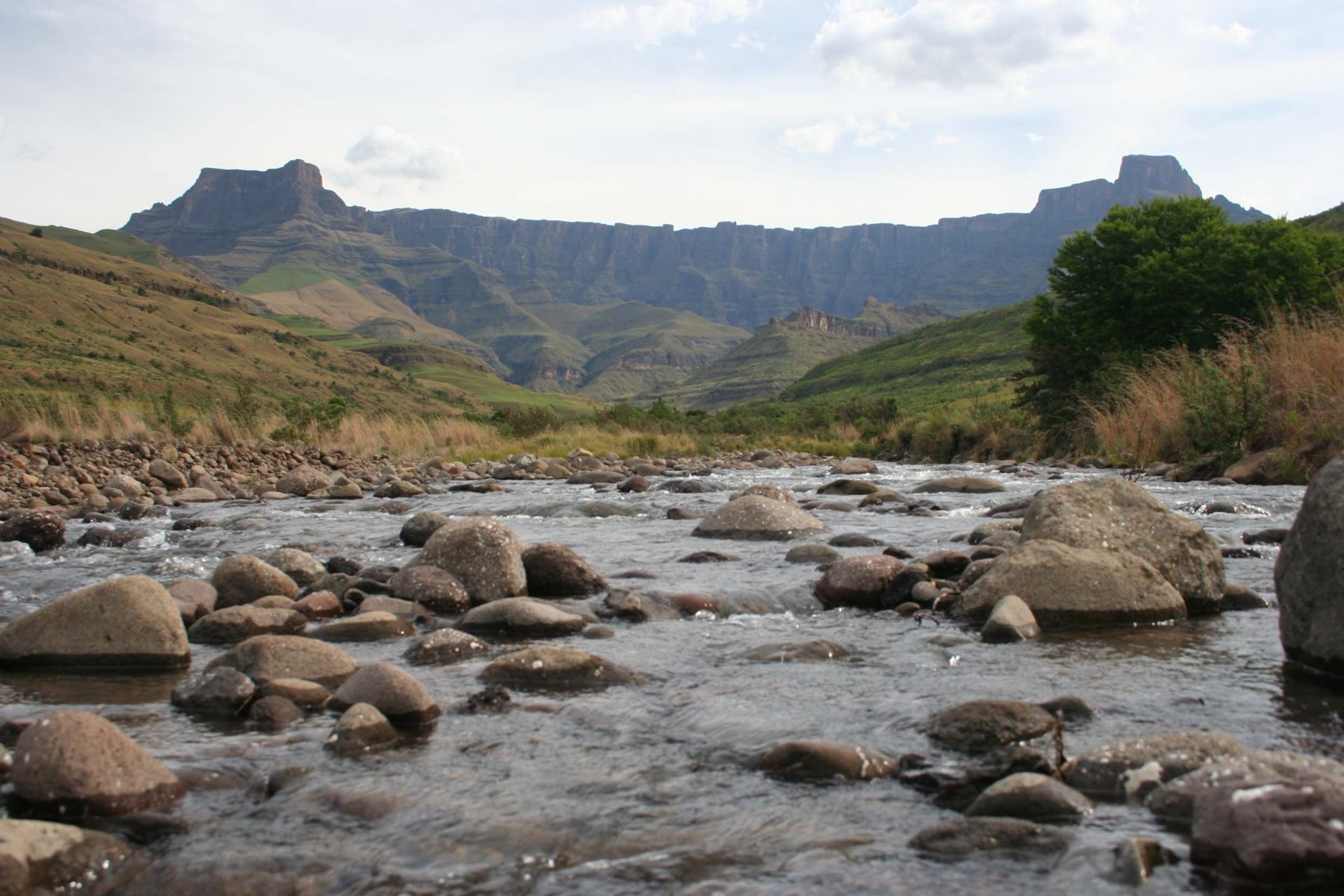
Northern Drakensberg
©
Northern Drakensberg

Northern Drakensberg

High Drakensberg mountain region of basalt escarpments, Tugela Falls, and the Amphitheatre above Royal Natal

The Northern Drakensberg is the highest and most dramatic section of the Drakensberg range, rising to over 3,000m along the escarpment that forms the border between KwaZulu-Natal and the mountain kingdom of Lesotho. The Zulu name is Ukhahlamba — "Barrier of Spears." The basalt peaks divide the watershed: rain falling west flows towards the Atlantic, while on the eastern side it tumbles down frequently vertical slopes into KwaZulu-Natal, towards the Indian Ocean.

The Tugela Falls, the second highest waterfall in the world, plunges 950m off the Mont-aux-Sources plateau. The Amphitheatre — the semicircular cliff face above Royal Natal National Park — is the most photographed feature of the range, an extraordinary wall of rock that dominates the horizon. In winter the escarpment is regularly covered in snow, and the falls sometimes freeze solid.

The Northern Drakensberg contains the Natal Drakensberg Park, a serious wilderness area. Hikers regularly encounter bushbuck, eland, mountain reedbuck, and baboons; lammergeier (bearded vultures) soar overhead. Spring brings carpets of wildflowers, autumn fills the lower slopes with cosmos. There are 24 snake species here — not all of them will move aside for you.

The mountains also hold thousands of San rock painting sites, the legacy of people who lived here for millennia. The oldest paintings date back about 800 years; the finest were produced between 200 and 400 years ago. The Mnweni area to the south of Royal Natal is the wildest and least-visited part of the Northern Berg, accessible only on foot and offering multi-day traverses into Lesotho.

The Northern Drakensberg consists of two main areas: - Mont-aux-Sources, Royal Natal National Park, the Amphitheatre, Rugged Glen Nature Reserve - Singati Valley, Ifidi, Mnweni and Ntonjelana valleys, the Mnweni cutback, Mponjwane, the Saddle

Guide

Things to Do

The Northern Drakensberg is primarily a hiking and wilderness destination. The Amphitheatre and Tugela Falls are the headline attractions, reachable on day hikes from Royal Natal National Park. Serious multi-day routes cross the escarpment into Lesotho, and the Mnweni area gives access to the high peaks with fewer visitors than the more developed sections of the range.

San rock paintings are found throughout the area. The best sites require a short walk and, in most cases, a guide arranged through the park. The views from the escarpment — across the lowveld of KwaZulu-Natal on one side, the vast plateau of Lesotho on the other — are reason enough to be here.

Guide

When to Go

The Northern Drakensberg can be visited year-round, but the experience varies significantly by season.

Winter (June–August) is the most popular time for serious hiking. Days are clear, cool, and dry. Nights on the escarpment can drop below freezing and snow is common on the high peaks. The Tugela Falls sometimes freeze. Visibility is exceptional and the trails are generally dry. Accommodation books out well in advance for this period, particularly July school holidays.

Summer (October–March) brings the rains. Mornings are often clear, but thunderstorms build rapidly over the escarpment from early afternoon — often explosive electrical storms. Flash flooding can close gorge trails. That said, the mountains are green, wildflowers are abundant, and there are far fewer hikers. Start every day hike very early and be off exposed ridges by midday.

Spring (September–October) and autumn (April–May) offer the best of both: stable weather, clear skies, and moderate temperatures. These are the sweetest months in the Berg.