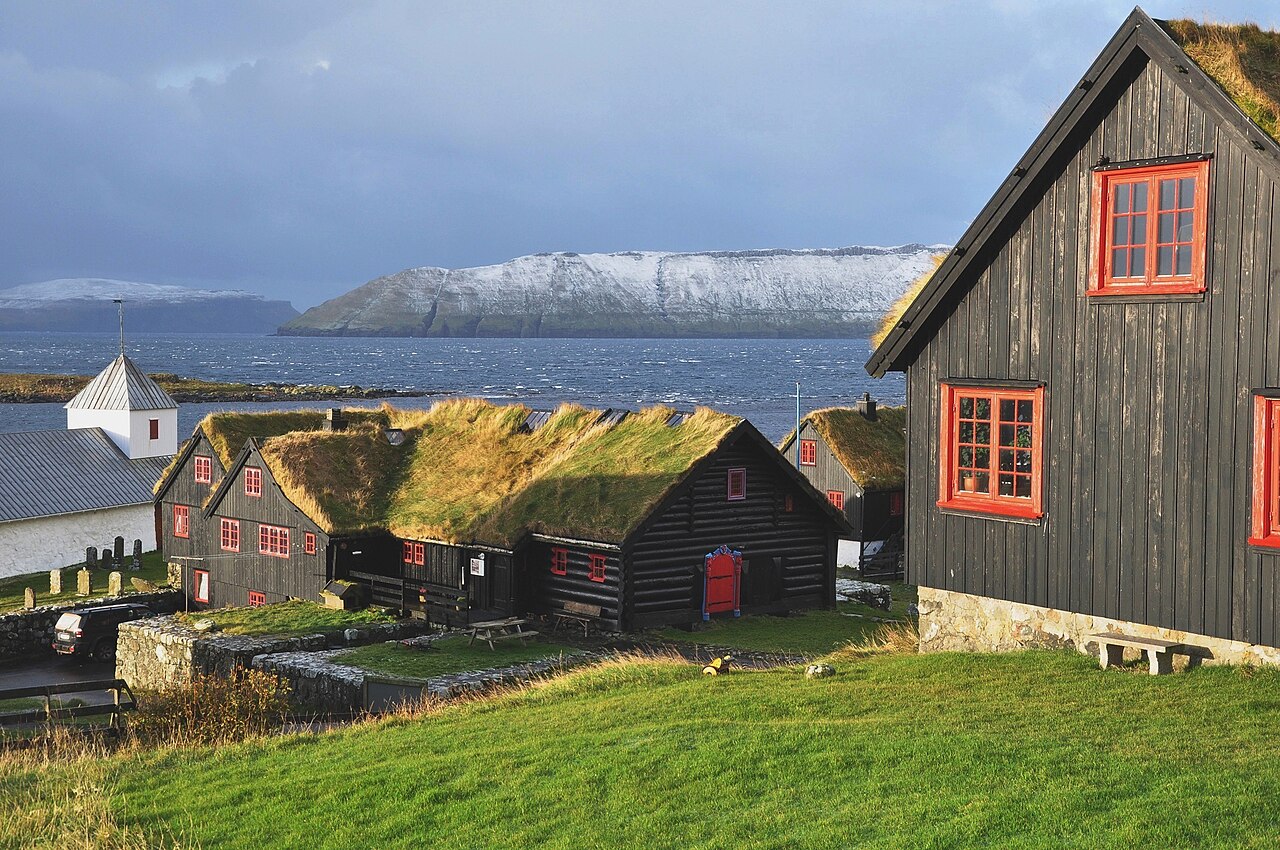
Kirkjubour was the medieval capital of the Faroe Islands, the seat of its bishop and a place of some importance in the Norse world. Today it's a small village on the southwest coast of Streymoy with remarkable views across the sound to the islands of Sandoy, Hestur, and Koltur, and beyond to Vagar with its airport.
The centrepiece is the ruined Magnus Cathedral, begun in the 13th century and never finished — it never had a roof. After centuries of open-air exposure, restoration work is finally under way, and the ruin has been covered with a large protective structure while it slowly dries out. Beside it stands Saint Olav's Church, which dates to the 12th century in origin and is still in regular use — the oldest functioning church in the islands. Its interior once held finely carved pew ends that were taken to Copenhagen and are now in the national museum in Torshavn; the church itself has plainer woodwork today.
The Kirkjubøargarður farmhouse next door is claimed to be the oldest continuously inhabited wooden building in the world, with parts dating to the 11th century. The Patursson family has lived here since 1550 and opens it to visitors in summer. The whole site is compact and can be seen in two to three hours, but it is one of the most historically charged spots in the Faroes.