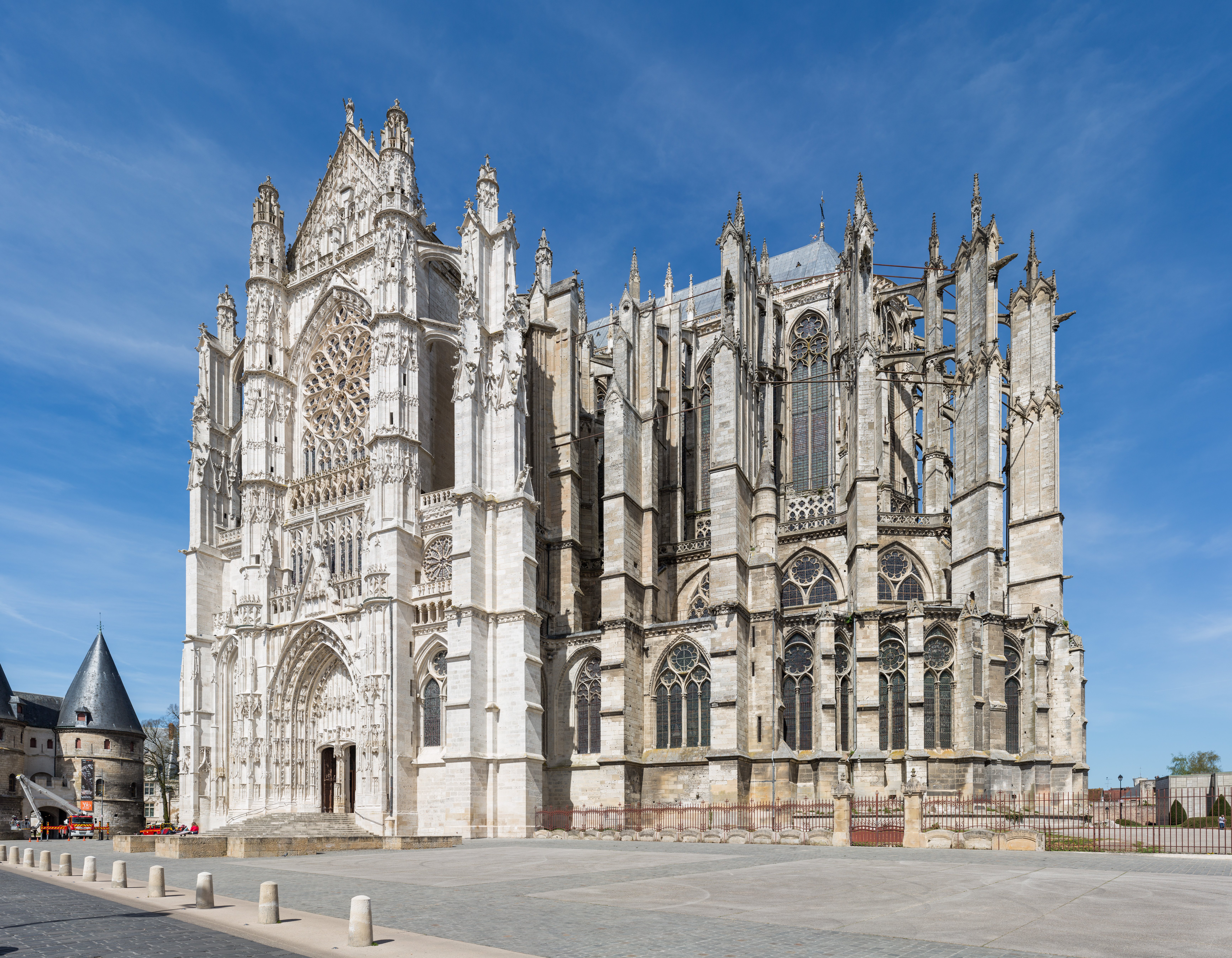
Most visitors arrive in Beauvais by budget airline and leave on the next bus to Paris, never quite intending to stop. That's a mistake. The city has one genuinely extraordinary thing — the Cathédrale Saint-Pierre de Beauvais — and it is among the most remarkable buildings in France.
The cathedral was the most audacious architectural gamble of the Gothic age. When construction began in earnest in 1225, the builders aimed to raise the tallest church in Christendom. The choir, completed in 1272, reached 48.5 metres at the vault — still the highest Gothic choir ever built. Then in 1284, the choir vaulting partially collapsed. The builders reinforced it and tried again, adding extra piers and flying buttresses that now crowd around the exterior like a forest of stone. Progress stalled, money dried up, and the nave was never begun. What stands today is a transept, a choir, and an apse — a great church missing its body. The visual effect, when you step inside, is vertiginous: all that height with no counterbalancing length, the proportions of a skyscraper compressed into something that fits your eye all at once. Go on a sunny morning when the light comes through the south transept rose window.
Beyond the cathedral, Beauvais is a pleasant small city in the former Picardy region, prefecture of the Oise department. The medieval quarter around the cathedral survived the devastating German bombing of June 1940, and those streets — the Place Jeanne Hachette, the old Bishop's Palace now housing the Departmental Museum — still read as a pre-war French town. The rest of the city centre is postwar reconstruction, functional but unremarkable. Beauvais has a long tradition in tapestry-making: the Manufacture Royale de Beauvais, founded by Louis XIV in 1664, rivalled the Gobelins in Paris for three centuries. Textiles remain part of the local identity, though the manufacture itself no longer operates in the city.
The Saturday market in and around the Place Jeanne Hachette fills the square with stalls and gives the city its most animated face. If you have a few hours between your Ryanair flight and the Paris bus, the cathedral alone justifies walking up from the station — and there is usually time for lunch too.