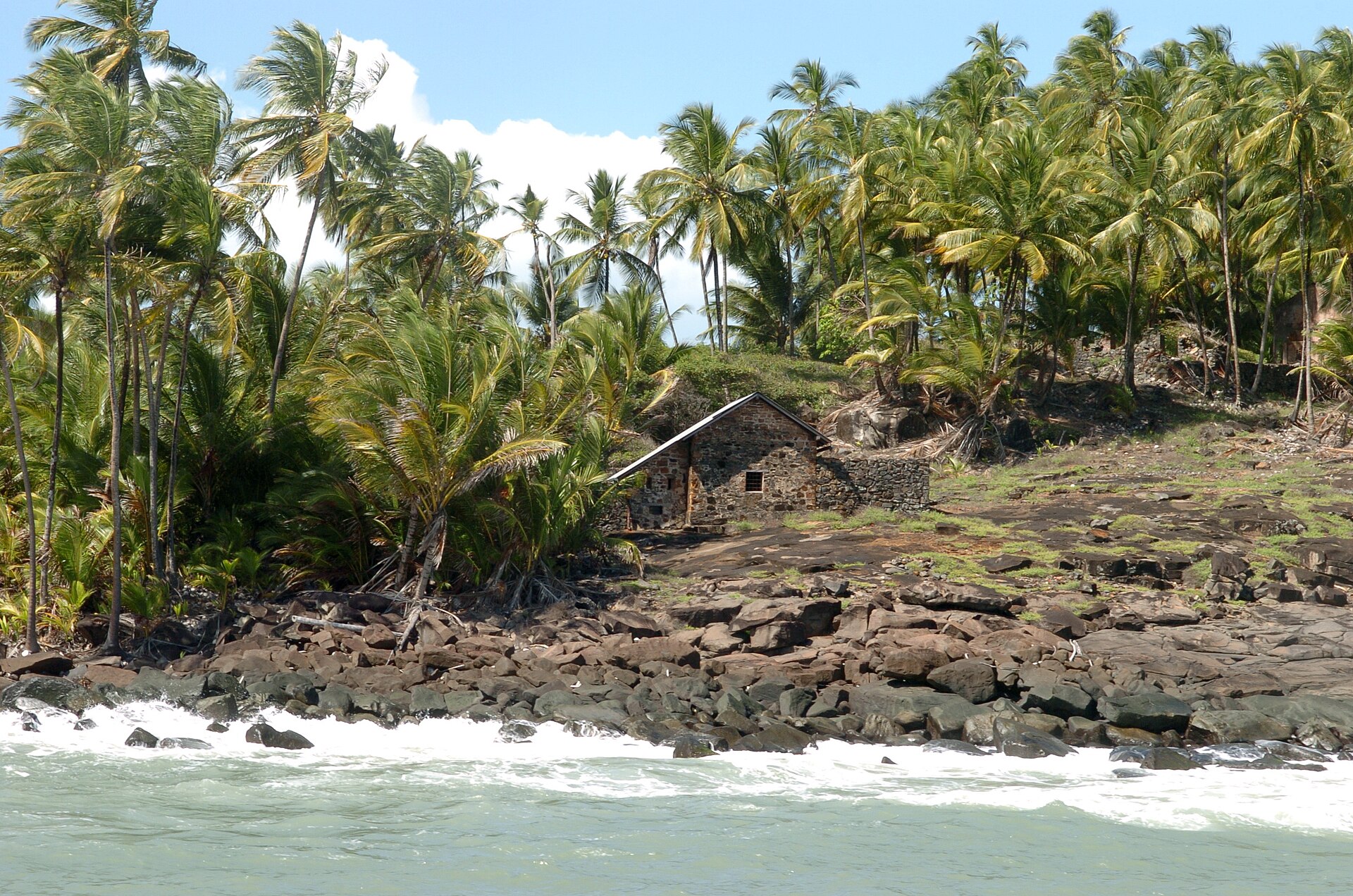
Îles du Salut
©
Îles du Salut

Îles du Salut

Three islands off Kourou that held France's most infamous penal colony, including Devil's Island

The Salvation Islands — three small volcanic outcrops roughly 14 km north of Kourou — are among the most visited sites in French Guiana, and for good reason. They were the heart of France's penal colony system from 1852 to 1953, and the ruins that remain are atmospheric enough to justify the ferry crossing on their own. Add the wildlife (howler monkeys, agoutis, sea turtles nesting on the beaches) and the archipelago becomes genuinely exceptional.

The main island is Île Royale, where the ferry docks. This was the administrative centre of the penal colony — there's a restored chapel, a former warder's mess that now operates as a hotel and restaurant, and various prison structures slowly being reclaimed by the jungle. The island is large enough that you can spend several hours walking the trails. Île Saint-Joseph is a short pirogue ride away and contains the most evocative ruin on the archipelago: the solitary confinement wing, the réclusion, where cells sit open to the sky in near-total silence, vines threading through the bars. It is a genuinely unsettling place.

Île du Diable (Devil's Island proper) is visible from Île Royale but not open to visitors — access is permanently restricted. The island's association with Alfred Dreyfus and Henri Charrière's Papillon has made it famous far beyond its size.

Boats depart from the dock at Vieux Bourg in Kourou, typically in the morning. The crossing takes about 45 minutes. Bring water, sun protection, and cash — the on-island restaurant accepts only euros, and there are no ATMs on the islands.

Just off the coast of Kourou are three islands: Ile Royale, Ile Saint-Joseph, and Ile du Diable (Devil's Island). Together they are known as the Iles du Salut (Salvation Islands).

France operated a penal colony here from 1852 to 1953, incarcerating over 80,000 prisoners in total. The most infamous was Devil's Island itself, reserved for political prisoners. Alfred Dreyfus, the French army officer falsely convicted of treason in the 1890s, was held here. Henri Charrière, whose memoir Papillon describes repeated escape attempts, was another resident — though historians dispute some of his account.

Today the islands are overgrown with tropical vegetation and populated by howler monkeys, agoutis, and seabirds. The ruins of the prison buildings remain largely intact and make for a haunting visit. Ile Royale is the largest and most visited, with a small auberge, restaurant, and camping facilities. Ile Saint-Joseph has the solitary confinement cells and is particularly atmospheric. Ile du Diable itself, where Dreyfus was held, cannot be visited.

Boats depart from Kourou's Vieux Bourg port (end of Avenue Charles de Gaulle) in the mornings and return in the late afternoon. The crossing takes about 30 minutes. Book ahead during the July–November dry season and French school holidays.

Guide

Activities

There is no operator on the islands: everything leaves from Kourou, twenty minutes away across the water, and the choice is between the scheduled ferry, a catamaran under sail, and a chartered fast boat.

The ferry is the cheapest and the most reliable; the catamarans make more of the crossing itself and usually include a circuit of Île Royale with the history told on the way. Whichever you take, the day is fixed by the boat — out in the morning, back in the late afternoon — unless you are staying the night on Royale.

Guide

Bars and Cafes

Beyond the auberge bar there is essentially nothing. The islands have no shops, no kiosks, and no street food. If you want anything other than what the auberge provides, bring it with you from Kourou. A cold beer from the bar after a day of exploring ruins in the tropical heat is, however, one of the better small pleasures the islands offer.

Guide

Books

Papillon by Henri Charrière (1969) — The most famous account of the penal colony, written by a convict who claimed to have escaped multiple times. Compelling reading, though historians have since questioned how much of it is memoir and how much is embellishment. Read it for the atmosphere rather than the facts.

Devil's Island: Colony of the Damned by Alexander Miles — A rigorous history of the penal colony from its founding to its closure, drawing on French colonial records and prisoner testimonies. More reliable than Papillon as a guide to what life on the islands was actually like.

The Dreyfus Affair by Piers Paul Read (2012) — The full story of Alfred Dreyfus, the Jewish army officer falsely convicted of treason and exiled to Devil's Island, whose case became a defining moment in French political history. Essential background for understanding the most famous prisoner the islands held.

South America on a Shoestring (Lonely Planet) or a comparable French Guiana travel guide — For practical context on getting to and around French Guiana more broadly, including Cayenne, Kourou, and the interior.

Guide

Day Trips

Kourou — The town from which you reach the islands is itself worth a few hours. The Guiana Space Centre (Centre Spatial Guyanais) is one of the world's primary rocket launch sites, operated by ESA and the French space agency CNES. Tours of the facility run on most weekdays and can be booked in advance; the visitor centre has exhibits on the Ariane, Soyuz, and Vega programmes. A launch, if you happen to be in French Guiana when one is scheduled, is an unforgettable spectacle visible from the town and the surrounding coast.

Cayenne — The capital of French Guiana, an hour's drive from Kourou, has a covered market full of Creole, Hmong, and Amerindian produce, colonial-era architecture around Place des Palmistes, and the best range of restaurants in the territory. The city has a distinctive character unlike anywhere else in South America — a creolised French Caribbean culture that takes some time to get a feel for.

Sinnamary and Iracoubo — Heading north from Kourou along the coast road, the small town of Sinnamary sits at the mouth of the Sinnamary river and has good birdwatching in the mangrove lagoons. A further 30 kilometres inland, the church at Iracoubo contains extraordinary murals painted in the late nineteenth century by a convict transported from the penal colony — a strange and vivid piece of art hidden in an unlikely corner of the territory.

Guide

Eating Out

The Auberge des Iles du Salut on Ile Royale is the only place to eat on the islands. It serves a simple menu of French Guianese food — rice, fish, grilled meats — and cold drinks, which are very welcome after a morning of walking in the heat. Lunch tends to be the main service.

It is advisable to book ahead, especially in the dry season and during school holidays when the islands can be busy. If you are making a day trip, confirm your lunch reservation when you book your boat ticket. Bring snacks and water regardless — portions are generous but the restaurant is not always open between meals.

Guide

Getting Around

Ile Royale is entirely walkable. A network of stone and dirt paths connects the dock, the auberge, the museum, the chapel, the cemetery, and the various prison buildings. A leisurely circuit of the island takes two to three hours, longer if you linger at the ruins or wait for the monkeys to come close.

A small boat shuttles between Ile Royale and Ile Saint-Joseph; the fare is paid separately from your main crossing ticket. The inter-island crossing is short — ten minutes or so — but can be choppy. Ile du Diable, the island where Dreyfus was actually held, is not accessible to visitors.

Allow a full day if you want to see both main islands properly. The afternoon return boat waits for no one, so keep an eye on the time.

Guide

Getting There

Boats to the Iles du Salut leave from Kourou's Vieux Bourg port, at the end of Avenue Charles de Gaulle. Departures are in the morning, typically around 8am, with the crossing to Ile Royale taking about 30 minutes. Return boats leave in the late afternoon. Schedules vary by season and operator; check locally for current timings.

Book ahead during the July–November dry season and during French school holidays — the boats fill up and last-minute tickets can be hard to come by. In the low season you may be able to turn up on the day, but calling ahead is still sensible.

Occasional day-trip tours operate from Cayenne, combining road transfer to Kourou with the boat crossing. These can be convenient if you are based in the capital. There is no overnight ferry service; the only way to stay on the islands is to be on one of the morning boats and pre-book accommodation at the auberge.

Guide

Things To Do

The Iles du Salut offer a singular experience: wandering through the crumbling ruins of one of the world's most notorious penal colonies, surrounded by dense jungle, howler monkeys, and nesting seabirds. There are no beaches to lounge on and no tourist infrastructure beyond the auberge — the draw is entirely the atmosphere and history.

Ile Royale is the hub, with the largest concentration of ruins, the small museum, and the auberge. Ile Saint-Joseph is the more unsettling island, its solitary confinement cells half-flooded and overtaken by roots and vines. Budget a full day for both.

Guide

When To Go

The dry season, roughly July to November, brings calmer seas and makes the crossing from Kourou considerably more reliable and comfortable. This is the recommended period for a visit, though it coincides with French school holidays, which means the islands can be busy and accommodation at the auberge fills up quickly — book well in advance.

The rainy season (December to June) brings rougher seas and the boat crossings can be unpleasant or cancelled altogether if conditions are bad. On the other hand, visitor numbers drop sharply and the islands feel more remote and atmospheric. If you have flexibility in your schedule and are comfortable with the possibility of a cancelled crossing, an out-of-season visit has its rewards.

Sea conditions can cancel boats at any time of year. Always have a contingency plan for your onward travel from Kourou, and do not rely on catching the return boat on a fixed deadline.