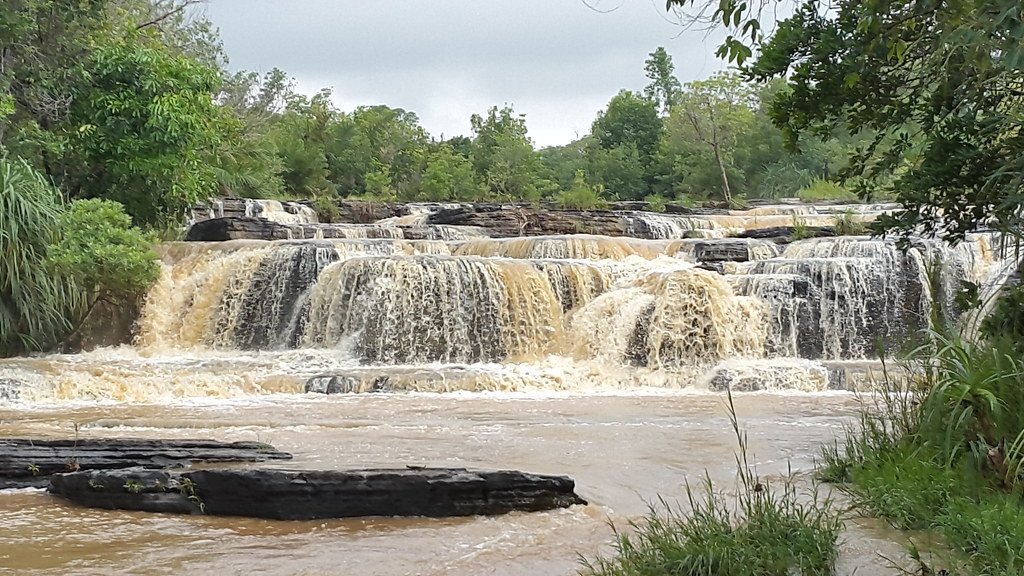
Southwestern Burkina Faso city surrounded by waterfalls, rock domes, and greener Sahel scenery.
Banfora is a small city in southwestern Burkina Faso, and it is surrounded by the best natural scenery in the country. The Cascades de Karfiguéla, about 12 km from town, are a series of waterfalls tumbling through lush vegetation — a rare sight in this part of the Sahel, and a popular swimming spot. The Dômes de Fabédougou, bizarre rock formations eroded into rounded pillars and mushroom shapes, are nearby and well worth the detour.
Lac de Tengréla, a shallow lake about 7 km west of town, has a resident population of hippos that can be observed from pirogues — one of the more surreal wildlife experiences in West Africa. The surrounding area is sugarcane country, greener and more fertile than the arid north, with mango trees and baobabs lining the roads. Further west, near the Mali border, the Pics de Sindou are a long ridge of needle-shaped sandstone pinnacles — a dramatic full-day excursion.
Banfora is reached by train or bus from Ouagadougou (about 8 hours) or from Bobo-Dioulasso (about 2 hours). The town itself is quiet and pleasant, with a busy Saturday market, good street food, and a couple of decent places to stay.
Guide
Eating Out
Banfora eats well for a small town. The local cuisine is solidly Burkinabé — riz gras (rice cooked in tomato and fish broth), poulet bicyclette (the scrawny free-range chicken grilled over wood), tô (millet porridge) with peanut sauce. The mangoes in season are extraordinary, and the local bissap (hibiscus juice) is a useful relief from the heat.
The maquis along the main street do the cheapest food — Maquis Le Refuge and Maquis Wend Konta are reliable. For something more polished, the Hotel Comoé and the Hôtel La Canne à Sucre both have decent restaurants open to non-guests, with international menus alongside the local options. The cheapest street food is at the night market that sets up after dark around the bus station.
Guide
Getting Around
The town itself is small and easily walked. For the surrounding attractions — the Cascades, the Dômes, Lac de Tengréla — the easiest options are a motorbike or a hired guide with car.
Mopeds are easy to hire at the bigger hotels in town for a modest daily rate. The road to the Cascades is partly tarred and partly hard-packed earth, manageable for a beginner. For Sindou Peaks (60 km west) you really need a car — a half-day taxi hire from town will cover the cost.
A few local guides offer day tours combining the three closer attractions for a reasonable price, usually with their own moped or 4x4. Ask at any of the bigger hotels; the bush guides at the Hotel Comoé and the Hôtel La Canne à Sucre are reliable.
Guide
Getting There
Banfora is on the main rail line and the main road between Ouagadougou and Abidjan — most travellers come either by train from Ouagadougou (around 8 hours) or by bus from Bobo-Dioulasso (about 90 minutes on a good day). Sitarail still runs a slow service between Ouaga and Abidjan that stops in Banfora; check current schedules in town, as the line is sometimes interrupted.
Buses leave Bobo-Dioulasso for Banfora roughly every hour from the main gare routière. Several companies (TCV, Rakieta, STAF) cover the route. The fare is a few thousand CFA. Bush taxis are an option but slower and less comfortable.
Banfora has a small airstrip but no scheduled flights. The nearest international airport is Bobo-Dioulasso, with onward connections via Ouagadougou.
Guide
When to Go
The best time to visit Banfora is November to February, when the harmattan season brings cooler days, clear skies, and dry roads. The harmattan wind blows from the Sahara, sometimes carrying red dust from the north, but temperatures are manageable — 25 to 30°C in the day, cool at night. This is the easiest time for the excursions to the Pics de Sindou and the Dômes de Fabédougou.
The rainy season runs from June to October. The Cascades de Karfiguéla are most spectacular in this period, with the full volume of the Komoé crashing over the rocks, and the surrounding countryside is lush and green. Roads to the Pics de Sindou and some of the smaller waterfalls can become difficult. March to May is the hottest period — temperatures regularly reach 38–40°C — and best avoided unless you have no alternative.