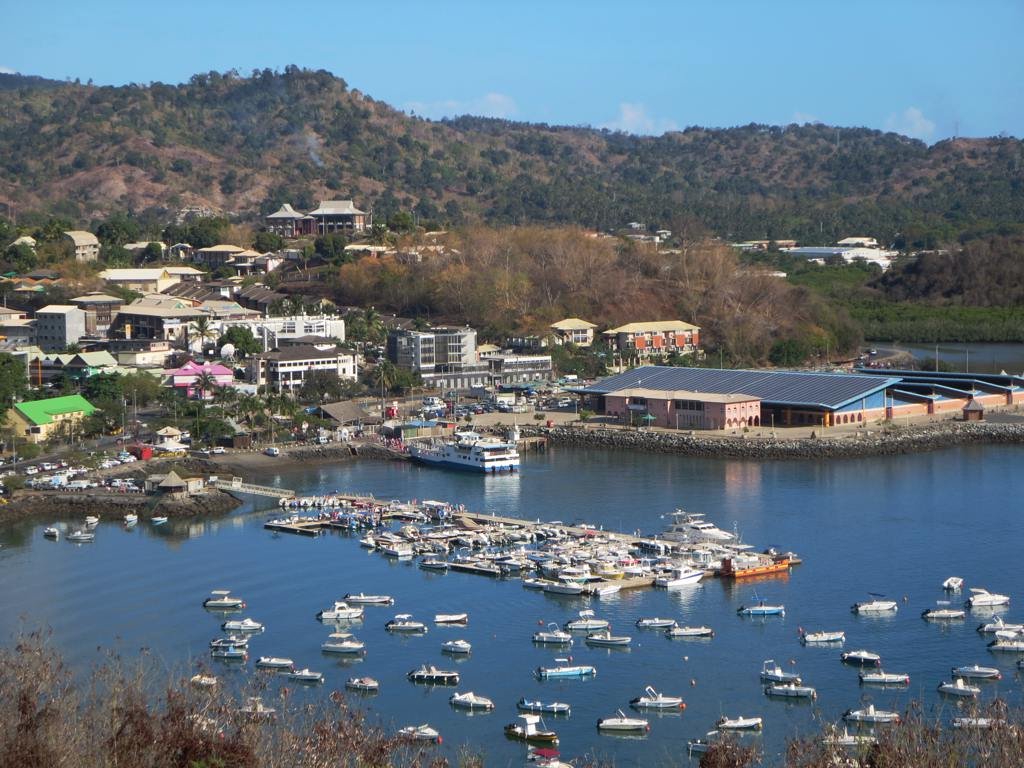
French island in the Comoros archipelago, where traditional villages sit beside a vast coral lagoon.
Mayotte is geographically part of the Comoros archipelago but politically part of France -- it voted to remain French when the other islands chose independence in 1974, and became a full French department in 2011. This creates a surreal contrast: European-standard roads and supermarkets sit alongside traditional villages and one of the most spectacular lagoons on earth.
The island consists of two parts, Grande-Terre and Petite-Terre, connected by a ferry. The main town, Mamoudzou, is on Grande-Terre. The administrative center, Dzaoudzi, sits on Petite-Terre alongside the airport.
Mayotte's lagoon is one of the largest in the world, covering more than 1,000 square kilometers and protected by a barrier reef over 160 kilometers long. The diving and snorkeling are outstanding -- the lagoon shelters sea turtles, dolphins, manta rays, and from July to October, humpback whales. This is one of the few places in the world where you can reliably swim with whale calves in shallow water. The beach at Plage de N'Gouja is the best base for marine wildlife encounters.
On land, Mount Bénara at 660 meters offers the island's best hiking through patches of intact rainforest. The island rewards slow travel -- the roads are good and two hours of driving covers most of Grande-Terre, but stopping in villages and following the smell of ylang-ylang through the hills takes considerably longer.
Because Mayotte is French territory, the visa requirements, currency (euro), and infrastructure are completely different from the rest of the Comoros. Flights connect Mayotte with Reunion, Paris, and Moroni on Ngazidja. It is significantly more expensive than the other Comoros islands but also much easier to navigate.
Guide
Getting Around
Getting around Mayotte requires some planning, as public transport is limited and the island's road network, while in good condition, doesn't lend itself to walking between sights.
Taxi-brousse (shared taxi) is the main form of public transport. These minibuses run between towns on Grande-Terre, are cheap, and run frequently during the day. You flag them down on the road. However, services thin out in the late afternoon and are unreliable on Sundays.
Car rental is the most practical option for independent travelers. Roads are well-surfaced by African standards and driving is on the right (French rules apply). Petrol is available throughout the island. Rental agencies are based at the Dzaoudzi-Pamandzi airport and in Mamoudzou.
The ferry between Mamoudzou (Grande-Terre) and Dzaoudzi (Petite-Terre) runs continuously throughout the day and takes about ten minutes. Fare is a couple of euros each way.
Water taxis can take you from Mamoudzou to various points along the lagoon and to offshore islets (îlots). Agree a price before departing. Some of the best snorkeling spots are only accessible by boat.
Guide
Getting There
Mayotte's airport is Dzaoudzi-Pamandzi International Airport on Petite-Terre.
From France, Air Austral and other carriers fly from Paris via Reunion, with a total journey time of around 12-14 hours including the connection. Direct flights from Paris are occasionally available. From Reunion, the flight to Mayotte takes about two hours.
From the Comoros, flights connect Mayotte with Moroni on Ngazidja. This is one of the most frequent routes in and out of Mayotte. Check current airlines and schedules, as operators change.
From East Africa, connections through Nairobi or Dar es Salaam are possible with one or two stops. From Madagascar, Air Madagascar has operated services to Mayotte, though schedules are irregular.
Because Mayotte is French territory, EU citizens do not need a visa. Other nationalities should check French visa requirements, which apply here. Note that a Comoros visa does not grant entry to Mayotte, and vice versa -- they are separate jurisdictions.
Guide
When to Go
Mayotte has two main seasons: a hot, wet season from November to April when temperatures reach 32°C and cyclones are possible, and a cooler, drier season from May to October when temperatures settle around 24-28°C and the sea is calmer.
May to October is the best time for diving and snorkeling — visibility is at its clearest and the lagoon is calmer. July to October is humpback whale season, when the lagoon fills with mothers and calves. This is the peak of peak season, and accommodation books up well in advance.
November to April is hotter and wetter, with afternoon downpours. The sea is rougher and visibility lower. From December to February, sea turtles nest on the beaches at N'Gouja and Saziley. Cyclone risk is real but most storms track south of Mayotte — check forecasts before traveling.
Ramadan significantly affects daily life on the island, as the majority of the population is Muslim. Many restaurants and businesses close during daylight hours.