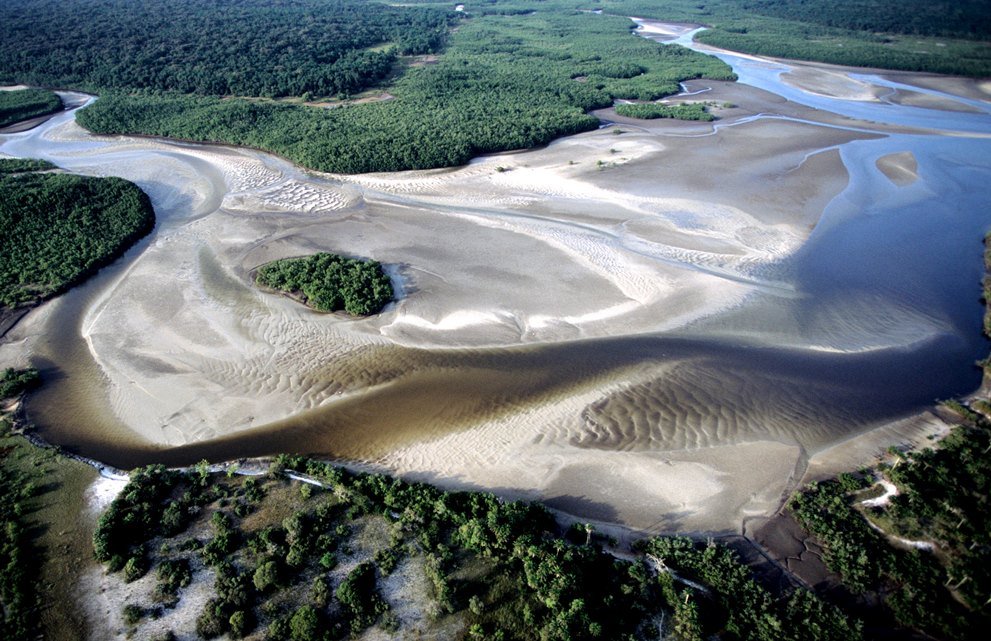
The Bijagos archipelago is the highlight of Guinea-Bissau and one of the most remarkable island groups in Africa. Eighty-eight islands, of which only about twenty are permanently inhabited, spread across the Atlantic off the coast. UNESCO declared it a Biosphere Reserve, and it is easy to see why: long white-sand beaches, dense palm forests, mangrove channels teeming with birdlife, and waters rich with fish.
The most famous residents are the saltwater hippos of Orango Island, Africa's only population of hippos that wade into the ocean. You can arrange boat trips to see them, though sightings depend on the season and on luck. The archipelago is also home to monkeys, sea turtles that nest on the beaches of Bubaque, and hundreds of bird species.
The indigenous Bijago people maintain a matriarchal society and deeply rooted spiritual traditions. Village life revolves around initiation ceremonies, sacred forests, and dances that mimic animal movements. Young men still undergo a seven-year initiation rite. Tourism has barely touched these traditions, and visitors who show respect are generally welcomed warmly.
Bubaque is the main island for visitors and the easiest to reach from Bissau. It has a handful of simple guesthouses and serves as the base for trips to other islands. The beaches at Bruce and Etikorete on Bubaque are beautiful. Rubane has a couple of upmarket eco-lodges. Orango is the place for hippo-watching.
Getting to the Bijagos takes some planning. A weekly ferry departs Bissau port on Fridays, taking about four hours to reach Bubaque, and returns on Sundays. During the dry season, Consulmar runs faster boats that take 90 minutes to two hours, costing around 30,000 CFA each way. Local pirogues are cheaper (around 3,000 CFA) but slow, overcrowded, and not recommended. Air Bijagos runs occasional flights for about 90,000 CFA each way. Moving between islands requires hiring a motorized canoe or catching one of the larger boats.
The best time to visit is during the dry season, from November to May. In the rainy season, boat services become irregular and some islands are difficult to reach.