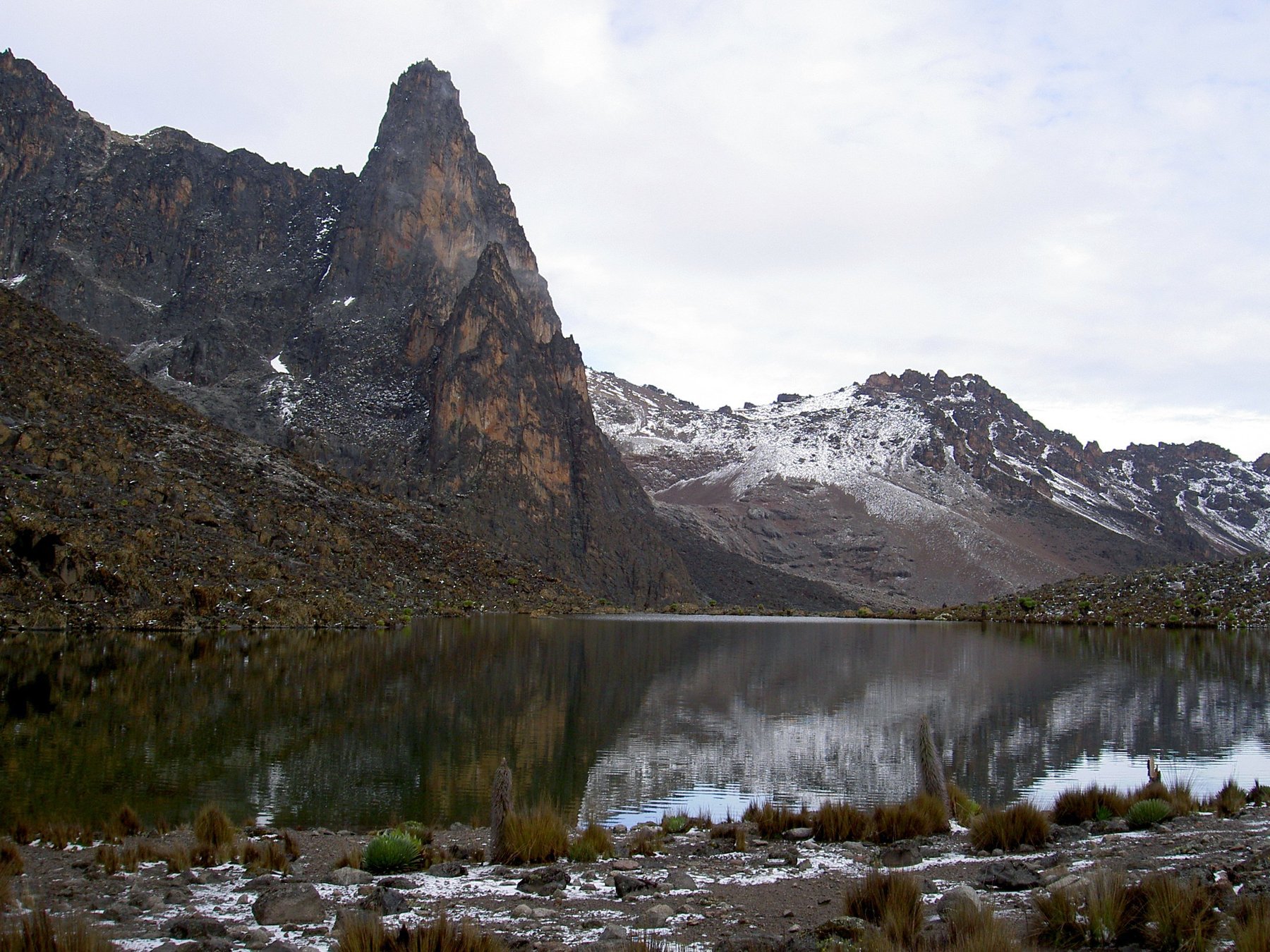
Mount Kenya, at 5,199 metres, is the second-highest peak in Africa, after Kilimanjaro across the border in Tanzania. Unlike Kili, it is a technical climb to its two summit peaks — Batian and Nelion — and only mountaineers reach them. But the third summit, Point Lenana at 4,985 metres, is a non-technical trek that anyone reasonably fit and acclimatised can do, and it is one of the great high-altitude walks in East Africa.
The mountain is a heavily eroded volcano, long extinct, ringed by equatorial rainforest on its lower slopes and surrounded by the Mount Kenya National Park. As you climb, the forest gives way to bamboo, then to high-altitude moorland of giant lobelias and senecios, then to the jagged rock and retreating glaciers of the summit zone. The three main routes up are the Naro Moru (the shortest and busiest, three or four days), the Sirimon (longer, gentler gradient, better views), and the Chogoria (the longest and generally considered the most beautiful — it passes through the dramatic Temple valley and past the Lake Ellis moorland). Most climbers go up one route and down another.
For the Kikuyu, Embu, and Meru peoples who live on its lower slopes, Mount Kenya is Kirinyaga — the home of Ngai, the creator. Many still face the mountain when they pray. The lower forests are also rich in wildlife: elephant, buffalo, leopard, and the rare bongo antelope all live here, and you can easily see them on the drive up to the park gates.
The climbing season is December to mid-February or July to September, avoiding the long rains (March–June) and short rains (October–November). Unlike on Kilimanjaro, you are not required to climb with a guide, but for anyone who isn't an experienced mountaineer it is sensible (and inexpensive) to hire at least a local guide and porter in Naro Moru, Nanyuki, or Chogoria. Altitude sickness is a real risk — take your time, drink plenty of water, and give yourself an acclimatisation day. The summit sunrise from Point Lenana, with Kilimanjaro visible 300 km to the south, is one of the most memorable things you can do in East Africa.