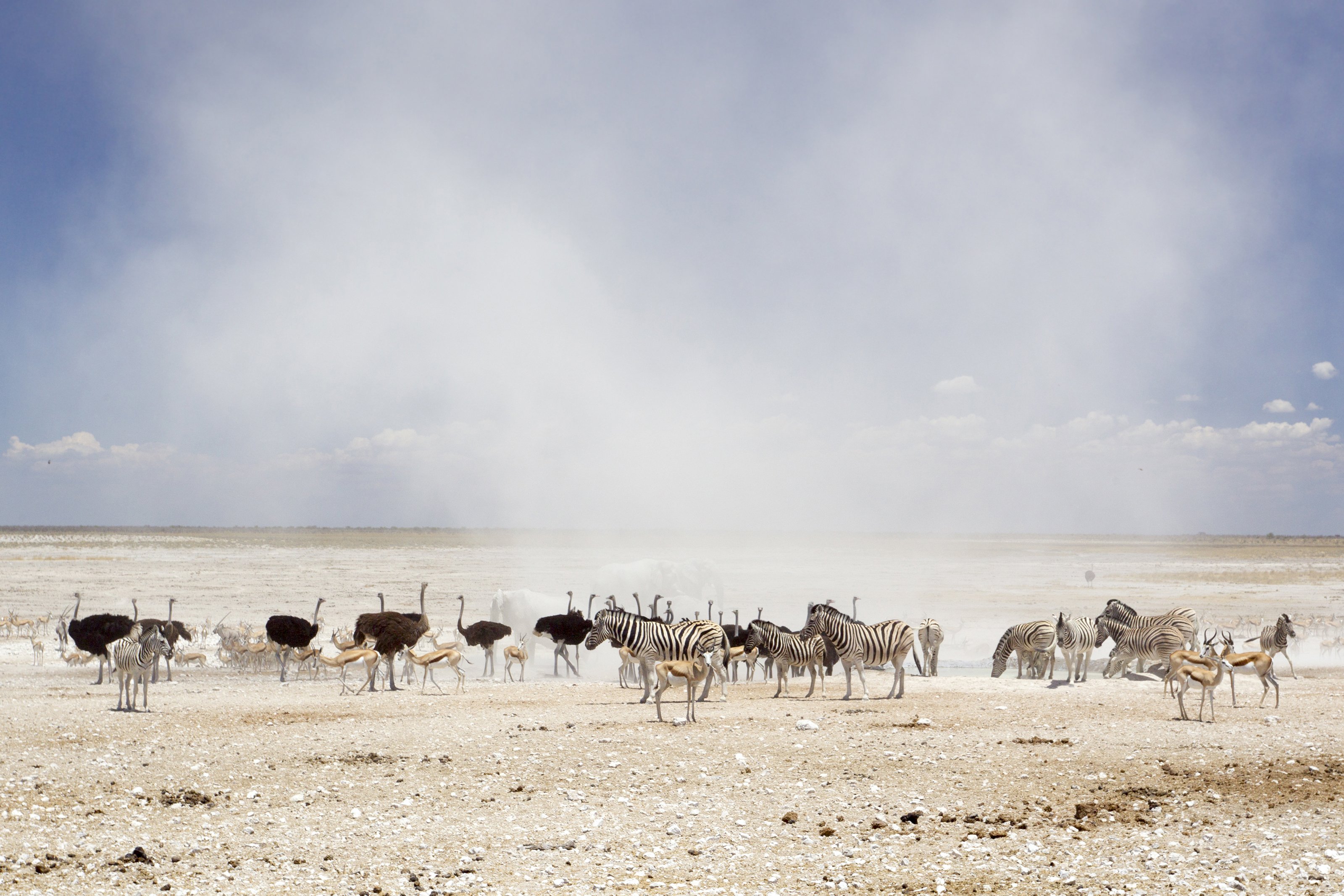
Etosha is one of Africa's great wildlife parks, and arguably the easiest on the continent in which to see large animals. The entire park centres on the Etosha Pan — a vast, flat saltpan covering roughly 5,000 square kilometres — and the animals come to you. In the dry season (May through October), every waterhole becomes a theatre: elephants, rhinos, lions, cheetahs, zebras, and dozens of antelope species converge on the same muddy pools within sight of your car. You don't need to track anything. You wait, and Africa arrives.
The pan itself is the remnant of a shallow lake that dried out thousands of years ago, leaving behind a white and shimmering expanse that can be seen from space. It appears lifeless, but the salt and mineral dust it releases in the wind feeds the surrounding grasslands. Most of the year it's too hostile even for flamingos, but in wet years, when rains fill the pan briefly, enormous flocks of pink gather on the horizon like a mirage.
The park is divided into accessible sections linked by gravel roads, with three main rest camps — Okaukuejo, Halali, and Namutoni — each with their own floodlit waterhole that operates through the night. Sitting at Okaukuejo's waterhole at 2am, watching rhinos arrive silently at the edge of the water, is one of those experiences that makes Namibia worth the journey. The park is well-run and self-drive friendly; no guide is required and the roads are manageable in a standard sedan outside the wet season.
Etosha shelters one of Africa's largest populations of black rhino — a genuine conservation success story in a species critically endangered elsewhere. The park is also one of the few places on the continent where you can reliably see lion and cheetah on the same day, and where the density of elephants, especially in September and October, can be extraordinary.