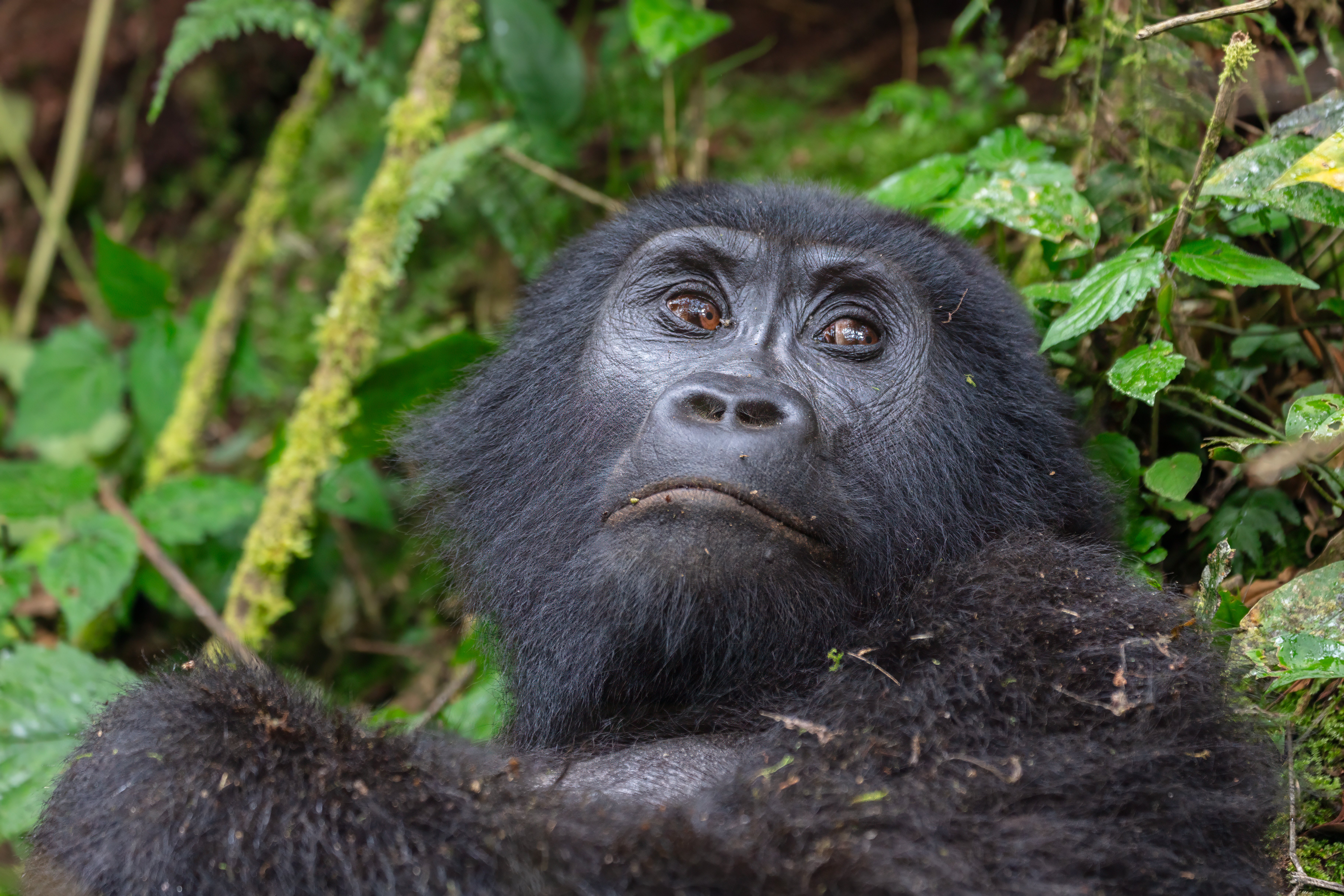
Bwindi is the reason many people come to Uganda. The forest shelters roughly half the world's remaining mountain gorillas — around 400 of the approximately 800 that still exist on earth — and a permit to spend one hour in the presence of a habituated gorilla family is, for many visitors, the single most powerful wildlife encounter of their lives. There is nothing quite like sitting in dense tropical forest with a silverback a few metres away, making eye contact, and understanding that you are in its home.
The forest itself is ancient. Bwindi survived the ice ages that stripped much of East Africa bare roughly 18,000 years ago, maintaining a refuge for species that disappeared elsewhere. The result is extraordinary biodiversity: over 200 species of trees, more than 350 bird species, 120 mammals, and over 200 species of butterfly. Many visitors are so focused on the gorillas that they fail to notice what else surrounds them, which is a shame. The forest floor is alive with other primates — chimpanzees, black-and-white colobus, red-tailed monkeys — and the birding is among the finest in Africa.
Reaching Bwindi requires real effort. The park sits in the far southwest corner of Uganda, close to the borders of Rwanda and the Democratic Republic of Congo. The journey from Kampala takes most of a day by road, or there are charter flights to the nearby airstrip at Kihihi. The gorilla permits — limited to eight visitors per family group per day — must be booked well in advance through the Uganda Wildlife Authority. They are expensive, with reason: the funds go directly into gorilla conservation and benefit the surrounding communities.
The villages around the forest are home to the Batwa, a pygmy people who lived inside the forest for thousands of years before the park displaced them. Several community tourism programmes work with Batwa groups to offer cultural experiences that are worth supporting. The combination of gorilla tracking, Batwa encounters, and the forest itself makes Bwindi one of the most complete wildlife and cultural experiences anywhere in Africa.