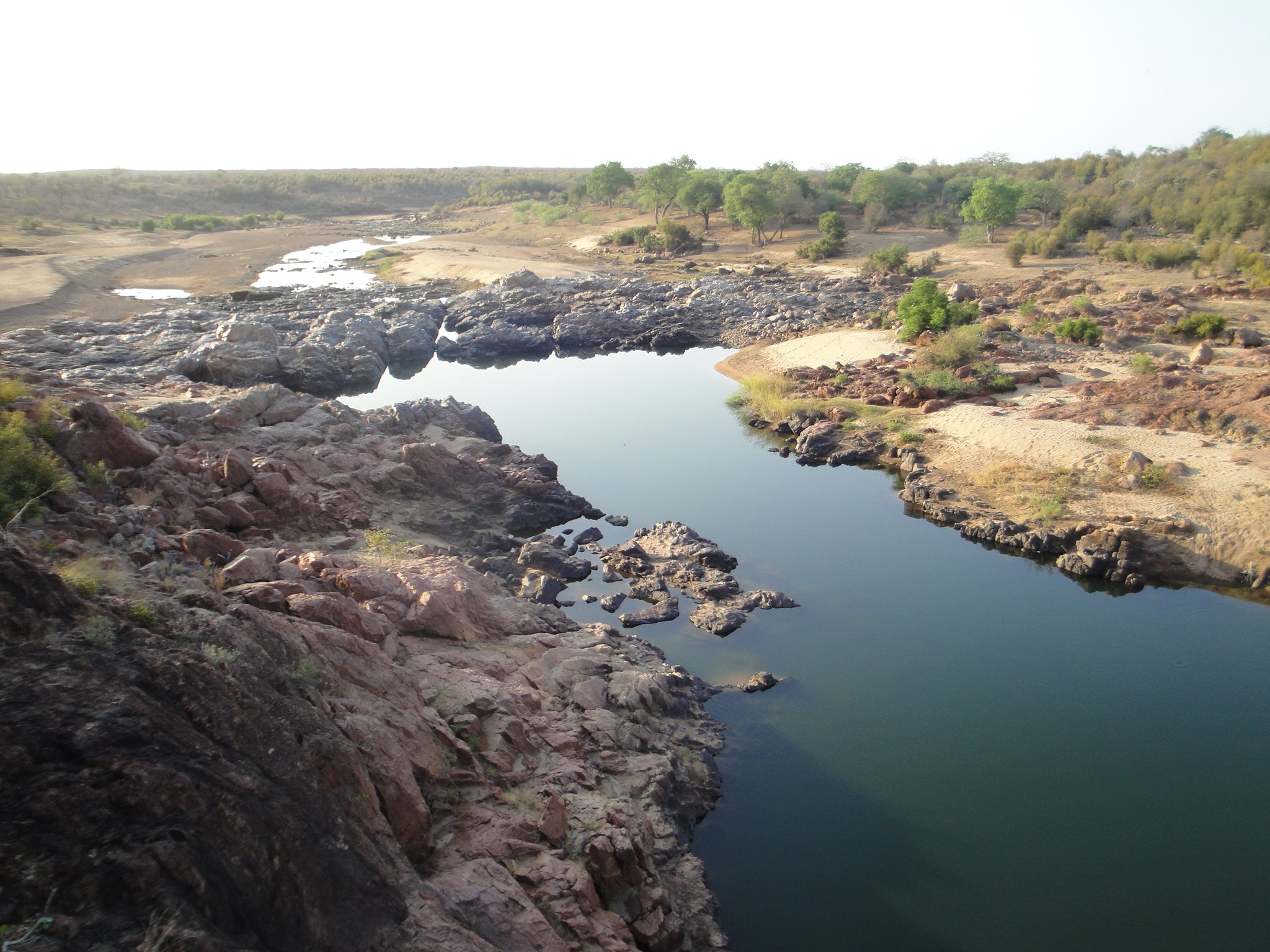
Wild Zimbabwean national park where elephant country, red sandstone cliffs, and lowveld rivers meet the Mozambique border.
Gonarezhou — the name means "place of many elephants" in Shona — is Zimbabwe's second largest national park and arguably its wildest. Sprawling across 5,000 square kilometres of the southeastern lowveld, it sits at the junction of Zimbabwe, Mozambique, and South Africa, forming part of the vast Great Limpopo Transfrontier Park. It sees a fraction of the visitors that Hwange attracts, which is precisely its appeal.
The landscape is dramatic and varied: sandstone cliffs glow red above the Runde River, mopane woodland stretches for miles, and the Runde and Save rivers carve their way through country that feels genuinely remote. The Chilojo Cliffs — towering red sandstone bluffs rising above a bend in the Runde — are the park's iconic sight, best seen from the Chipinda Pools area at sunset when elephant herds come down to drink.
Wildlife is exceptional and less habituated to vehicles than in more visited parks. Gonarezhou's elephant population numbers some 10,000 to 11,000 animals — one of the largest in southern Africa. Lion, leopard, wild dog, cheetah, buffalo, and an important population of nyala round out a list that includes all the big five. Birding is outstanding, with over 500 species recorded across the park's biome transition zones.
Access requires a 4WD and some advance planning. The closest upmarket option is the Malilangwe Wildlife Reserve, which adjoins the park and is home to Singita Pamushana Lodge. Basic camping is available at Chipinda Pools in the north and at Swimuwini camp on the Mwenezi River in the south — remote, unfenced, and genuinely wild. The far southeastern corner of the park, where the Runde meets the Save at Zimbabwe's lowest point, is the most remote and arguably the most rewarding for serious wildlife travellers.
Guide
Getting Around
You need your own 4WD to get around Gonarezhou. There is no vehicle hire within the park and no guided game drive vehicles available for independent travellers at the public camps (though ZimParks rangers can sometimes be hired as guides with advance notice). The tracks range from reasonable graded dirt roads near Chipinda Pools to deep sand or heavily eroded tracks in the remote sections around the Save–Runde confluence.
The northern and southern sectors are not connected by a road that can be driven in a single day during the dry season. To get from Chipinda Pools to Mabalauta/Swimuwini, you either have to exit the park and drive around on public roads, or plan a multi-day traverse via the internal tracks — the latter requires experience, good maps (the tracks are not well marked), and ideally two vehicles. The distance as the crow flies is not large; the road distance is considerable.
GPS tracks for the main roads in Gonarezhou are available on Tracks4Africa and on the Gonarezhou Conservation Trust's website. Download them before you leave Harare — there is no data signal inside the park. A paper map as backup is not optional.
Walking safaris are available through some of the private operators working in the park and are the finest way to experience the lowveld bush. Walking here is not like walking in the Serengeti — the vegetation is dense and you are genuinely in an uncontrolled environment with dangerous game. All walks must be accompanied by a licensed professional guide. Contact the Gonarezhou Conservation Trust for current options.
Guide
Getting There
Gonarezhou has no public transport access and no entry without a 4WD vehicle. This is not hyperbole — the tracks within the park are deeply rutted sand, river crossings can be axle-deep, and the distances involved mean a breakdown without recovery equipment is genuinely dangerous.
Northern sector (Chipinda Pools): The main access route is via Chiredzi, reached by driving south from Harare on the A4 to Masvingo, then east on the A9 toward Chiredzi — about 550 km and a full day's drive. From Chiredzi, take the B9 south toward Sango Border Post; the turn-off for Chipinda Pools is signposted. A 4WD is required from Chiredzi town, and the last 60 km on dirt can be slow. Fuel up in Chiredzi; there is nothing inside the park.
Southern sector (Mabalauta/Swimuwini): Access is via Rutenga on the Beitbridge–Chiredzi road, then south on a track to Mabalauta warden's post. From Harare this is around 667 km. From Beitbridge (the South Africa border post on the Limpopo) it is a much shorter drive — useful if you are coming from the Kruger. A 4WD is essential, and the tracks deteriorate severely in the wet season.
By air: Buffalo Range Airport near Chiredzi has a small airstrip that accepts charter flights and some scheduled services from Harare. Most upmarket safari operators fly clients in directly from Harare or Victoria Falls. For those staying at Singita Pamushana in Malilangwe, the lodge can arrange transfers from Buffalo Range (about 30 km).
Carry all fuel, food, and water for your intended stay plus at least one day's emergency reserves. The park has no shops, no fuel, and no medical facilities.
Guide
When to Go
The dry season from May to October is the classic time to visit. As the months progress and the Runde and Save rivers drop to their dry-season levels, wildlife concentrates along the remaining water. By August and September, the mopane woodland is leafless, visibility is exceptional, and herds of a hundred elephants at the river is not a notable event. The heat is intense — temperatures above 38°C are normal in the lowveld in October — but tolerable with early starts and afternoon rests.
July and August are the most comfortable months: cool nights (sometimes cold, down to 8°C), warm dry days, and game viewing at its best. This is also the period when the park gets its highest — still very modest — number of visitors. Book Chipinda Pools campsite in advance if you're visiting during this window.
November through April is the wet season. The rains transform the park — the landscape turns brilliant green, migratory birds arrive from Europe and northern Africa, and the Save–Runde confluence pans fill with waders and wildfowl. But this is also when the tracks become deeply rutted or impassable, river crossings flood, and the risk of vehicle recovery is real. Only experienced self-sufficient 4WD travellers should attempt Gonarezhou in the wet season, and the Mabalauta sector in particular can be completely inaccessible. The birding reward is genuine, but it comes with a cost.
Malaria is present year-round in this part of Zimbabwe; risk is highest during and just after the rains. Prophylaxis and mosquito precautions are strongly recommended.