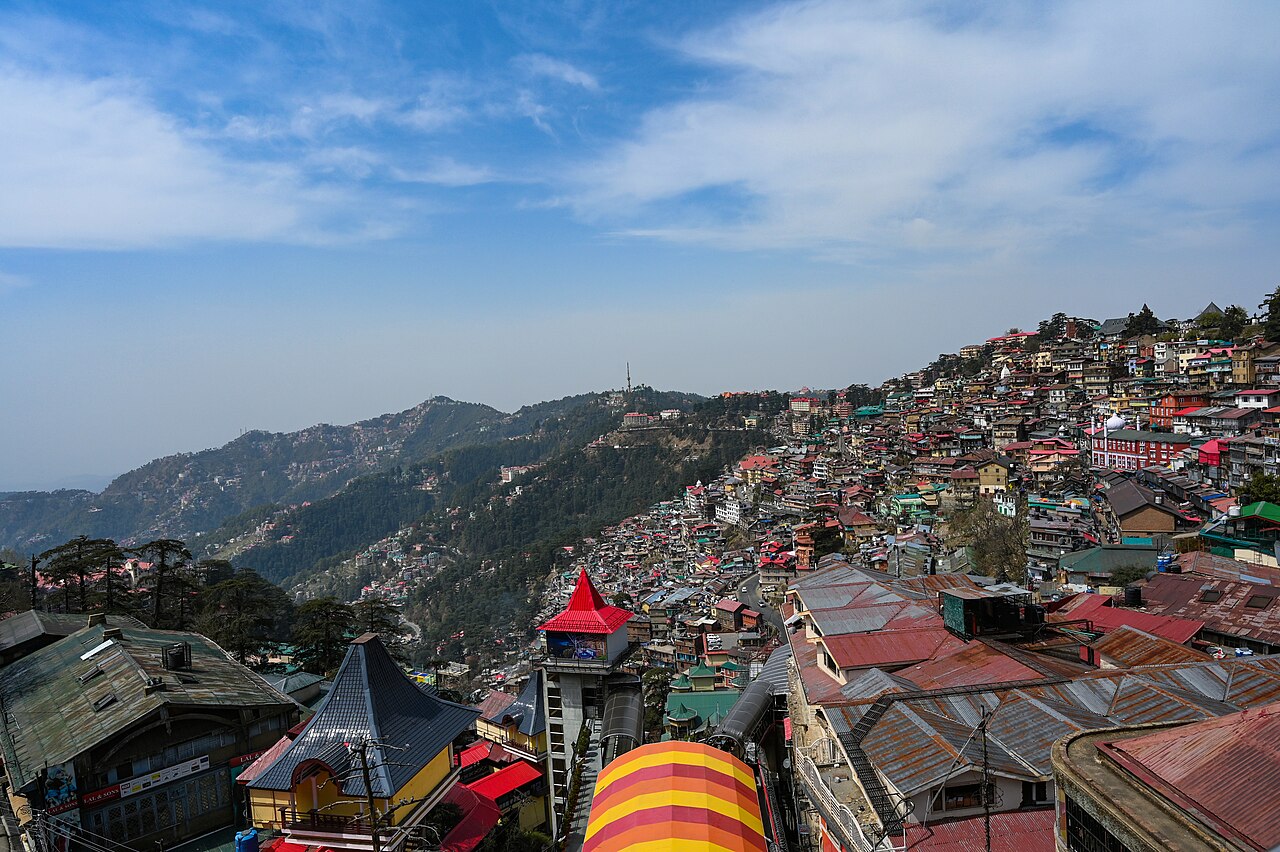
Shimla is the capital of Himachal Pradesh and, at 2,130 metres above sea level, India's most famous hill station — the summer capital of British India from 1864 until Independence, where the Raj's administration decamped each year to escape the plains heat. The colonial legacy is visible everywhere: in the mock-Tudor architecture of the Viceregal Lodge, the cast-iron bandstand on the Ridge, the pedestrianised Mall Road with its tea shops and bookstores, and the remarkable narrow-gauge Kalka-Shimla Railway that climbs through 102 tunnels and 864 bridges over 96 kilometres to reach the town.
The centre of Shimla is walkable and pleasant. The Ridge — a broad open promenade — connects the Mall to Christ Church (1857), one of the oldest churches in northern India. From Scandal Point, the walk up to Jakhoo Hill (about 2 km) leads to the Hanuman Temple at the summit, the highest point in the immediate area, with views over the town and the forested slopes of the outer Himalaya. The Lower Bazaar below the Ridge is more authentically Indian: wool shops, Tibetan jewellery, and small restaurants.
Shimla is also the starting point for treks into the Himalayan foothills and for road journeys to Spiti, Kinnaur, and Manali. The Gaiety Theatre on Mall Road and the State Museum with its Pahari miniature painting collection are worth seeking out beyond the main promenade.