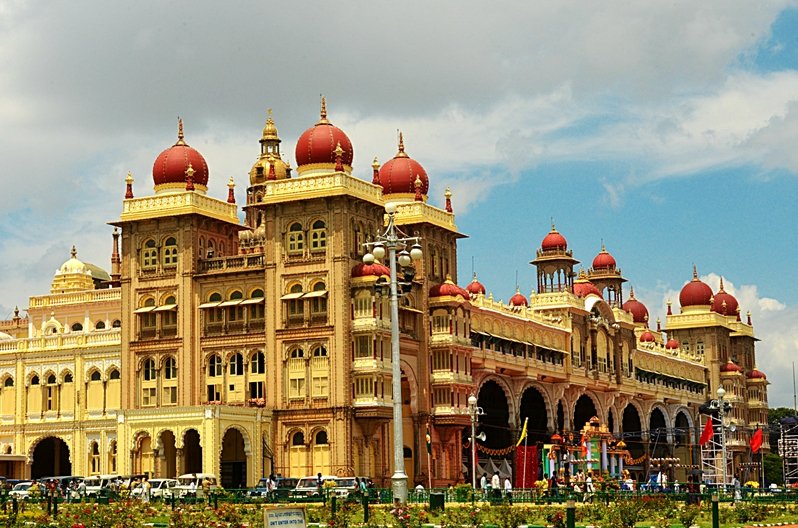
Mysore (officially Mysuru) is Karnataka's second-largest city and one of South India's most graceful — the former capital of the Wodeyar dynasty, a royal state that maintained its independence from the British Raj as a princely territory. The city wears its royal past lightly but visibly: in the lavish Mysore Palace (open to the public and illuminated on Sundays and public holidays), in the wide tree-lined streets laid out under enlightened maharajas, and in a civic tradition of sandalwood and incense craftsmanship that fills the air as soon as you step outside the train station.
The palace is the main attraction — a 1912 Indo-Saracenic pile of domes, arches, and carved teak that is, after the Taj Mahal, the most visited monument in India. The Jaganmohan Palace nearby houses an art collection including works by Raja Ravi Varma. Chamundi Hill, south of the city, has a temple at the summit reached by road or by 1,000 steps up the hillside — the carved monolithic Nandi bull along the way is one of the finest in South India.
Mysore is the home of Ashtanga yoga in its modern form; the K. Pattabhi Jois Ashtanga Yoga Institute draws practitioners from around the world. The Dasara festival in October, when the Mysore Palace is illuminated and a procession of decorated elephants carries the palace idol through the city streets, is one of India's grandest public celebrations.