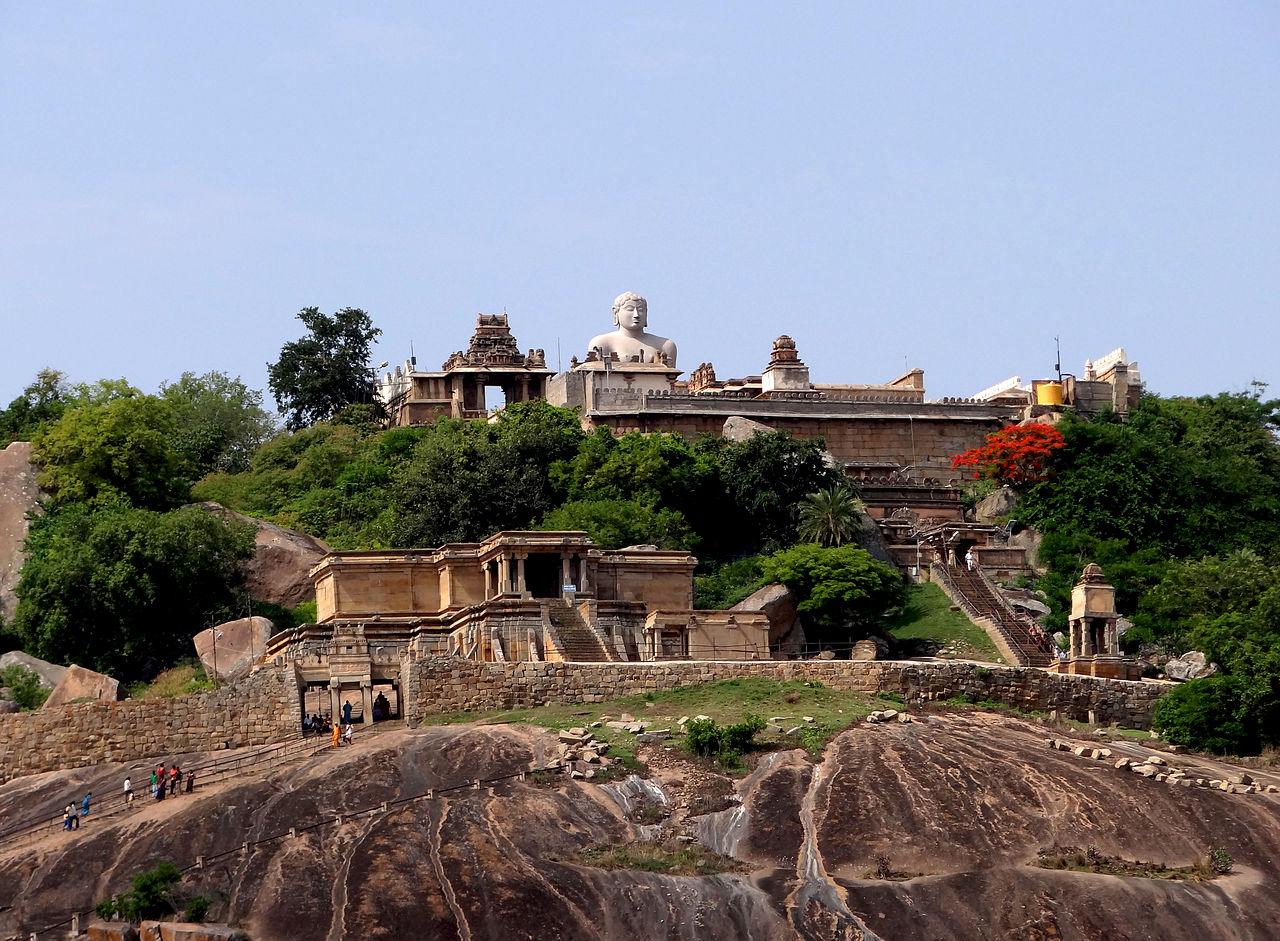
Jain pilgrimage town in Karnataka, dominated by the monolithic Gommateshwara statue on Vindhyagiri Hill.
Sravanabelagola is home to the Gommateshwara statue, a 17-metre monolithic figure of Lord Bahubali carved in 981 AD and widely considered the tallest freestanding monolithic statue in the world. It stands on top of Vindhyagiri Hill and can be seen for miles across the surrounding plains. Climbing the 614 rock-cut steps to the top is part of the experience.
The town is one of the most sacred Jain pilgrimage sites in India, and every 12 years hosts the Mahamastakabhisheka — an anointing ceremony in which the statue is bathed in milk, curds, saffron, and gold coins from scaffolding erected for the occasion. It draws hundreds of thousands of people. The facing Chandragiri Hill has a quieter cluster of Jain temples and is associated with the emperor Chandragupta Maurya, who according to Jain tradition abdicated his throne and came here to die. The Akkana Basadi in the town itself is a well-preserved 12th-century Jain temple with fine Hoysala-era carving.
Located on the Bangalore–Hassan highway, Sravanabelagola makes an easy stop on the way to Hassan or Belur, and can be combined with the great Hoysala temple towns in a single day trip from Bangalore.
Guide
Getting There
Sravanabelagola is on the main Bangalore–Hassan highway (NH75), about 144 km from Bangalore. It's an easy day trip from Bangalore by car or bus — the drive takes about 3 hours. It can also be combined with a visit to Belur and Halebidu (the great Hoysala temple towns), which are 50–60 km further north.
From Bangalore, buses run to Hassan, with connections to Channarayapatna (the nearest town to Sravanabelagola, 12 km away). Local buses and autos cover the last stretch. Alternatively, direct buses from Bangalore to Sravanabelagola run on festival days. The nearest railway station is Hassan (about 50 km).
Guide
When to Go
The best time to visit is October through February, when temperatures are cooler and the hill climb is more comfortable. Summer (March–May) can be very hot, and the bare rock steps retain heat — early morning visits are essential if you go in this season.
The Mahamastakabhisheka anointing ceremony happens every 12 years (the next is scheduled for 2030). If you can time a visit to coincide, it is one of the most extraordinary religious gatherings in India — hundreds of thousands of pilgrims, priests performing elaborate rituals from scaffolding, and an atmosphere that is genuinely once-in-a-generation.