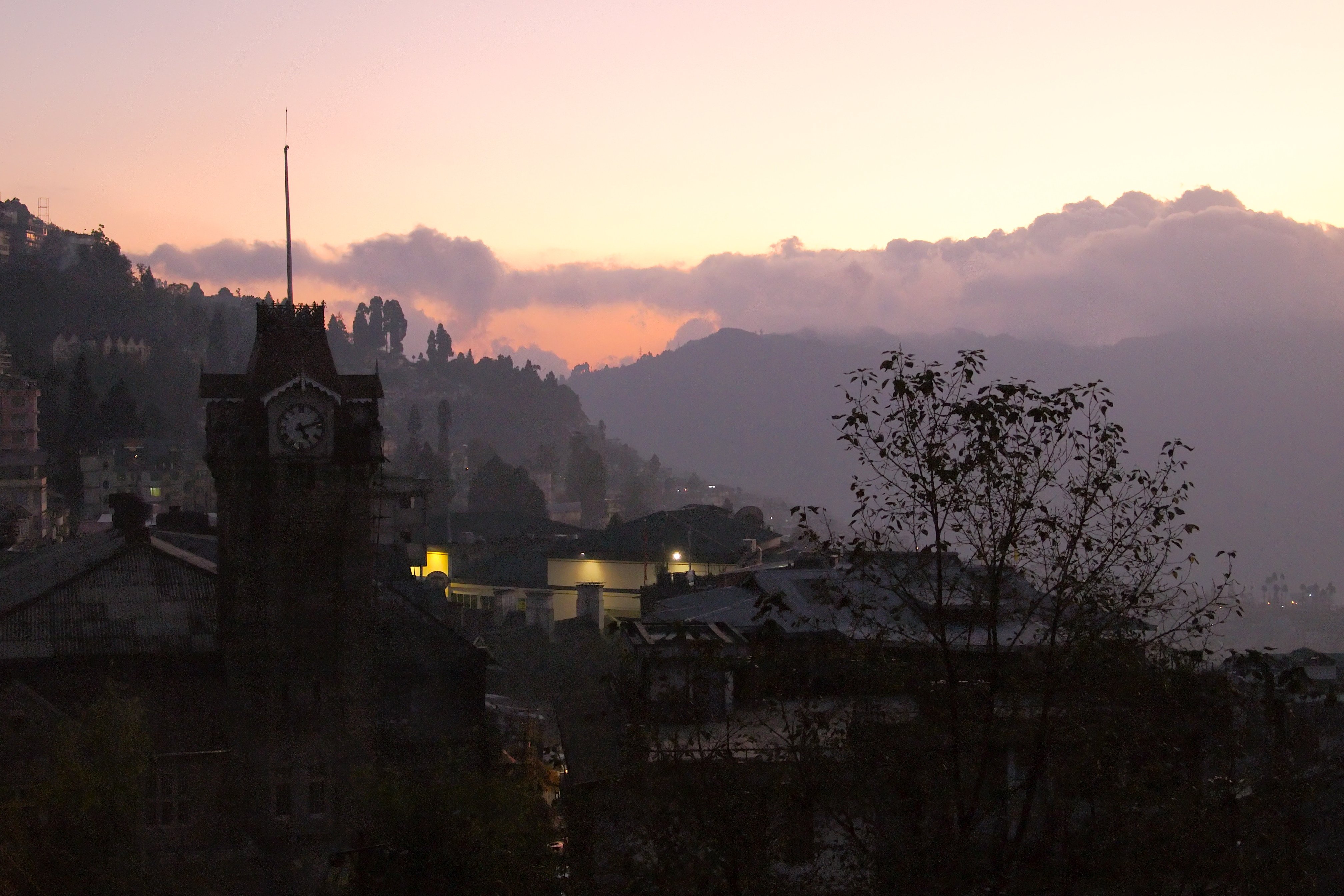
Darjeeling is a hill town of tea gardens, Victorian-era churches, and one unforgettable view — Kanchenjunga, the world's third-highest peak, rising across the valley in the mornings before the clouds close in. It sits at 2,050 metres in the far north of West Bengal, just below Sikkim, and was built by the British in the 1840s as a summer refuge from the heat of the Bengal plains. The name comes from Dorje Ling, the Tibetan for "place of the thunderbolt."
The town itself is a ridge-top sprawl of hotels, tea shops, and steep lanes that drop away to the valleys on either side. Chowrasta, the promenade at the top, is where everyone ends up at some point — sitting on a bench in the sun with a cup of the local tea, watching pony rides and the evening passeggiata of Indian honeymooners. Below it, Mall Road curves around the ridge; above it, the 19th-century Observatory Hill houses a Hindu temple on the site of what was once the town's founding Buddhist monastery. The old colonial hotels — the Windamere, the Elgin — still take afternoon tea in front of coal fires.
The surrounding hills are what make Darjeeling worth the journey. The tea estates first planted in the 1840s produce what connoisseurs consider the finest black tea in the world, and several are open to visitors. Tiger Hill is the classic dawn excursion — a pre-dawn jeep ride to watch the sun hit Kanchenjunga, with Everest just visible 225 km to the west on clear mornings. The Darjeeling Himalayan Railway, a UNESCO World Heritage site, still runs its toy train on narrow-gauge track through the hills; the short joyride between Darjeeling and Ghoom with the original steam locomotive is worth doing for the engineering alone.
Come in October–November or March–May for clear skies and mountain views. Avoid the monsoon (June–September), when the clouds shroud everything and the leeches take over the trails. Darjeeling is also a natural base for trekking into Sikkim, for day trips to the Buddhist monasteries at Ghoom, and for onward travel to Bhutan.