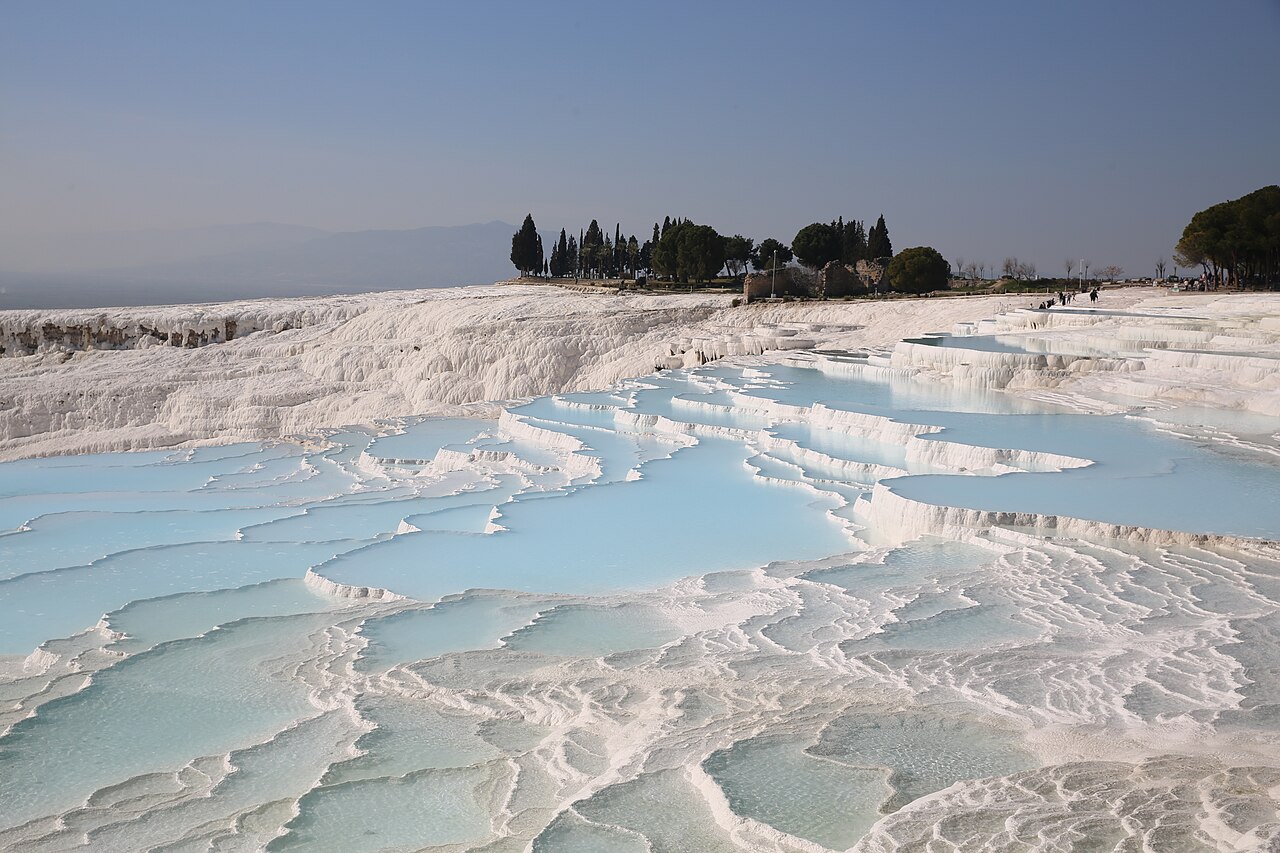
Pamukkale — "cotton castle" in Turkish — is one of Turkey's most extraordinary natural sights: a hillside of brilliant white travertine terraces formed over millennia by calcium-rich thermal springs. The warm, mineral-laden water flows down the slope, depositing limestone as it goes, creating a cascade of shallow turquoise pools that look like something from another planet.
Above the terraces lie the extensive ruins of Hierapolis, a Greco-Roman spa city founded in the 2nd century BC. The theatre is remarkably well preserved, the necropolis is one of the largest in Anatolia, and the "Sacred Pool" — where you can swim among submerged Roman columns in warm thermal water — is a unique experience. Don't miss the Ploutonion, a Roman shrine built over a still-lethal CO2 vent the ancients understood as a gateway to the underworld.
Pamukkale is usually visited as a day trip from the Aegean coast (Kuşadası or Selçuk, about three hours by road) or from Denizli, the nearest city. The site is open year-round, but early morning or late afternoon visits avoid both the heat and the tour-bus crowds. Walking on the travertines is permitted only barefoot, to protect the fragile formations.