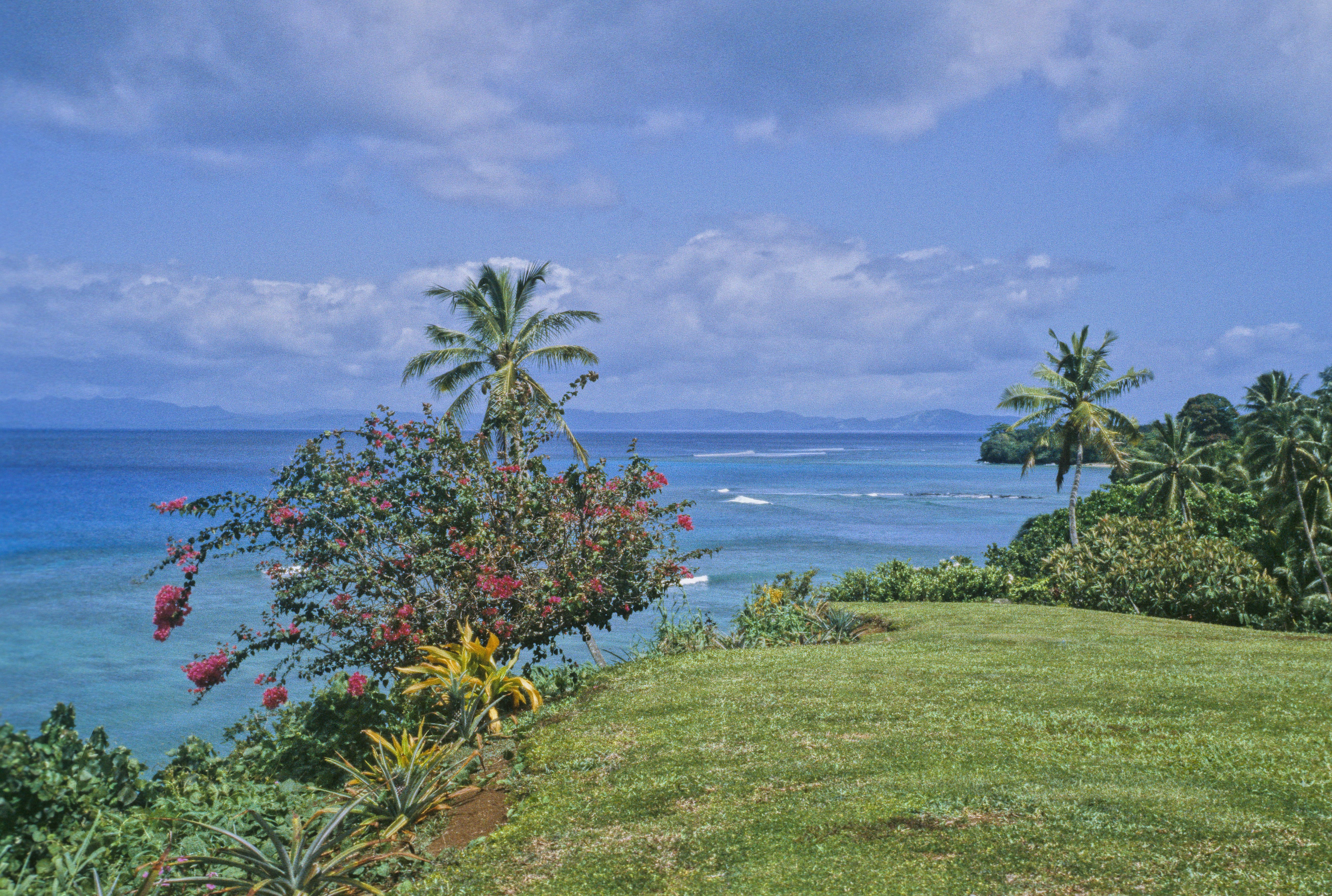
Lush volcanic Fijian island known as the Garden Island, crossed by the 180th meridian.
Taveuni is Fiji's "Garden Island," the third-largest island in the archipelago and one of its most beautiful. The volcanic soil and heavy rainfall produce an almost absurdly lush landscape: dense tropical forest, cascading waterfalls, and hillsides thick with coconut palms and tropical flowers. The 180th meridian runs through the island, which means you can technically stand with one foot in today and one foot in yesterday, though the International Date Line itself was long ago bent around Fiji for practical reasons.
The island's star attraction on land is Bouma National Heritage Park, where a series of waterfalls tumble through pristine rainforest and well-maintained trails lead through some of the best-preserved native forest in Fiji. The park also gives access to Lake Tagimaucia — a volcanic crater lake at 800 metres where Fiji's national flower grows wild and nowhere else on earth. Offshore, the diving is world-class: the Rainbow Reef, in the Somosomo Strait between Taveuni and Vanua Levu, is home to stunning soft coral walls and the famous Great White Wall, a vertical drop covered in white soft coral.
Near Waiyevo, a simple marker indicates the 180th meridian — the theoretical date line, bent around Fiji in 1879 so the islands could share a calendar. The Lavena Coastal Walk on the southeast coast is a beautiful half-day trail through coastal forest and Fijian villages, ending at a waterfall at the sea's edge. Taveuni moves at a pace even slower than the rest of Fiji. There is one main road, a handful of small villages, and a scattering of low-key resorts and guesthouses. If you have come to Fiji looking for something beyond the resort beaches of the Mamanucas, this is the place.
Guide
Getting There
Taveuni has its own small airport at Matei, on the northern tip of the island. Fiji Airways operates regular flights from Nadi (Fiji's main international airport) and from Suva, the capital. The flight from Nadi takes about an hour. Seat numbers are limited and flights fill up; book in advance, especially during peak season.
There is also a ferry connection from Savusavu on Vanua Levu, operated by Patterson Brothers Shipping. The crossing takes a few hours and is a scenic and cheaper alternative to flying, though schedules can be irregular. Check departure times locally before relying on the ferry.
Once on Taveuni, the island has a single main road running along the western and northern coasts. Most guesthouses and resorts will arrange airport transfers; otherwise, shared taxis and minibuses serve the main road.
Guide
When to Go
Taveuni's climate is warm and humid year-round, but the seasons matter. The dry season (May–October) is the best time for most activities: diving conditions are generally excellent, hiking trails are less muddy, and rainfall is lower. July and August are the most popular months and the peak for international visitors.
The wet season (November–April) brings heavy and sustained rain, particularly on the windward (eastern) side of the island. Trails can be very muddy and the Lavena Coastal Walk may be impassable. On the other hand, the wet season is when the tagimaucia flower blooms (October–December), if that is your reason for visiting.
Cyclone season runs from November through April, and Fiji does get hit by cyclones — the worst can cause significant disruption to travel. The diving is less affected by weather than the land activities, since conditions in the Somosomo Strait depend more on current and visibility than on rainfall.