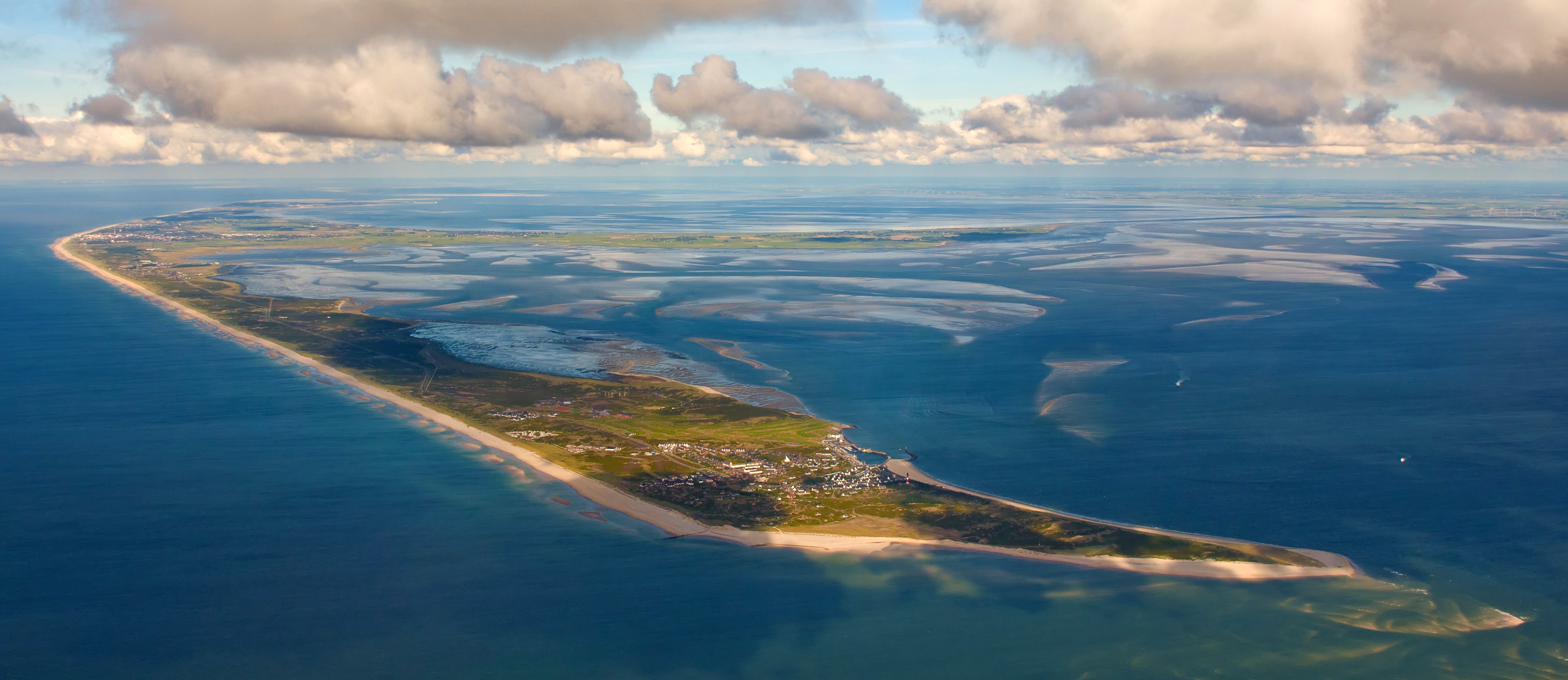
Wadden Sea barrier-island chain spanning Denmark, Germany, and the Netherlands as one tidal ecosystem.
The Frisian Islands are an interregional archipelago stretching in a crescent from the Dutch coast through Germany to Denmark. Divided between three countries for administrative purposes, they form a single ecological entity — a chain of low-lying barrier islands fronting the Wadden Sea, one of the world's most important tidal wetlands and a UNESCO World Heritage Site.
The islands share a character despite their different national administrations: flat, windswept, and defined by the relationship between land, sea, and the vast inter-tidal mudflats of the Watt. Cycling, mudflat walking (Wadlopen), birdwatching, and beach life are the dominant activities. Most islands restrict or ban private cars, which gives them a peaceful, human-paced quality that is rare in Northern Europe.
In the west, the Wadden Islands follow the Dutch coast — Texel, Vlieland, Terschelling, Ameland, and Schiermonnikoog. In the east, the East Frisian Islands line the coast of Lower Saxony, protected within the Lower Saxony Wadden Sea National Park. The Hamburg Wadden Sea National Park extends from the mouth of the Elbe to the tiny bird islands of Neuwerk and Scharhörn. Further north, the North Frisian Islands sit off the Schleswig-Holstein coast — including Sylt, the fashionable and wealthy resort island connected to the mainland by causeway. The chain continues into Denmark as the Vadehavet Nature Reserve, protecting Fanø, Mandø, and Rømø.
The Wadden Sea ecosystem is one of the most biologically significant in the world: 10–12 million migratory birds use it annually as a feeding and staging ground, and the tidal mudflats support some of the highest densities of invertebrate life on Earth. An international coordination effort between all three countries — the Trilateral Wadden Sea Cooperation — manages the UNESCO site, though tensions remain between conservation and shipping traffic from the major estuaries.
Guide
Getting There
Each national section of the Frisian Islands is reached differently.
Dutch Wadden Islands are served by ferries from the mainland ports of Den Helder (Texel), Harlingen (Vlieland and Terschelling), Holwerd (Ameland), and Lauwersoog (Schiermonnikoog). Ferries run multiple times daily in summer, less frequently in winter. Texel can also be reached by car ferry; most other islands are car-free or strictly limit vehicles.
East Frisian Islands (Germany) are reached by ferry from Norddeich (Norderney and Juist), Bensersiel (Langeoog), Neuharlingersiel (Spiekeroog), and Harlesiel (Wangerooge), among others. Borkum has ferry service from Emden. Most East Frisian Islands allow no cars or only island-owned vehicles; cyclists and walkers are the norm. Check the ferry schedule carefully as crossing times are tied to the tides.
North Frisian Islands (Germany) are more varied in access: Sylt is connected to the mainland by a rail causeway (you can take your car on the train), Föhr and Amrum are served by ferries from Dagebüll, and the smaller Halligen islands have ferry connections from Husum and other ports.
Danish Wadden islands are accessed from Esbjerg — ferries reach Fanø, while Mandø is accessible by tractor at low tide across the tidal flats.
Guide
Things to Do
The Frisian Islands offer some of the finest cycling in Europe. Most of the islands are flat, the roads (where cars are allowed at all) are lightly trafficked, and the combination of sea views, dune landscapes, and beach access makes a slow cycling tour one of the best ways to experience the chain. Bikes can be rented on every inhabited island.
Wadlopen (mudflat walking) is a uniquely Frisian experience. At low tide, the Wadden Sea recedes to expose vast mudflats — the actual seabed — that can be walked across to reach islands that have no ferry connection, or to cross between islands. It requires a guide (the tides move fast and the channels are disorienting), and it is one of the more extraordinary things you can do anywhere in Northern Europe. Tours are organised from the mainland coast and from various island harbours.
Birdwatching is excellent throughout the islands but particularly at the designated nature reserves and bird sanctuaries. Memmert (near Juist) and the Griend reserve (in the Dutch Wadden Sea) are among the most significant breeding sites in Western Europe. Tens of millions of wading birds pass through the Wadden Sea during migration; the spectacle of vast flocks of knot, dunlin, and oystercatcher at high tide roost is one of the great wildlife experiences of the continent.
Swimming and beaches are the main draw for most visitors. The North Sea is not the warmest (water temperatures peak in August), but the beaches are wide, the surf reliable for bodyboarding, and the light in summer extraordinary. The Dutch islands generally have the most developed beach infrastructure; the German islands the widest open beaches.