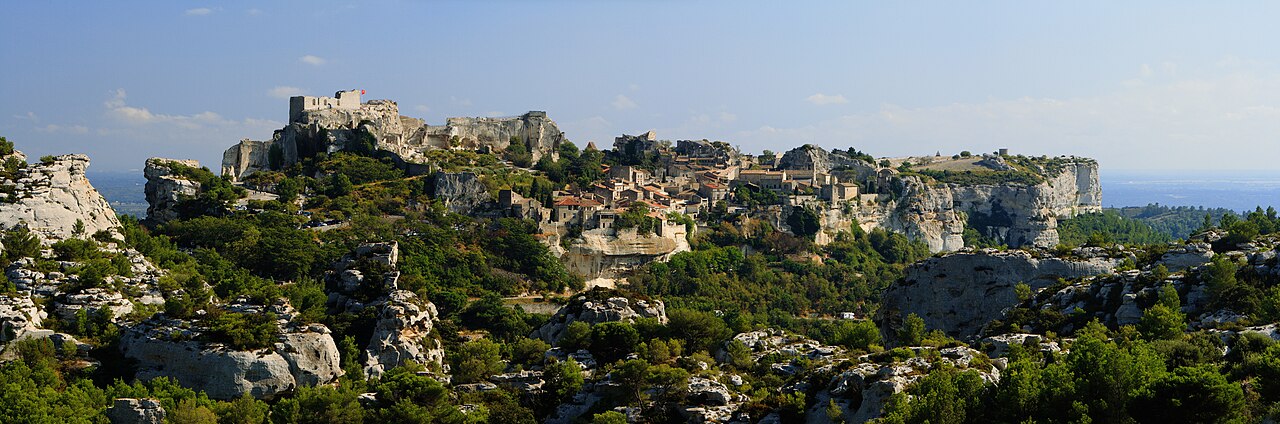
Les Baux-de-Provence
©
Les Baux-de-Provence

Les Baux-de-Provence

Fortified Provençal village on a limestone ridge, crowned by castle ruins above the olive groves of Les Alpilles.

Few villages in France announce themselves quite so dramatically as Les Baux-de-Provence. The entire settlement — ruined castle, medieval streets, and all — sits on a narrow limestone ridge rising abruptly from the olive groves of Les Alpilles, its cliffs dropping sheer on three sides. In the Middle Ages that made it one of the most powerful strongholds in the south. Today it makes it one of the most photogenic.

The Château des Baux sprawls across the upper third of the plateau — towers, keep, and reconstructed siege engines included. The views from the ramparts over the patchwork of vineyards and garrigue below are as good as anything in Provence. Below the castle, the medieval village is worth an hour of unhurried wandering: galleries and craft shops tucked into stone buildings, steep lanes that dead-end at views, the whole place built from the same pale limestone it stands on.

The other major draw is the Carrières de Lumières, a converted bauxite quarry in the Val d'Enfer just outside the village that hosts large-scale immersive art projections. The scale is extraordinary — floor-to-ceiling images covering 7,000 square metres of raw rock face, with a new programme each year. It's the kind of thing that sounds gimmicky and turns out to be genuinely impressive.

The village gets very crowded in summer, especially on weekends. Come on a weekday morning in spring or autumn and you'll have the place closer to yourself.

Guide

Eating Out

Les Baux has a surprisingly good restaurant scene for a village of its size, though prices reflect the tourist trade. The best option is to eat in the village itself on a weekday, when the crowds thin, and choose carefully.

Oustau de Baumanière, just below the village, is one of the most celebrated restaurants in Provence — two Michelin stars and a long history of feeding the world's wealthy and well-connected. It's expensive in the manner of haute Provençal cuisine: beautiful produce, perfect technique, a dining room designed to feel like a film set. The terrace views over the Alpilles are extraordinary.

For something less expensive, the village's handful of bistros offer solid Provençal cooking — lamb from the Alpilles, tapenade, cheese from the hills — in historic settings. Avoid the worst tourist menus posted at the entrance; a few places still cook honestly.

Guide

Getting There

Les Baux-de-Provence has no train station and no bus service worth relying on. You really need a car.

By car: it's 30 km from Arles (about 35 minutes) and 25 km from Saint-Rémy-de-Provence (25 minutes). Parking is on the flat ground below the village — a short walk up to the main gate. There is a charge for parking in summer.

The nearest airport is Marseille Provence (MRS), about 50 km away. From there a hire car is the practical option.