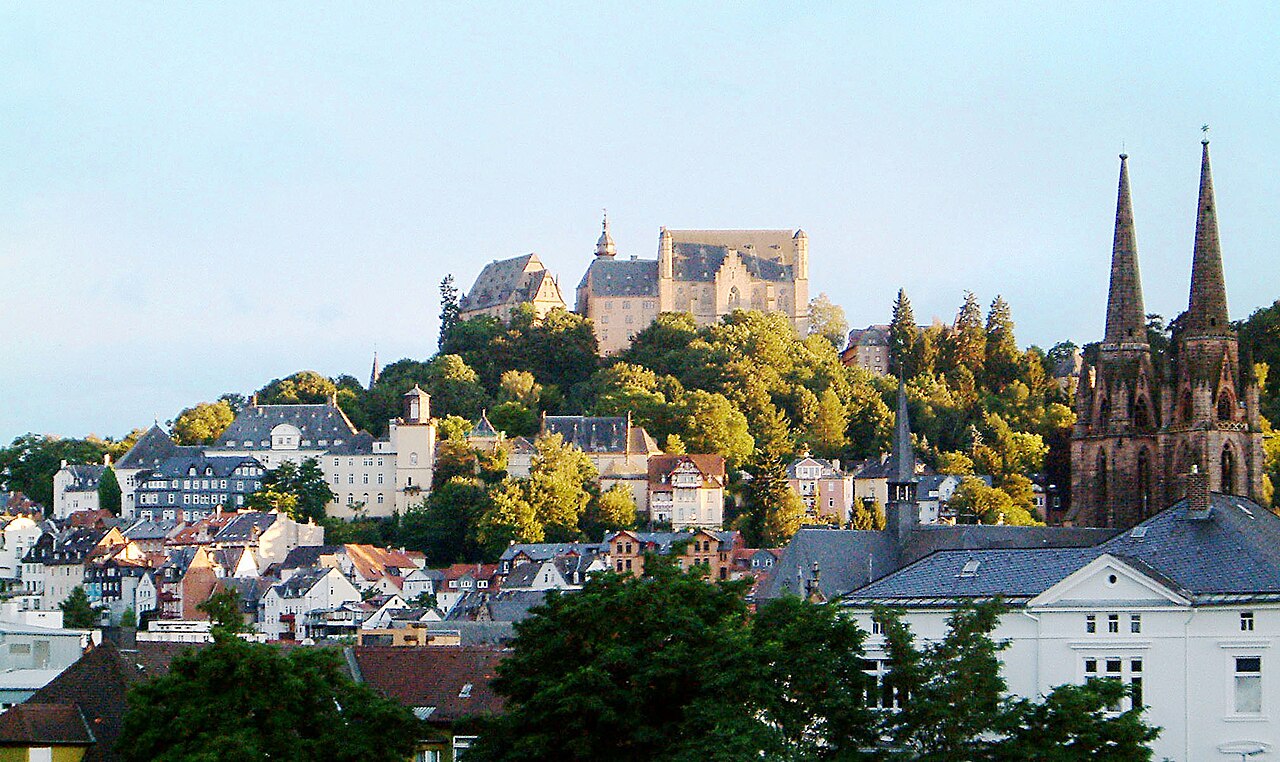
Marburg is a university town in the hills of central Hesse, compact and handsome and largely unspoiled — the kind of German town that didn't get bombed flat in the war and still looks like itself. The old town climbs steeply from the River Lahn up to the Landgraviate castle at the top, with half-timbered houses stacked along the lanes in between. It is a pleasure to walk.
The university — founded in 1527 by Philip of Hesse, making it one of the oldest Protestant universities in the world — shapes everything about the place. Students make up a quarter of the population, which keeps the bars lively and the rents high. The lower town around the Marktplatz fills up at night and empties on summer weekends when everyone has gone home. It feels most alive in term time.
The Elisabethkirche, on the north edge of the old town, is the city's single most important building and worth your full attention. Built in the 13th and 14th centuries in Gothic style, it was among the first purely Gothic churches in German lands, and it is remarkable — slim, pale, and full of light inside. Elisabeth of Hungary, a Franciscan tertiary who died at 24 and was canonised three years later, is buried here. After World War II the remains of Field Marshal Hindenburg and the Hohenzollern kings Frederick William I and Frederick II were moved here from Potsdam.
Above all of it sits the Landgraviate castle, Marburg's skyline-defining landmark. It was here in 1529 that Philip of Hesse convened the Marburg Colloquy, a famous theological conference at which Luther and Melanchthon met Zwingli in an attempt to reconcile their differences over the Eucharist. They failed. The castle is now a museum and gives you the best view over the town.
Marburg is an easy day trip or overnight from Frankfurt — about an hour by train. It is also a satisfying base for exploring the Lahntal, the river valley that runs north toward Limburg.