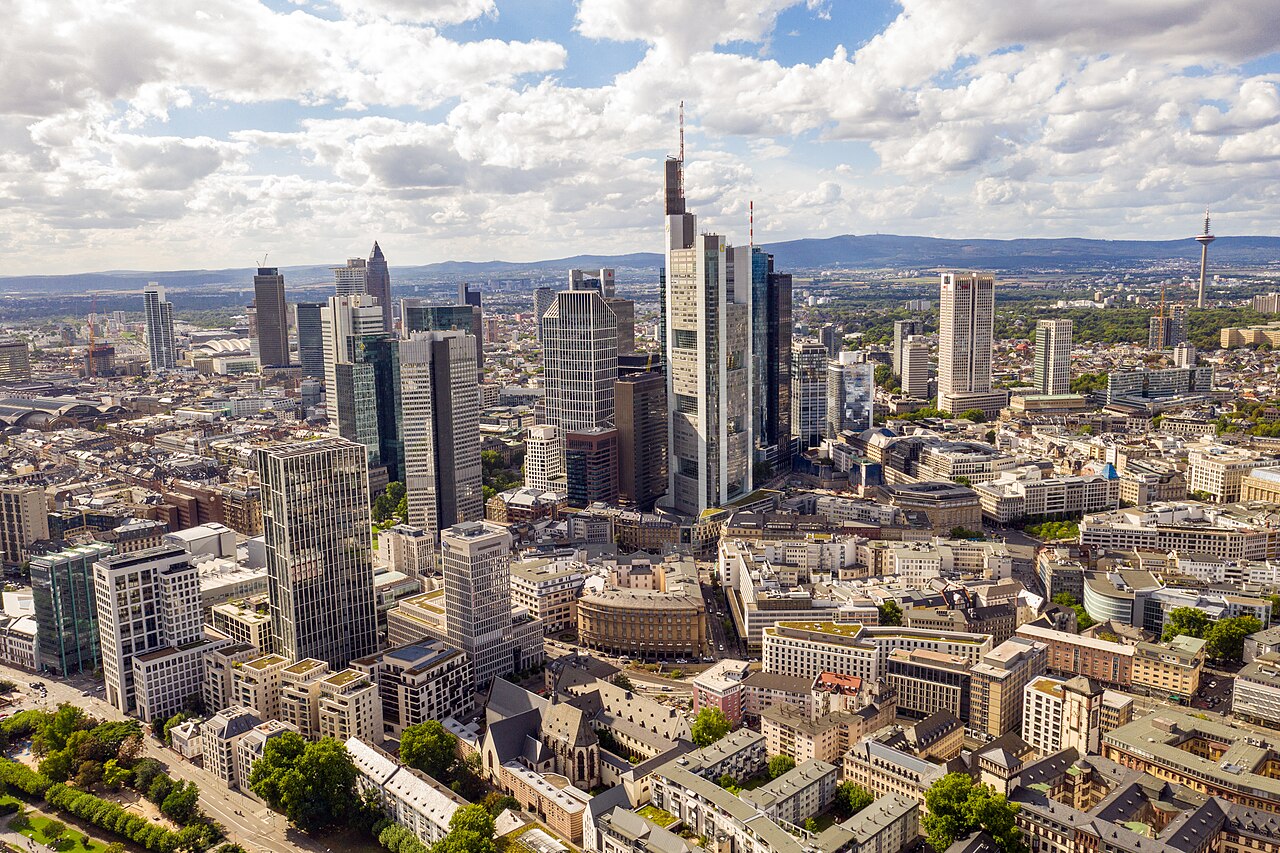
Frankfurt am Main — "Mainhattan" to the Germans, "Bankfurt" when they are feeling uncharitable — is a rich, restless city of 750,000 on the banks of the Main river in the centre of Germany. For a lot of overseas travellers it is the first thing they see of Europe, because of the airport: one of the busiest in the world and the hub of Lufthansa. That reputation as a stopover is unfair. Frankfurt is a compact, surprising, and far more liveable place than its glass towers suggest.
The city has two faces. One is the financial capital of Germany, home to the European Central Bank, the Bundesbank, and the Frankfurt Stock Exchange — a skyline of banking towers that smacks more of Chicago than anywhere else on the continent. The other is a civilised, almost bohemian city that spends more on the arts than any other in Europe, with world-class museums, a respected opera, and a nightlife scene that punches above its weight. Most of the medieval centre was flattened in 1944, and the rebuilders went for modernism rather than pastiche. A recent wave of reconstruction has returned a handful of the old half-timbered houses around Römerberg square, and the effect is oddly convincing.
Spend time on both banks of the river. On the north bank, the Römerberg and the Dom — the old coronation cathedral of the Holy Roman emperors — anchor what is left of the old town; ten minutes' walk north is the Zeil, the main shopping street. The south bank is Sachsenhausen, the old apple-wine quarter, where you can still find Ebbelwoi (apple cider) served by the bembel in traditional taverns, alongside Handkäs mit Musik — a strong cheese with raw onions and vinegar that is an acquired taste. The riverside promenade between the two is the Museumsufer, a string of twelve museums that is one of the best museum concentrations in Europe: the Städel (old masters and moderns), the Liebieghaus (sculpture), the Film Museum, and the Museum Angewandte Kunst among them.
Frankfurt was Goethe's hometown — his birthplace is preserved as a museum — and it was where the first democratically elected German parliament met in 1848, in St. Paul's Church. If you only have a half-day between flights, take the S-Bahn in from the airport (fifteen minutes), walk the Römerberg, cross the Eiserner Steg footbridge to the Museumsufer, and have an Apfelwein in Sachsenhausen before heading back. It is also a strong base for the Rhine valley — Rüdesheim, Mainz, and Wiesbaden are all under 45 minutes away by train, and Heidelberg is an hour south.