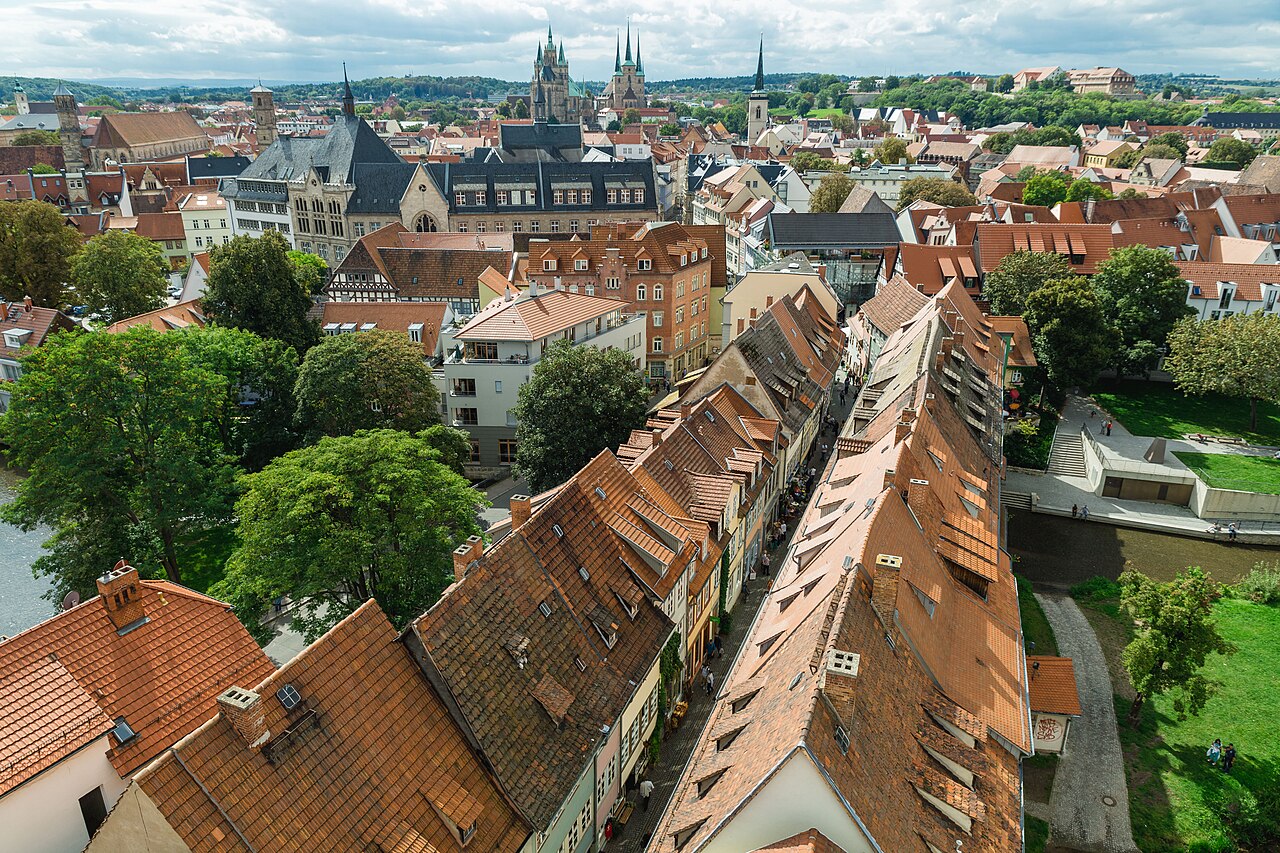
Of all Germany's large cities, Erfurt is the one most redolent of pre-war Germany. Although it lost a couple of important monuments in bombing raids, it was otherwise little damaged in World War II — and its streets of grand turn-of-the-century shopfronts were saved from postwar developers by the fact that the city ended up in East Germany.
The city's most photographed sight is the Krämerbrücke, a medieval bridge lined with half-timbered houses that have been continuously inhabited for centuries — one of only a handful of such bridges still standing anywhere in Europe. At the top of the old town, the Erfurt Cathedral and the Severikirche rise side by side from a broad flight of steps, a dramatic ensemble that dominates the skyline. Between them and the Krämerbrücke stretches a network of lanes and squares that rewards wandering without a map.
The Old Synagogue, a UNESCO World Heritage Site since 2023, is one of the best-preserved medieval synagogues in Europe — and inside it, the Erfurt Treasure, a hoard of gold and silver hidden in the walls during a medieval massacre and only discovered in 1998, is extraordinary. The Augustinerkloster, where Martin Luther studied and was ordained as a monk, is now a museum and hotel. The city has worn its history lightly — it feels lived-in and unpretentious, with a busy market square and a university that keeps it young.
For art, the Angermuseum on the broad Anger boulevard has the best regional collection of medieval and early modern painting. The Andreasstrasse Memorial occupies the former Stasi prison and is a sobering reminder of the city's more recent history.