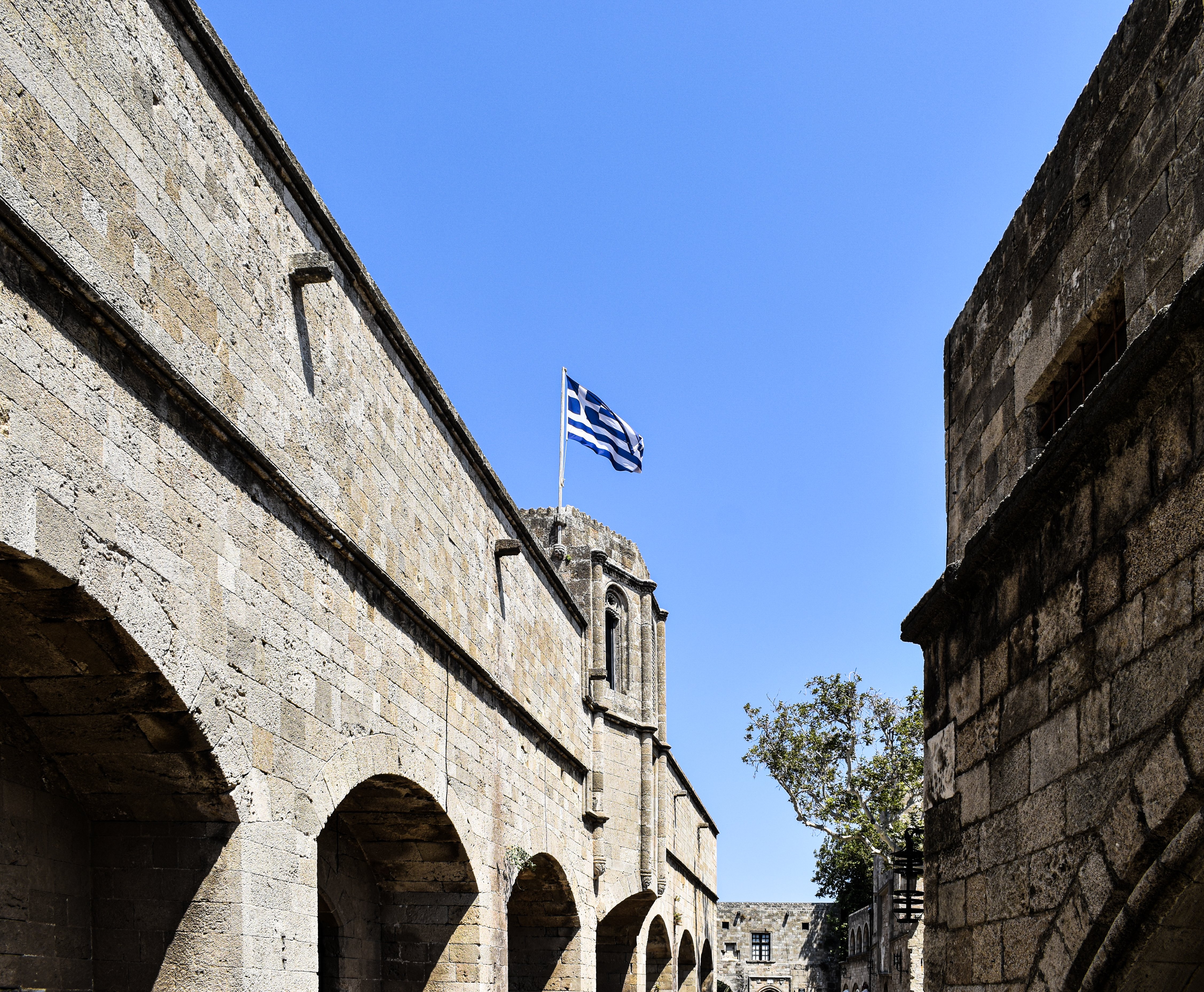
Rhodes City is one of the finest medieval towns in Europe. The Old Town, enclosed within massive walls built by the Knights of St. John in the fourteenth century, is a living monument -- some 6,000 people still live and work in the same buildings the Knights occupied six centuries ago. UNESCO granted it World Heritage status, and it deserves every bit of the recognition.
The Old Town divides into two parts, just as it did in the time of the Knights. The northern Castello was the administrative quarter, home to the Grand Master's Palace and the famous Street of the Knights, one of the best-preserved medieval streets in Europe. The larger southern Chora was where Greeks, Jews, and European merchants lived, and its character remains more chaotic and residential. Sokratous Street, the old bazaar, runs roughly along the line that once separated the two. During Turkish occupation, Greeks were expelled from the Old Town entirely and those caught inside after dark risked beheading.
Entering through the Gate of Freedom from Mandraki Harbor, you reach Simi Square, where the ruins of a third-century BC Temple of Aphrodite sit beside the Inn of the Tongue of Auvergne (1507). Note the external staircase on the inn, a purely Aegean architectural feature. Beyond, Argyrokastrou Square has a fine fountain with an early Christian font as its base, found by Italian archaeologists in a church near Arnitha. Piles of cannonballs scattered through the Old Town were collected for the Turkish siege of 1522.
The Archaeological Museum, housed in the medieval Hospital of the Knights, is well worth a visit, as is the smaller Museum of Folk Art. The Armeria, probably built by Grand Master Roger de Pias in the fourteenth century (his escutcheon is visible on the facade), now houses the Institute of History and Archaeology. Outside the walls, the modern town has a busy waterfront, a good selection of restaurants, and the site where the Colossus of Rhodes once stood -- though nothing of that ancient wonder survives.