Comacchio
©
Comacchio

Comacchio

Po Delta canal town of bridges, lagoon fisheries, and the five-stairway Ponte dei Trepponti.

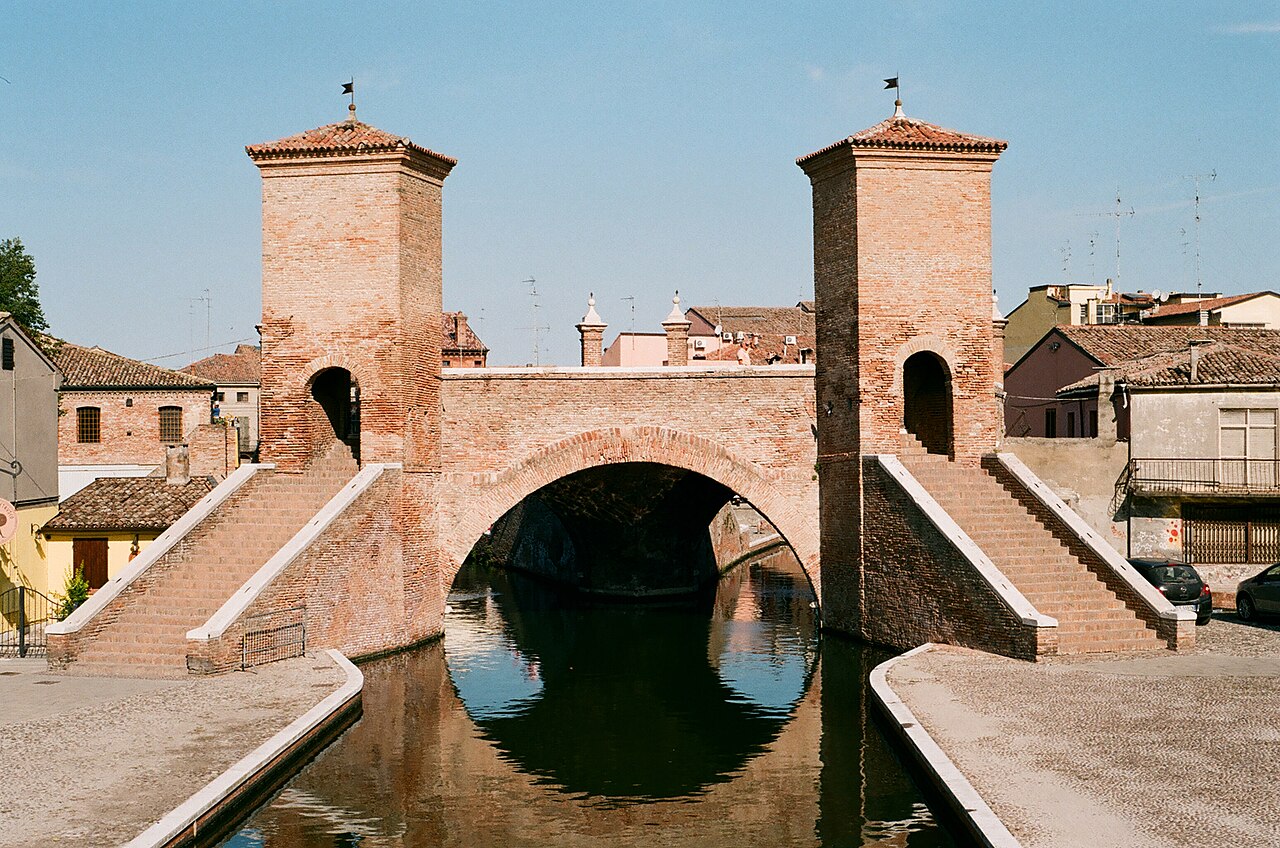
Comacchio is like a small Venice, built on islands in a lagoon and connected by canals and bridges, roughly 30 km north of Ravenna at the southern edge of the Po Delta. The comparison to Venice is obviously hyperbolic — Comacchio is a small town of 20,000, not a city — but the visual logic holds: pale facades reflected in still water, boats moored at doorsteps, and the Ponte dei Trepponti at the northern entrance, a 17th-century bridge of extraordinary design with five stairways ascending from five different directions to a single central arch.

The town is built on the Valle di Comacchio, one of the largest brackish lagoon systems in Europe and a habitat for eels since Roman times. Comacchio's defining product is the eel, caught in the surrounding wetlands and preserved for centuries using a marinating technique developed here: slow-cooked in vinegar and spices, then stored in terracotta vessels. The Manifattura dei Marinati — the old eel processing factory, now a working museum — is the most atmospheric building in town. The Sagra dell'Anguilla (Eel Festival) in October draws visitors from across Emilia-Romagna.

Beyond the lagoon and the eel, there are good Baroque churches — the Cattedrale di San Cassiano on the main square, the Church of Santo Rosario on Piazza del Popolo — and a genuinely unhurried atmosphere that makes Comacchio a pleasant base for exploring the Po Delta. The Lidi di Comacchio, 5 km to the east, offer wide sandy Adriatic beaches for a day's swimming.

Guide

Eating Out

Comacchio's cuisine is inseparable from its lagoon. Eel — marinated in vinegar and spices (anguilla marinata), grilled (anguilla alla brace), or stewed — appears on most menus and should be tried at least once. The marinated version is the local speciality: chunks of eel slow-cooked and preserved in terracotta, served at room temperature with bread. The flavour is rich and slightly sour, quite unlike anything else.

Beyond eel, the local cooking runs to freshwater and lagoon fish — carp, pike, sea bass, clams — prepared simply and without the elaborate sauces that characterise more fashionable Italian restaurants. The town has several good trattorie around Piazza XX Settembre and along the canal streets.

Guide

Getting There

Comacchio has no railway station of its own. The nearest train connections are at Ferrara (48 km southwest) and at Ravenna (35 km south), both well-connected cities on main Italian rail lines.

From Ferrara: Buses run to Comacchio several times daily, journey time around 50 minutes. By car, take the SS16 east then follow signs for Comacchio; the drive takes around 40 minutes.

From Ravenna: Buses connect the two cities, roughly 45 minutes by road. By car, take the SS309 north towards the Po Delta.

From Bologna: Roughly 90 minutes by car via Ferrara, or take the train to Ferrara then the bus.

By car: Comacchio's historic centre is small; parking is available in several lots on the town's perimeter. Bicycles are the ideal way to explore once you arrive and can be hired from several shops near the central square.

Guide

When to Go

Comacchio is a year-round destination in theory, but in practice it is most rewarding in spring and autumn. Spring (April–June) brings migrating birds to the Valle di Comacchio in vast numbers — flamingos, herons, marsh harriers — and the light over the lagoon is exceptional. The town itself is quiet and accommodation easy to find.

Summer (July–August) is the Italian beach holiday season, and the Lidi di Comacchio fill to capacity with families from Ferrara and Bologna. The town itself remains manageable, but accommodation prices rise steeply and the beach resort strip is very busy.

Autumn is the most evocative time to visit. The Sagra dell'Anguilla (Eel Festival) takes place in October, when the traditional eel catch is celebrated with cooking demonstrations, markets, and a procession of fishing boats. The lagoon light in September and October is warm and low, and the Valle di Comacchio hosts another wave of migrating birds on their way south.

Winter is quiet and sometimes grey, but Comacchio with no tourists has a melancholy appeal. The canals and bridges, empty of people, have exactly the feel that earned the town its comparison to Venice.