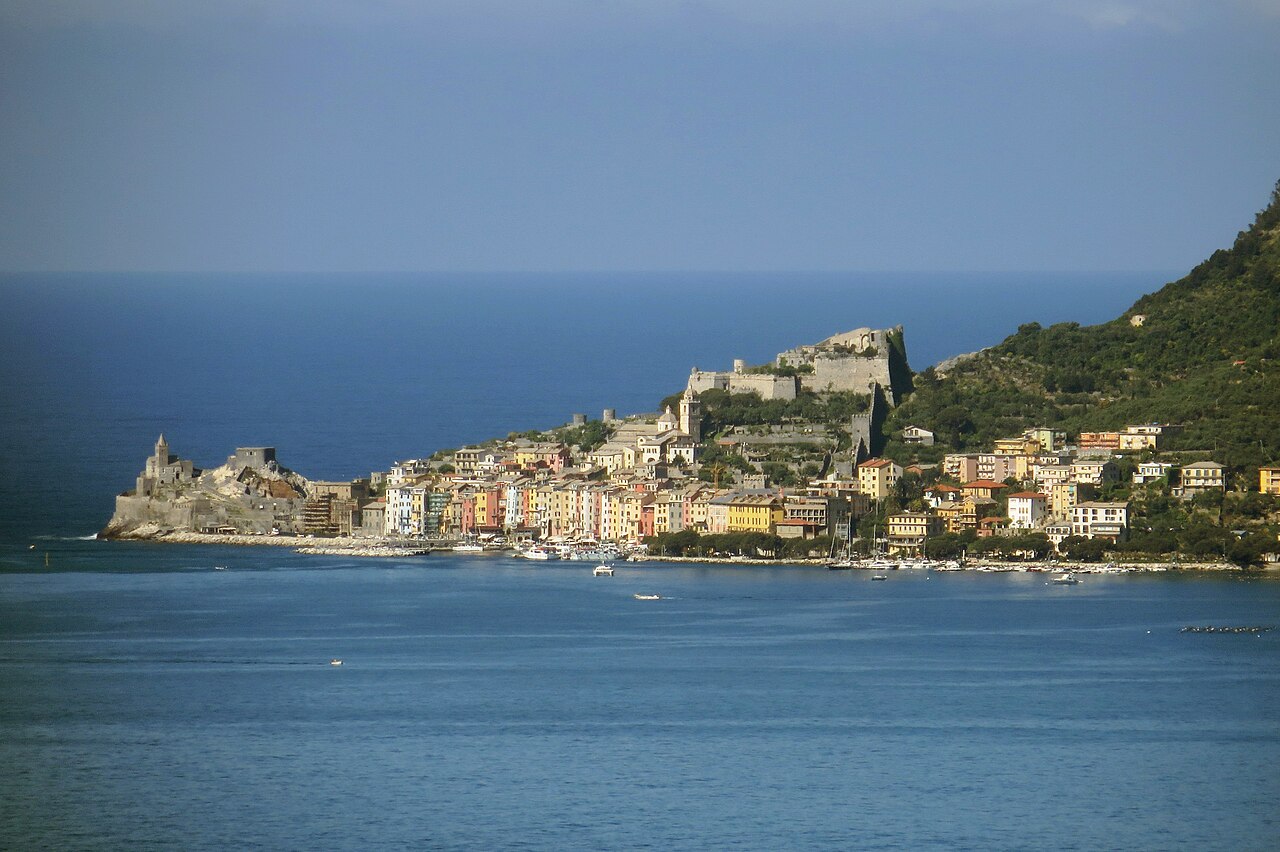
Portovenere is one of the most striking villages on the Ligurian coast — a tight cluster of tall, brightly painted medieval houses stacked along a narrow promontory jutting into the sea between La Spezia and the Cinque Terre. Together with the offshore islands of Palmaria, Tino, and Tinetto, it was designated a UNESCO World Heritage Site in 1997, recognised as a cultural landscape shaped by centuries of human settlement in a place of exceptional natural beauty.
At the tip of the promontory stands the Church of San Pietro, a black-and-white striped Gothic structure built on the foundations of a pagan temple. It commands dramatic views back toward the Gulf of La Spezia and out to Palmaria island, which lies just a short boat ride away. Below the church, the Grotta di Byron — a sea cave carved into the rock — is named after Lord Byron, who reputedly swam across the gulf from here to visit the poet Shelley in San Terenzo. Whether entirely true or not, the story fits the place.
The village itself rewards slow walking. The main street, Via Capellini, runs the length of the old town beneath arched porticoes, lined with restaurants and small shops. The harbour is compact and photogenic, framed by the Case Veneziane — the tall medieval tower-houses painted in stripes of ochre and terracotta that define the harbourfront. Portovenere was a fortified Genoese outpost from the 12th century, and the old walls and the Doria Castle at the top of the promontory are largely intact. The Church of San Lorenzo, near the northern gate, is a 12th-century Romanesque church with the same striped marble facade as San Pietro.
Day-trippers arrive from La Spezia and the Cinque Terre by ferry throughout the summer, so mornings and late afternoons are the best times to have the place to yourself. If you can, stay the night — Portovenere in the early evening, once the boats have gone, is a different and much quieter village.