Renaissance Tuscan hill town between Val di Chiana and Val d'Orcia, famed for Vino Nobile
Montepulciano is a Renaissance hill town in southern Tuscany, perched on a long narrow ridge between the Val di Chiana and the Val d'Orcia at about 600 metres elevation. The views in every direction are the classic Tuscan rolling-hills panorama that appears on a thousand magazine covers, and the town itself is exceptionally well-preserved — its main street climbs steeply through layers of Renaissance civic architecture to a handsome main square flanked by a Florentine-style palazzo and a seventeenth-century cathedral.
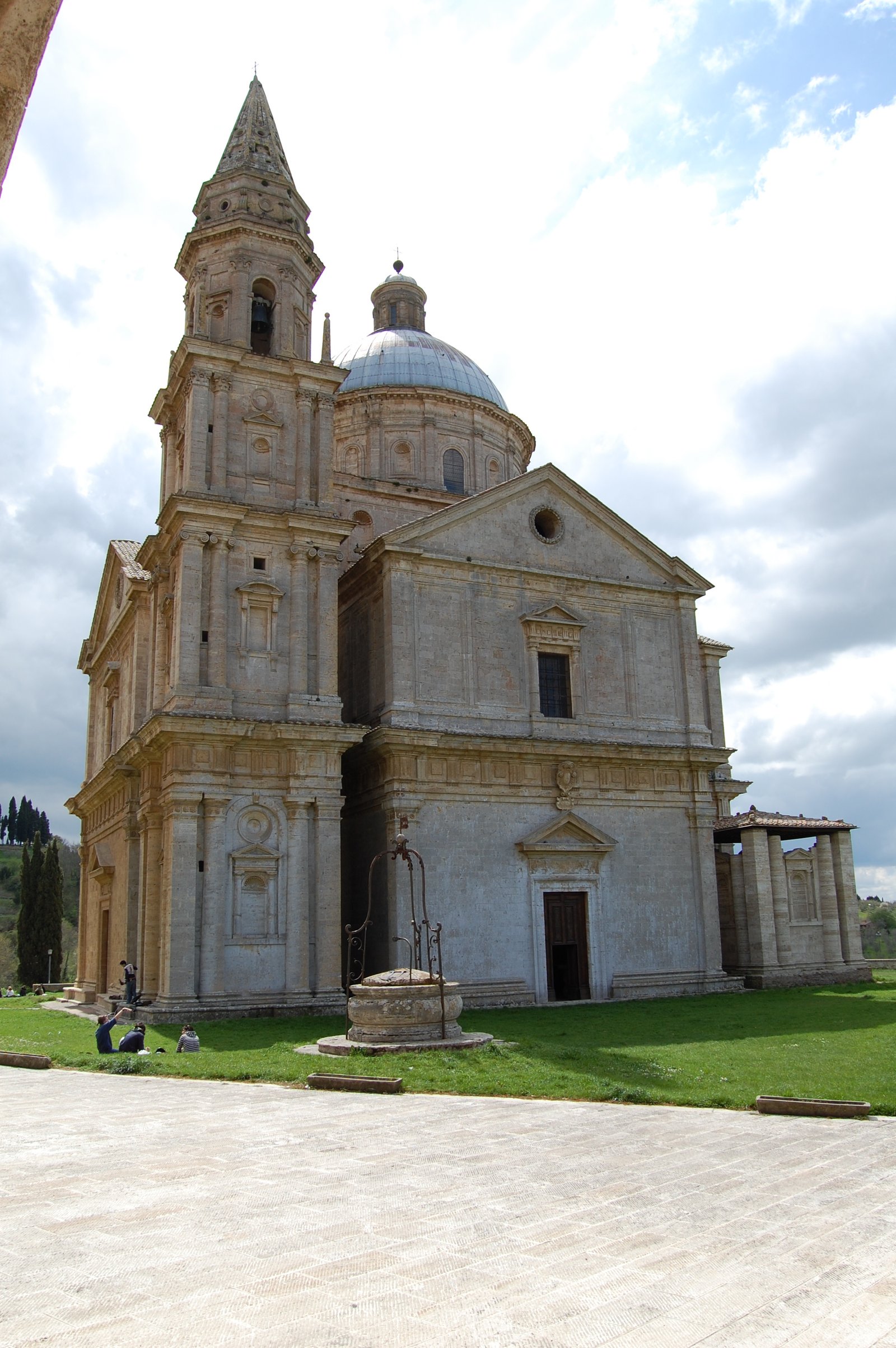
The town's most famous building is outside the walls: San Biagio, a Renaissance pilgrimage church completed by Antonio da Sangallo the Elder in 1545, stands alone on a terraced hillside to the west of town and is considered one of the finest examples of High Renaissance religious architecture in Italy. The single campanile (the second was never built, though the base is visible) gives the church an unexpectedly asymmetric quality up close.
Montepulciano is primarily famous for its wine — Vino Nobile di Montepulciano, made from the Prugnolo Gentile grape (a clone of Sangiovese), has been produced on these hillsides since the Middle Ages and carries DOCG classification. The wine cellars (cantine) are cut into the rock beneath the town, some of them medieval vaults of considerable size, and many are open for tasting. The Cantiere Internazionale d'Arte, a summer festival of contemporary performance and music, brings a more unconventional energy to the town each July and August.
Guide
Getting There
Montepulciano has no railway station. The nearest train connections are at Chiusi (on the Rome–Florence main line, about 20 kilometres away) and Montepulciano Stazione in the valley below, served only by infrequent regional services. From Chiusi, buses connect to the town.
By car is the most practical approach: Montepulciano is about 120 kilometres south of Florence and 60 kilometres north of Orvieto, accessible from the A1 motorway via the Valdichiana exit. Siena is about 65 kilometres to the northwest. Parking is available outside the town walls; most of the historic centre is restricted to residents.
Guide
When to Go
Montepulciano is enjoyable throughout the year, but summer (July–August) brings large crowds and high prices to what is a small town with limited capacity. Spring and autumn are the best seasons: April and May offer wildflowers on the surrounding hills, September and October the grape harvest, golden light, and the Bravio delle Botti — the town's barrel-rolling race on the last Sunday of August, which draws large local crowds.
The Cantiere Internazionale d'Arte festival brings contemporary music and performance to Montepulciano in July and August, making those months particularly vibrant culturally if you can tolerate the crowd levels. Winter is quiet but not grim — the town functions normally, the cellars are open, and you will have the streets largely to yourself.