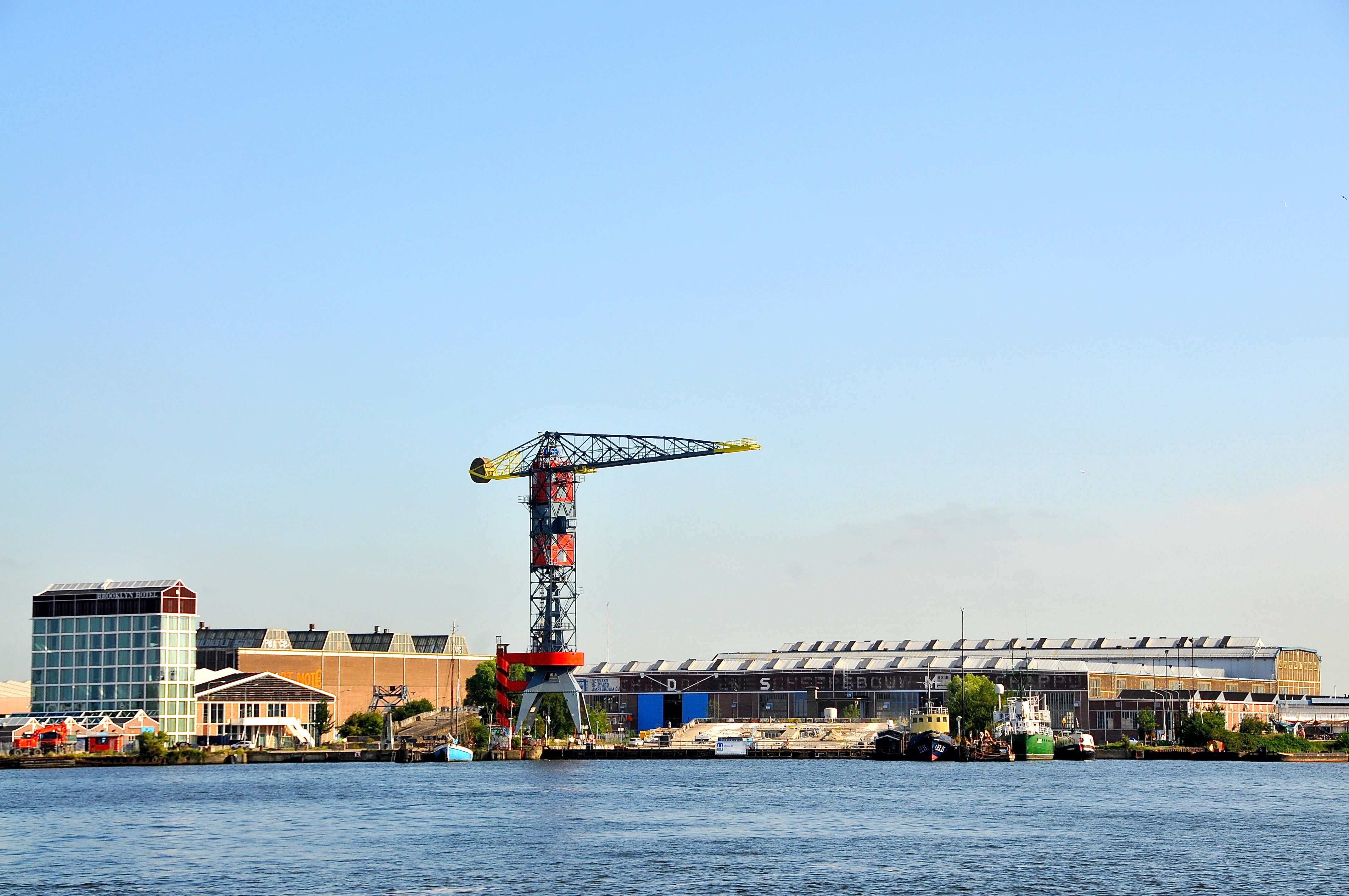
Amsterdam Noord (North Amsterdam) is the city's fastest-changing neighbourhood and currently its most interesting. Separated from the city centre by the IJ waterway, it was historically the working-class counterpart to the prosperous south — shipyards, chemical plants, and large housing estates — and has spent the last fifteen years reinventing itself without entirely losing its industrial character. The transformation accelerated when the free ferry from Central Station became reliable and frequent; Noord is now a destination rather than an afterthought.
The NDSM wharf, at the western end of Noord, is the cultural anchor: a former shipbuilding yard turned creative complex with artists' studios, the STRAAT street art museum, festival stages, and the Pllek bar and restaurant at the water's edge. It has enough going on to deserve its own neighbourhood page.
The EYE Film Museum — the national film institute and archive — sits directly at the ferry landing point on the north bank of the IJ, in a sharp white building designed by Delugan Meissl and opened in 2012. The free public areas (lobby bar, rooftop terrace) are worth the ferry crossing alone. The exhibitions and screenings are consistently among Amsterdam's best film programming.
The Overhoeks neighbourhood, immediately east of the EYE, is where the densest new residential development has landed — the A'DAM Tower (formerly the Shell research centre) has a hotel, clubs, and a rooftop with a swing overhanging the waterfront, which is either terrifying or exhilarating. The area between the ferry landing and the NDSM, now increasingly called the Buiksloterham, is where Amsterdam's most interesting food businesses have been opening — restaurant clusters in a landscape still surrounded by warehouses and water.