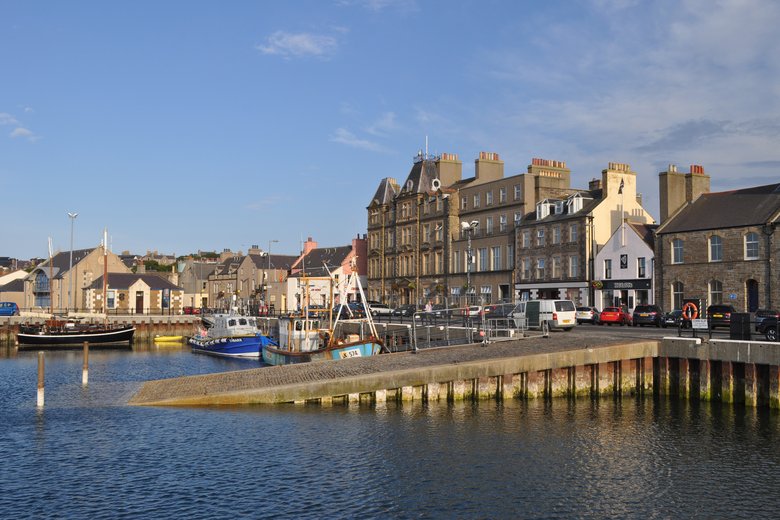
Kirkwall is the capital of Orkney and home to about ten thousand people — more than a third of the archipelago's entire population. It sits on a narrow neck of land on Mainland, the largest island, with a natural harbour that has made it a trading post since Norse times.
The town's centrepiece is St Magnus Cathedral, a red and yellow sandstone cathedral begun in 1137 by the Norse earl Rögnvald Kali Kolsson in honour of his martyred uncle. It is one of the best-preserved medieval buildings in Scotland and still an active parish church. The scale of it, rising out of a small town on a windswept island, is genuinely surprising. Beside the cathedral stand the ruins of the Earl's Palace, a Renaissance landmark built through forced labour by one of Orkney's most villainous nobles.
Behind the cathedral, the streets of the old town — particularly Albert Street and its continuation, Broad Street — are lined with low stone buildings and independent shops. The Orkney Museum on Broad Street occupies a handsome sixteenth-century townhouse and spans the Stone Age through the Viking era; admission is free. Kirkwall has a functional, unhurried character: it is the kind of place where you can get everything done in a morning and spend the afternoon at a prehistoric site.
The town is also the main gateway for exploring Orkney's extraordinary concentration of Neolithic monuments. Skara Brae, the Ring of Brodgar, and the Standing Stones of Stenness are all within easy reach by car or bicycle. On the town's southern edge, two of Scotland's finest single malt distilleries — Highland Park and Scapa — offer tours and tastings and represent two very different approaches to Orcadian whisky.