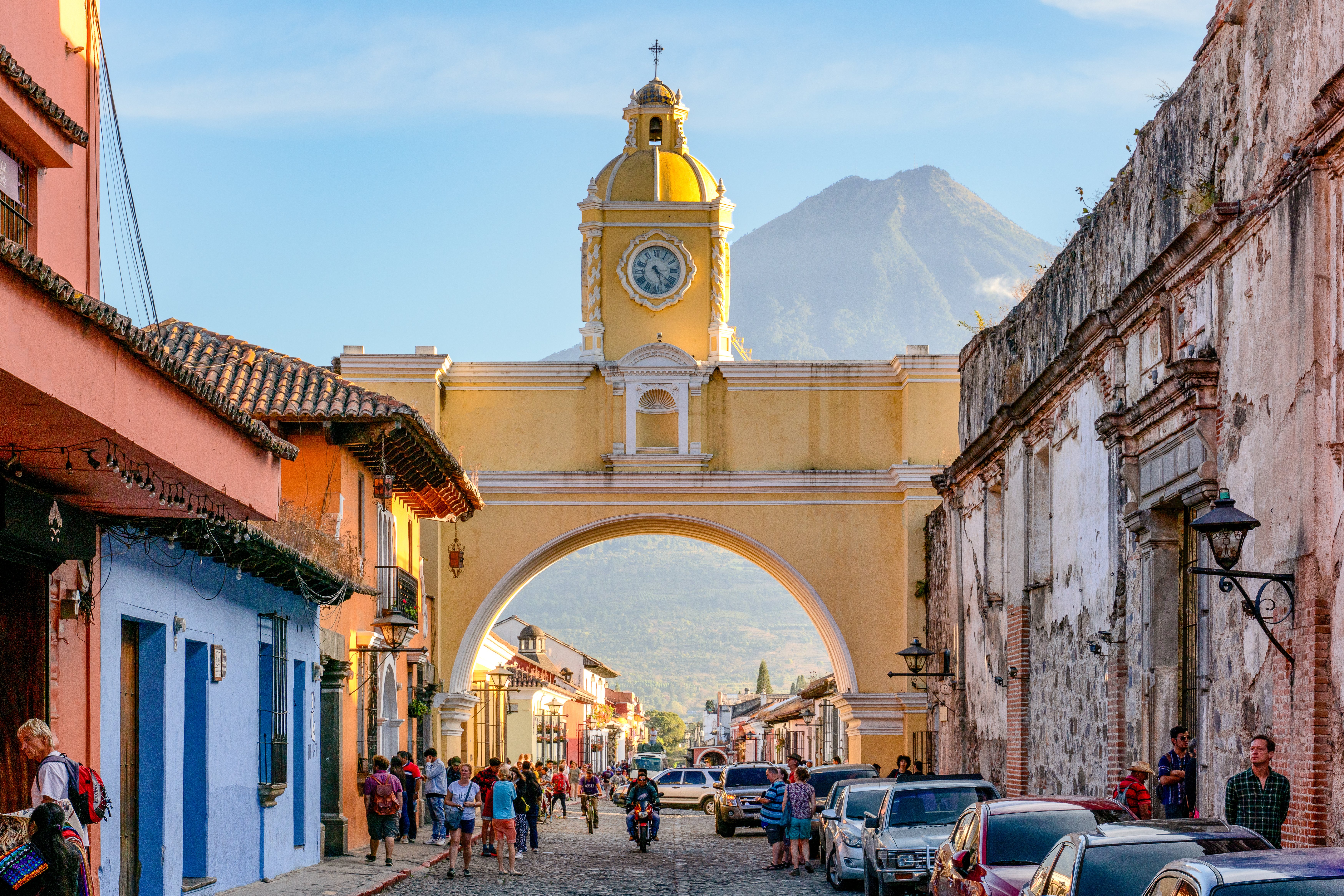
Antigua Guatemala is the most complete surviving colonial city in Central America, and one of the best-preserved in the hemisphere. Founded in 1543 as the capital of Spanish Guatemala, it was shattered by earthquakes in 1773 and never fully rebuilt — which is the reason it looks the way it does today: an extraordinary grid of streets lined with ochre and terracotta facades, ruined convents open to the sky, and baroque churches whose façades were rebuilt while their naves stand roofless behind them. In 1979 UNESCO listed it as a World Heritage Site.
The city is small and walkable. Everything of importance lies within a few blocks of the Plaza Mayor (also called the Plaza de Armas), the central square flanked by the Palacio de los Capitanes Generales, the old town hall, and the ruined Cathedral. From here you can walk to the Iglesia de La Merced — with its extraordinary wedding-cake stucco facade — the Convento de las Capuchinas, and the Arco de Santa Catalina, the arch that straddled the street so that cloistered nuns could cross between their convent and the church without being seen. The ruins of Casa Popenoe tell a stranger story: this restored colonial house is where the botanist who introduced Guatemalan avocados to California lived.
Three volcanoes surround the city. Volcán de Agua, the near-perfect cone directly to the south, is visible from almost everywhere in Antigua. Volcán Acatenango and the actively erupting Volcán de Fuego stand to the west and southwest; on clear evenings you can see the glow of Fuego's eruptions from the city streets. Climbing Acatenango overnight — camping near the summit to watch Fuego erupt at dawn — is one of the great experiences of Guatemala. The town fills with travellers doing this, which is part of its character: Antigua is emphatically on the gringo trail, with language schools, yoga studios, and coffee shops catering to long-term residents. But the colonial city beneath all this is the real thing.