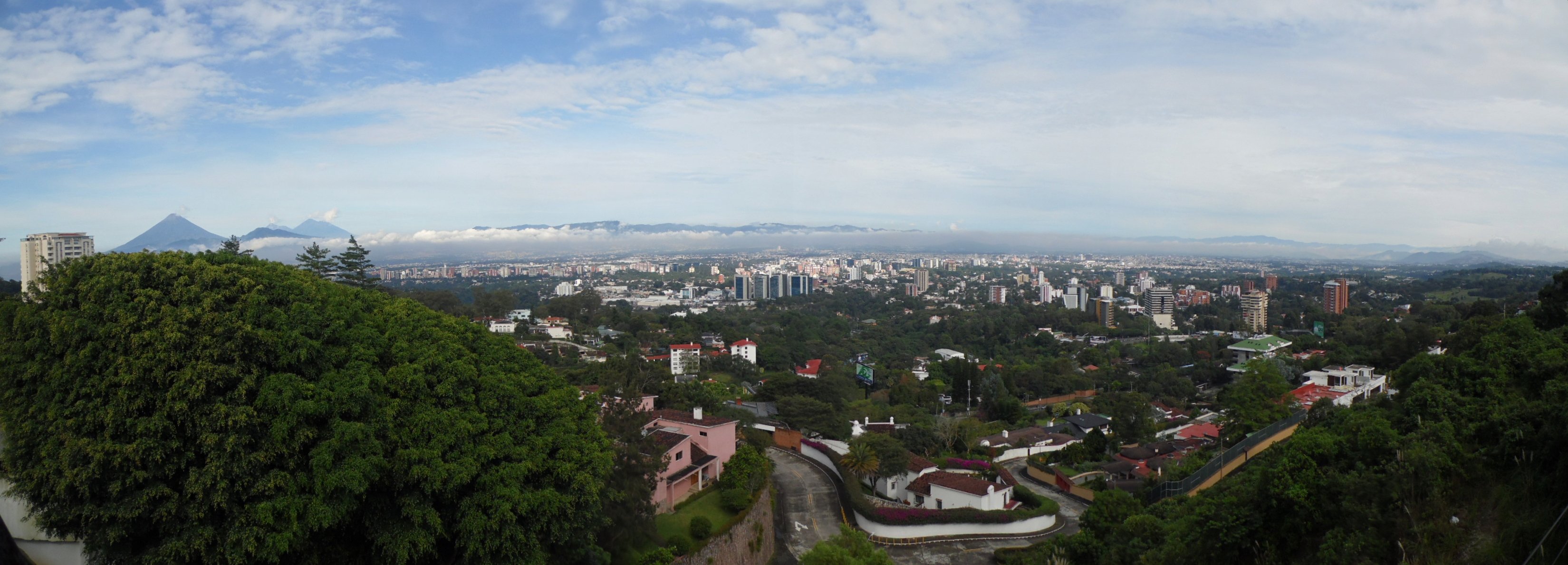
Guatemala City is the capital and by far the largest city in Central America (excluding Mexico), with a metropolitan population over 3 million. It sits in a wide valley at about 1,500 metres elevation, giving it a mild climate year-round.
Most travellers pass through rather than linger, but the capital has more to offer than it gets credit for. The Zona 1 historic centre has the Palacio Nacional de la Cultura — the green volcanic-stone palace now open as a museum — the Metropolitan Cathedral, and the vast Mercado Central underground market beneath the cathedral. The Kaminaljuyú pre-Classic Maya site in Zona 7 is surrounded by housing but archaeologically significant. The modern Zonas 9 and 10 have good restaurants and the excellent Popol Vuh Museum and Ixchel Museum of Indigenous Dress, both on the Francisco Marroquín university campus. The National Museum of Archaeology and Ethnology in Zona 13 has the best state collection of Maya stelae and jade. The bizarre Mapa en Relieve in Zona 2 — a 1,800 square metre topographic model of the entire country built in 1904 — is one of the strangest attractions in Central America.
Safety is a genuine concern in certain areas — Zone 1 at night, the bus terminals, and peripheral neighbourhoods. The tourist zones (Zonas 9, 10, 13, 14) are considerably safer. Use Uber rather than street taxis.
Antigua is 45 km to the west by shuttle (about 1 hour), and most travellers base themselves there rather than in the capital.