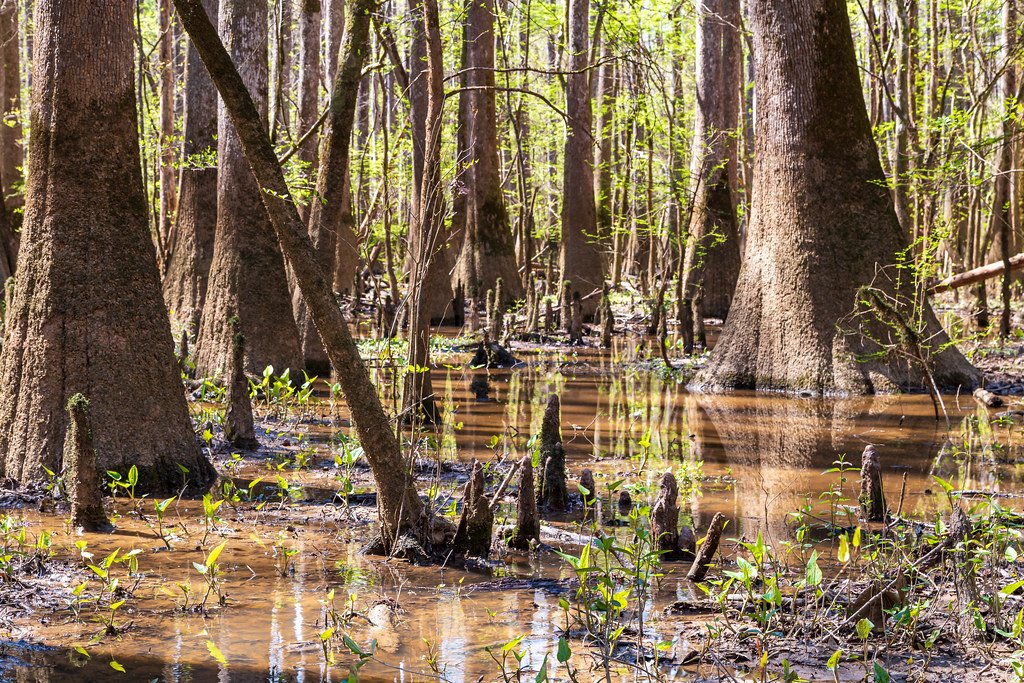
Small community southeast of Columbia, best known as the gateway to Congaree National Park.
Hopkins is a small community about 15 miles southeast of Columbia, best known as the gateway to Congaree National Park. The park preserves the largest intact tract of old-growth bottomland hardwood forest in the United States — not technically a swamp, but a seasonally flooded river floodplain on the Congaree River.
The trees here are extraordinary. Some of the tallest hardwoods in the eastern US grow in Congaree, with a canopy that rivals tropical rainforests. The park is an International Biosphere Reserve, a National Natural Landmark, a Wilderness Area, and a Continentally Important Bird Area for birders.
Beyond the park, the surrounding countryside is a quiet corner of Lower Richland County with scattered Reconstruction-era and antebellum sites such as the Harriet Barber House and Wavering Place. For most visitors, though, Hopkins itself is just the address — the park is the draw.
Guide
Getting There
Hopkins sits about 15 miles southeast of Columbia, reached most easily by car on US-378 or via Bluff Road from the city. The drive from downtown Columbia takes about 25 minutes.
There is no public transport to the park itself. Columbia Metropolitan Airport is the closest air gateway, around 35 minutes by road. If you are arriving from further afield, fly into Charlotte or Charleston and rent a car; the Lower Richland countryside is best explored with your own wheels.
Guide
When to Go
Spring and autumn are the best times to visit Hopkins and Congaree. Late March through May brings mild temperatures, wildflowers and migratory birds, while October and November bring crisp air and a quieter park. Summer is hot, humid, and heavy with mosquitoes — bring repellent and start early.
The most famous time to come is the synchronous firefly event in mid- to late May, when thousands of fireflies along the boardwalk flash in coordinated waves. The park runs a lottery for access during the peak nights; book months ahead. Winter is cool and largely free of bugs, with good chances of seeing wildlife through the bare canopy.